$300 Billion. Now Name the Inspector.
The Plumb Line
Tuesday, June 16
$300,000,000,000.
The Financial Times reported that figure this morning as the reconstruction fund attached to the US-Iran nuclear framework — a sum with no precedent in post-conflict international finance, announced before a single international inspector has publicly confirmed physical access to the enrichment sites the deal is meant to constrain.
While that number was circulating in Evian, Ukraine launched drones at a Moscow-area oil refinery, per the New York Times — striking Russian energy infrastructure at the precise moment G7 leaders were meeting to discuss the conflict's trajectory. Simultaneously, two Iran-linked tankers sailed through the Strait of Hormuz before the formal deal signing, per Bloomberg, a sequence this brief flagged yesterday as the key falsifier of durable verification. And Trump told Netanyahu, on camera, to be "more responsible" with Lebanon — the sharpest public presidential rebuke of an Israeli leader in years, punctuated by Trump's suggestion that Syria would do a better job than Israel at managing Hezbollah.
Three tracks. Three conflicts. All moving during the same summit, in different directions.
$300 Billion. Now Name the Inspector.
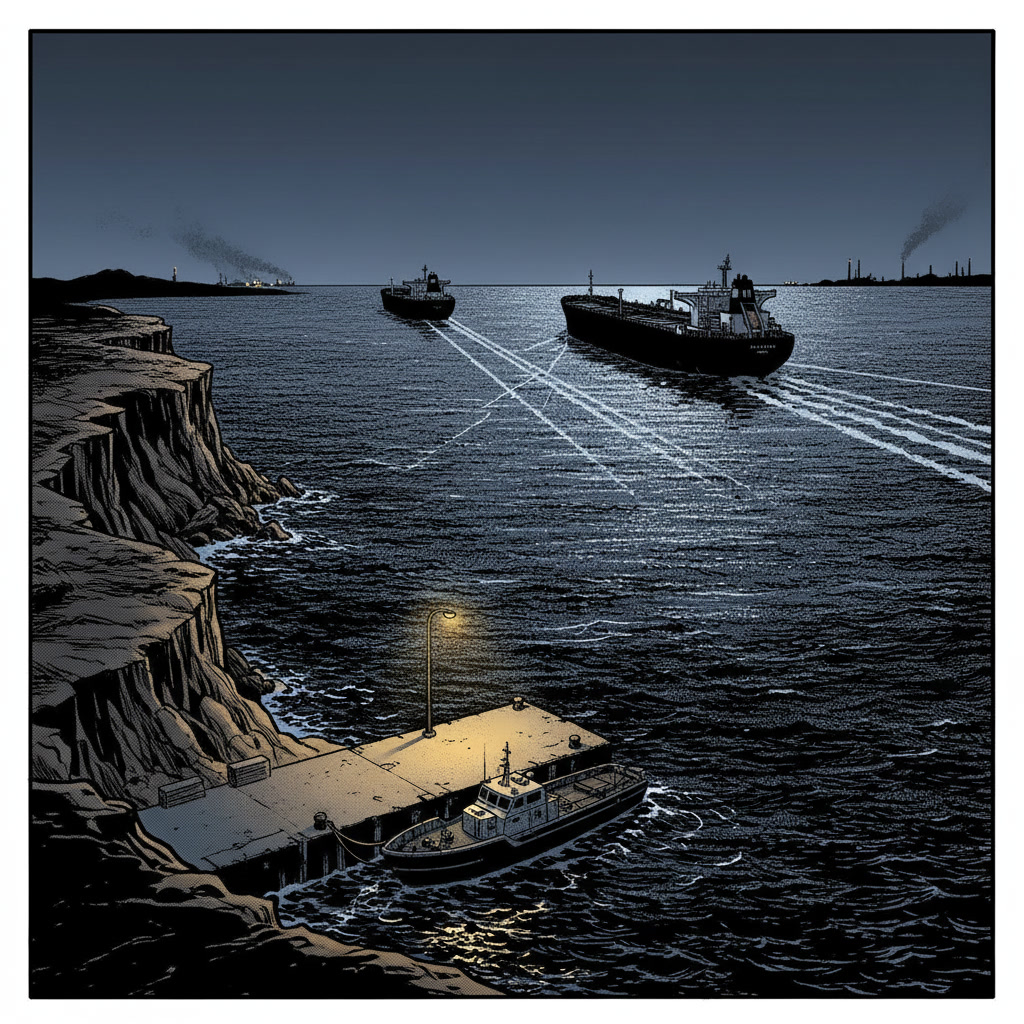
Ukraine struck a Moscow-area oil refinery with drones overnight, the New York Times confirmed, at the precise moment G7 leaders gathered in Evian to debate the conflict's future. The Kremlin has not publicly characterized the damage. Simultaneously, the US and Iran moved toward a formal signing, with the Financial Times reporting a $300 billion reconstruction fund attached to the framework. Two Iran-linked tankers sailed through the Strait of Hormuz before the ceremony, per Bloomberg. France and Britain announced they will send naval vessels to Hormuz to support the reopening, per the New York Times.
The read here: yesterday this brief named the falsifier precisely — if Iran-linked vessels moved through Hormuz before international inspectors confirmed physical access to enrichment sites, the 1994 US–North Korea Agreed Framework analog was activated, an announcement enabling both parties to claim victory, with verification that collapses when tested. The tankers have moved. No inspector access confirmation has appeared on any wire. A $300 billion reconstruction fund does what large numbers always do in diplomatic announcements: it crowds out the smaller, harder question. The analytical claim: reconstruction funds create powerful incentives for the receiving party to perform compliance during politically sensitive windows — and to renegotiate when those windows close. Durability turns entirely on whether the IAEA monitoring framework is confirmed before the Strait of Hormuz is declared fully open. The sequence matters more than the dollar amount.
What I'd watch for next: the falsification trigger is unchanged from yesterday. Does the IAEA publicly confirm physical monitoring presence at Iranian enrichment sites before a formal Hormuz-open declaration? The tankers are already through, which compresses the timeline. Secondary: France and Britain have announced naval deployments to Hormuz. If those ships arrive while the IAEA question is still unresolved, the analytical read is that Western navies are providing security cover for a verification gap — a materially different posture than either government described. If IAEA confirmation comes first, this brief upgrades its assessment. If Hormuz is declared open without it, the 1994 analog holds and the conflict's next chapter has already begun.
Three other things worth knowing
Trump has broken with Netanyahu, publicly and on specifics. Trump said Netanyahu should be "more responsible with Lebanon," per Bloomberg, and told reporters that Syria would do better at managing Hezbollah than Israel — an explicit endorsement of a third party over a formal ally on a core security task. The Financial Times headlines it as a genuine falling-out, not routine friction. The read here: reaching a workable framework with Tehran requires, at minimum, not having Netanyahu simultaneously escalating the Lebanese track. The question that determines how consequential this break is: does Netanyahu test it? If Israeli operations in Lebanon continue or intensify in the next 48 hours, the analytical call is that Netanyahu is calling Trump's bluff. If they pause, Trump's leverage over Israeli action is real, and the deal's Lebanese dimension becomes manageable.
EU lawmakers approved the US trade deal ahead of Trump's deadline. Bloomberg confirmed. The full terms haven't been published, but the sequencing matters structurally: Brussels calculated the cost of negotiating was lower than the cost of continued tariff escalation. Japan is simultaneously pushing to put China's aggressive trade practices on the G7 agenda, per the New York Times. The read here: the deadline-and-deal approach worked once in Evian. Every other US trading partner is now recalibrating whether to settle before the next deadline or wait to see whether the pattern holds.
The flooding is widening and the fires are still running. NOAA flood warnings remain active from coastal Texas — Matagorda, Brazoria, Fort Bend, Nueces — through the Missouri and Illinois river corridors, with several warnings running through June 21 and June 23, well beyond the storm that generated them. The Siberian fire cluster northwest of Krasnoyarsk, tracked in this brief since Saturday, continues registering above 600 megawatts of fire radiative power in NASA satellite data. Neither the domestic flooding nor the Siberian fires is breaking through to sustained international wire coverage. What I'd watch for next: a federal disaster declaration tied to river crests in the next 24 hours — that determination follows crest confirmation, not initial flooding.
Echoes
In February 1957, Eisenhower completed a precedent worth revisiting today. Israel had launched the Suez campaign in October 1956 alongside Britain and France without American sanction. Eisenhower moved against all three: on Britain through currency pressure on the pound; on Israel through the threat of UN General Assembly sanctions and a public demand for withdrawal. Ben-Gurion complied. Menachem Begin, then in opposition, called it a capitulation. The historical parallel here: the Eisenhower episode established a structural fact about the alliance that has held ever since — US-Israel alignment is real but not unconditional, and sitting American presidents have overruled Israeli military action before when it conflicted with a broader US strategic priority. Trump's public rebuke of Netanyahu over Lebanon today is not Eisenhower's economic coercion — it is sharper in tone and gentler in mechanism — but the structural message is the same: the alliance has limits, and you have reached one. Whether Netanyahu reads it as binding is the open question. Ben-Gurion eventually complied. Begin did not, until Camp David made compliance the better deal.
The quiet things
No wire service has published an IAEA statement on monitoring access to Iranian enrichment sites. The agency has issued no public confirmation that inspectors are physically present on the ground. The read here: this is the most consequential silence in today's coverage — a $300 billion figure draws headlines; the absence of an inspector confirmation does not. The tankers are moving. The inspector is not yet named.
Saudi Arabia's official response to the Iran framework is still absent from any major wire. Riyadh's assessment has been the regional architecture test this brief has flagged since June 14. The read here: silence from the kingdom is not neutrality — it is a signal being read by every Gulf capital, and its continued absence grows more informative by the hour.
The Bank of Japan has now gone seven consecutive days without a public statement on Governor Kazuo Ueda's condition or policy succession. The yen carry trade continues to price continuity on inference alone. That is day seven.
How I'd act on this
If you watch the Iran file — the tankers are through Hormuz. The IAEA statement is the only data point that changes the analysis. If confirmation of inspector access appears before a formal Hormuz-open declaration, upgrade the assessment. If Hormuz is declared open without it, yesterday's falsifier has fired, and you are reading the opening of the next problem.
If you hold energy positions tied to Hormuz — the tanker movement suggests the market is already pricing the reopening. The analytical read: the residual risk sits on the verification side. If the IAEA story breaks badly over the next two weeks, you are not looking at a crude price adjustment — you are looking at a risk-premium reprice across the full Middle East energy complex.
If you cover US-Middle East policy — Netanyahu's response in the next 48 hours is the read. Continued or escalated Israeli operations in Lebanon after Trump's public rebuke means Netanyahu is calling the bluff. A pause means Trump's leverage is real. Either answer reshapes how you cover the next six months.
If you're following the G7 summit — the analytical call is that the meeting's actual output is being written by events outside the room. Trump's bilateral with Indian Prime Minister Narendra Modi, flagged by both Bloomberg and the New York Times, may be the most consequential conversation in Evian that nobody is leading with. A US-India reset at this moment — Iran deal on the table, China trade on the G7 agenda — carries strategic weight the summit communiqué will not capture.
If you are in coastal Texas, the lower Missouri valley, or the Illinois flood corridor — multi-day warnings run through next week in several zones. Federal disaster declarations follow river crests, not initial flooding. Watch the 24-hour crest numbers.
At Evian today, three conflicts moved in three directions while G7 leaders sat in the same room: Ukraine struck Moscow's energy infrastructure, Iran-linked tankers crossed Hormuz ahead of the signing ceremony, and Trump publicly broke with Netanyahu over Lebanon.
The deal gets the ceremony; the inspector gets the truth.
— *The Plumb Line*. Daily world brief.
Sources
Iran / Hormuz / nuclear framework
- newswire/bloomberg — "US and Iran Prepare for Deal Signing With Both Claiming Victory," June 16
- newswire/ft — "FirstFT: $300bn reconstruction fund to rebuild Iran," June 16
- newswire/nyt — "Iran Will Enter Nuclear Talks Feeling Emboldened," June 16
- newswire/bloomberg — "Two Iran-Linked Tankers Sail Through Hormuz Before Deal Signing," June 16
- newswire/nyt — "France, Britain and Other Countries Say They'll Send Ships to the Strait of Hormuz," June 16
- newswire/bloomberg — "Trump Says US Is Not Investing Any Money in Iran," June 16
Ukraine / Russia / G7
- newswire/nyt — "Ukraine Targets Moscow Oil Facility With Drones as G7 Leaders Meet," June 16
- newswire/bloomberg — "Trump Says That Russia Should Make a Deal With Ukraine," June 16
- newswire/nyt — G7 summit live coverage, June 16
- newswire/bloomberg — "Modi Lines Up Middle-Power Talks Ahead of Trump Meeting at G7," June 16
- newswire/nyt — "Can a Trump-Modi Meeting Reset U.S.-India Relations?," June 16
- newswire/nyt — "Japan tries to put China's aggressive trade policies on the G7 agenda," June 16
Trump / Netanyahu / Lebanon
- newswire/bloomberg — "Trump Says Netanyahu Should Be More Responsible With Lebanon," June 16
- newswire/ft — "This time, Trump and Netanyahu have really fallen out," June 16
- newswire/bloomberg — "Trump Says Syria Would Do Better at Taming Hezbollah Than Israel," June 16
EU / trade
- newswire/bloomberg — "EU Lawmakers Approve US Trade Deal Ahead of Trump Deadline," June 16
US flooding
- noaa_alerts (multiple IDs) — Flood warnings: Texas (Matagorda, Wharton, Nueces, Brazoria, Fort Bend, Burleson, Washington, Bexar, Wilson); Missouri/Illinois (Calhoun, Pike, Jackson, Randolph, Greene, Jersey, Lincoln, Ste. Genevieve, Perry); Louisiana (Calcasieu); warnings extended June 21–23
Siberian fires
- nasa_firms (multiple IDs) — Fire radiative power above 600 MW at 59.5–59.9°N, 89.9–90.2°E (northwest of Krasnoyarsk, Siberia), June 16
Historical references
- Suez Crisis, October 1956; Israeli withdrawal from Sinai, February 1957; Eisenhower diplomatic and economic pressure; Ben-Gurion compliance
- US–North Korea Agreed Framework, October 1994; North Korean enrichment acknowledgment, October 2002; primary structural analog in The Plumb Line since June 14
Continuity
- The Plumb Line, June 15 — IAEA verification falsifier named; tanker-before-IAEA sequence identified as key trigger; Siberian fires tracked (now day 4); Texas/Louisiana flooding tracked; Bank of Japan silence flagged at day 6 (now day 7)