Wake up sharper than the room.
A daily intelligence briefing synthesized across 30 verified sources. Eight minutes. Every claim traceable. Every gap named.
The Plumb Line
Thursday, July 2
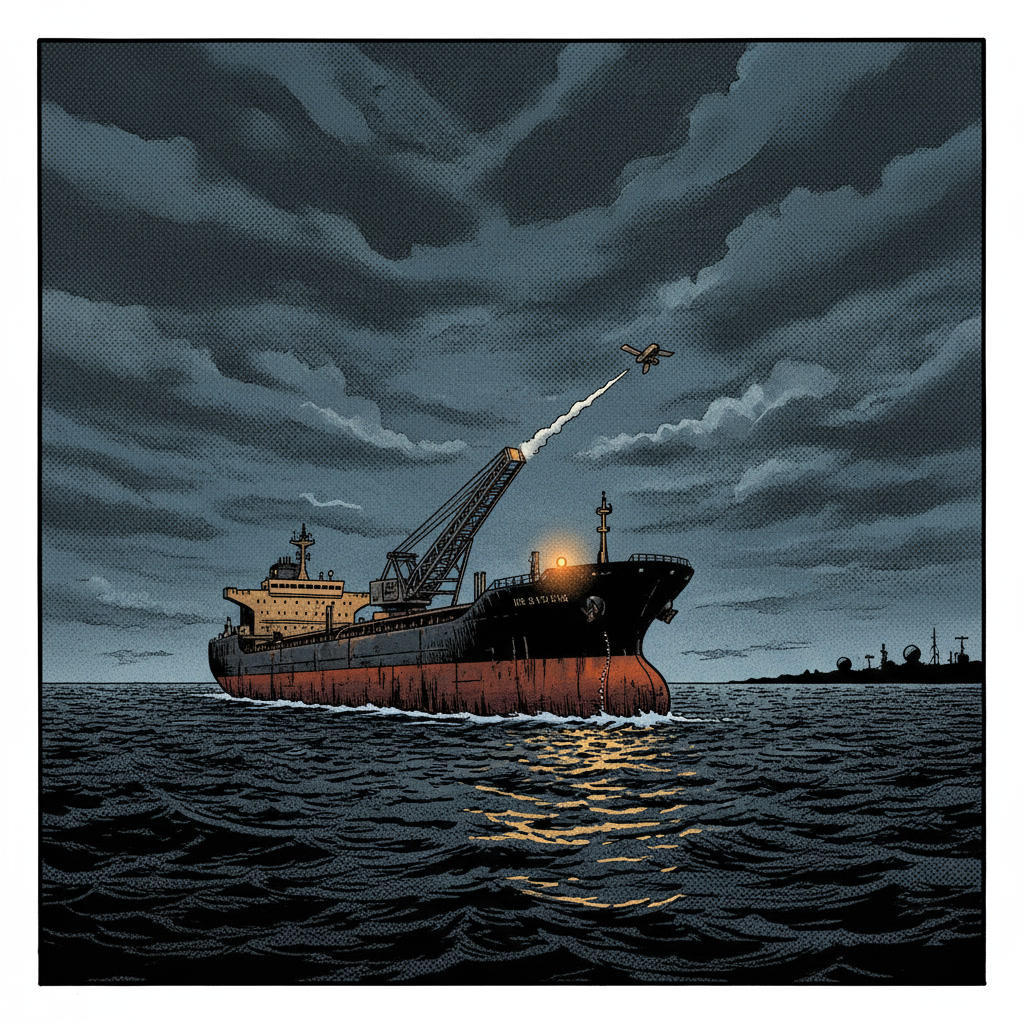
Three things happened in the last 24 hours that belong in the same sentence. Russia launched one of its heaviest bombardments of Kyiv in recent memory, with missiles and drones striking Ukraine's capital through the night and into this morning, with confirmed fatalities. Iranian Supreme Leader Ali Khamenei was laid to rest while Chinese and Russian dignitaries occupied the front rows — Beijing sending its first senior official to Iran since the war began. And a study disclosed that Russia had spent months positioning shadow fleet oil tankers — the sanctioned vessels it uses to sell crude in defiance of Western price caps — as drone-launch and surveillance platforms in European waters, systematically mapping gaps in NATO air defense radar coverage while no Western government detected it in real time.
The read here: this is not a collection of unrelated crises. It is a single picture — Russia pressing on military, intelligence, and diplomatic fronts simultaneously, while the structures built to contain that pressure show visible seams. A fourth thread ran underneath: the Trump administration blocked a long-term renewal of the U.S.-Mexico-Canada Agreement — the USMCA, which replaced NAFTA in 2020 — during the same week that Mexico and Canada are co-hosting the FIFA (Fédération Internationale de Football Association) World Cup with the United States. The timing is not accidental. The message to Ottawa and Mexico City is that North American partnership has conditions.
Kyiv Burns While Tehran Buries
Russian missiles and drones struck Ukraine's capital in waves overnight and through this morning, in what the Financial Times called a "huge bombardment" and what the New York Times has been covering in real time with confirmed fatalities. The strikes hit multiple districts of Kyiv.
The read here. The closest historical parallel is Russia's autumn 2022 infrastructure campaign — the one that produced rolling blackouts across Ukraine through the following winter. That campaign did not break Ukrainian will; it accelerated Western air defense deliveries. If Moscow is running a version of the same playbook in summer 2026, the critical question is whether the Western air defense pipeline is still flowing at sufficient volume to matter. The shadow fleet reconnaissance study released today makes that question more urgent: according to reporting by the Financial Times and Bloomberg, Russia spent months using sanctioned oil tankers as drone-launch and surveillance platforms in European waters, identifying specific weaknesses in NATO radar coverage before the current bombardment campaign escalated. That is not background context. That is the operational foundation for what struck Kyiv last night.
What I'd watch for next: if Kyiv's power grid goes dark in the next 72 hours, this was a precision campaign against identified infrastructure nodes — and that shifts the Western response calculus significantly. If instead the damage is dispersed across residential districts, this is a campaign designed to exhaust Ukrainian air defense stockpiles, not to destroy specific targets. The falsification trigger either way: a clear, on-the-record U.S. commitment to accelerate air defense resupply would signal that Washington is still substantively in the game. As of this morning, that commitment has not come publicly.
Three other things worth knowing
Khamenei's funeral guest list is a foreign policy declaration. China sent its first senior official to Iran since the war began — Bloomberg confirmed — alongside Russian dignitaries. Diplomatic attendance at a Supreme Leader's burial is not ceremony; it is alignment signaling at the highest level. The read here: Beijing's presence in the front row communicates that China intends to anchor the post-Khamenei transition toward deeper solidarity with Tehran, not toward the Western economic engagement that American officials are publicly hoping for. The New York Times piece arguing that the U.S. believes Iran might "swap ideology for investment" is worth reading alongside the funeral photographs. The two pictures don't reconcile.
A Ukrainian faces criminal charges for sabotaging Russian-German pipelines — and that creates an uncomfortable problem for Kyiv's coalition. The New York Times reported today that a Ukrainian national faces charges connected to sabotaging pipeline infrastructure linking Russia and Germany. The legal awkwardness is real: Ukraine's Western allies are simultaneously supplying Kyiv's military and prosecuting one of its nationals for covert action against Russian infrastructure running through European territory. The proceedings will be watched closely in Berlin, where the pipeline relationship with Moscow was a defining domestic political controversy for years.
Germany is drawing a formal line with Washington, and Brussels is moving its own pieces independently. Bloomberg reported that Berlin formally rejected what the Trump administration framed as demands for "NATO loyalty to Washington" — language implying conditional security guarantees tied to German political deference toward the White House. Separately, the European Union announced it will lift tariffs on Armenia, explicitly to reduce Yerevan's economic dependence on Russia. The read here: these are not unrelated moves. Germany and the EU are calibrating a posture that preserves the transatlantic relationship while building structural independence from American political direction.
Echoes
Khamenei's death carries one specific historical echo worth naming: the death of Ayatollah Ruhollah Khomeini in June 1989. Then, as now, Western analysts predicted that succession pressure and economic exhaustion would push Iran toward pragmatic engagement. Then, as now, the successor consolidated power rapidly and reoriented policy toward resistance rather than accommodation — Khamenei himself was that successor in 1989. The mechanism was the Revolutionary Guard's structural control of the succession process, which remained intact despite Western expectations of moderation. That structure is intact today. The read here: Chinese and Russian attendance at this week's funeral suggests that Iran's most powerful external partners are actively reinforcing it, not permitting it to loosen. One falsifier: if the new Supreme Leader's first substantive foreign policy action is a genuine signal toward nuclear security talks — not simply economic opening, but strategic architecture — the 1989 parallel breaks. Watch the Assembly of Experts, not the funeral oration.
The quiet things
Khamenei's successor has not been named in today's coverage. The Assembly of Experts — the clerical body constitutionally responsible for selecting a new Supreme Leader — is presumably convened, but its deliberations are entirely absent from the wire reports. The funeral is the visible story. The selection is the consequential one, and it is happening off-camera.
Also absent: any on-the-record U.S. government response to the Kyiv bombardment. What I'd watch for next: whether Washington publicly signals solidarity with Ukraine or maintains studied ambiguity is the single variable most likely to affect Russia's assessment of how far it can push. Silence is not a neutral signal; Moscow reads it as one.
How I'd act on this
If you cover Iran or the Middle East — the question that matters before next week is who emerges from the Assembly of Experts as Supreme Leader. Everything downstream from that appointment — the nuclear file, sanctions enforcement, Gaza ceasefire architecture, U.S.-Iran back-channel contacts — is contingent on that selection. Don't wait for the burial to conclude before reading the Assembly membership carefully.
If you work in defense or track congressional appropriations — the NATO drone surveillance study released today is already being shaped into a legislative argument. Its core finding, that Russia built a detailed map of alliance air defense weaknesses without triggering any detection, is exactly the kind of documented failure that moves supplemental defense funding. Watch for it in floor debate before the summer recess.
If you hold peso or Canadian dollar exposure — today's USMCA news is a watch item, not an exit signal. The Trump administration has disrupted trade framework negotiations before without collapsing the underlying agreement. The read here: the question is whether this is negotiating pressure or the first move in a structural unwinding of North American trade integration. The shared World Cup hosting relationship makes any clean break politically complicated in the near term.
If you're in the Midwest, Great Plains, or Great Lakes today — the National Weather Service has issued active extreme heat warnings across more than a dozen states, from Maine to Alabama and Kansas to Michigan, running through at least July 3. Several warnings extend through July 4. This is a public health event, not a weather footnote.
Russia hit Kyiv last night with a strike plan built on months of covert shadow fleet reconnaissance, and China answered the question of which bloc Iran now belongs to by sitting in the front row at Khamenei's funeral. The axis wasn't announced today — it was demonstrated.
— *The Plumb Line*. Daily world brief.
Sources
Newswire — Ukraine / Russia
- newswire/https://www.nytimes.com/live/2026/07/02/world/ukraine-kyiv-russia-attack — NYT live: "Russia Hammers Ukraine's Capital in Deadly Attacks"
- newswire/https://www.nytimes.com/live/2026/07/02/world/ukraine-kyiv-russia-attack/ukraine-kyiv-russia-attack — NYT: "Russia Strikes Ukraine as Explosions Rock Capital of Kyiv"
- newswire/f85948e6-d779-4d74-9a59-56e83c3534d6 — FT: "Russia unleashes huge bombardment of Kyiv"
- newswire/49ed0040-7f5d-402d-b42d-1d8eab27114c — FT: "Russian drone campaign mapped Nato air defence gaps, study finds"
- newswire/https://www.bloomberg.com/news/articles/2026-07-02/russia-used-shadow-fleet-tankers-for-drone-campaign-over-nato-sites — Bloomberg: "Russia Used Shadow Fleet for Europe Drone Campaign, Report Says"
- newswire/https://www.nytimes.com/2026/07/02/world/europe/drone-incursions-europe-russia.html — NYT: "Drones over Europe raise concerns about Russian activities"
- newswire/https://www.nytimes.com/2026/07/02/world/europe/pipeline-sabotage-ukraine-russia-germany.html — NYT: "Ukrainian Charged With Sabotaging Pipelines Between Russia and Germany"
- newswire/ee0cfdba-9689-4c68-bc05-ee460be401d2 — FT: "Moscow hockey match shows limits of Trump-Putin thaw"
Newswire — Iran / Middle East
- newswire/https://www.nytimes.com/2026/07/02/world/middleeast/iran-funeral-ali-khamenei-preparations.html — NYT: "Mass Mournings, 6 Days and 2 Countries: Iran Prepares to Bury Supreme Leader"
- newswire/https://www.bloomberg.com/news/articles/2026-07-02/china-sends-first-senior-official-to-iran-since-war-for-funeral — Bloomberg: "Khamenei's Funeral Draws Chinese and Russian Dignitaries to Iran"
- newswire/https://www.nytimes.com/2026/07/02/world/middleeast/us-iran-negotiations-economy-opening-up.html — NYT: "U.S. Says Iran May Swap Ideology For Investment. History Shows Otherwise"
Newswire — Europe / NATO / Trade
- newswire/https://www.bloomberg.com/news/articles/2026-07-02/germany-rejects-trump-s-demands-for-nato-loyalty-to-washington — Bloomberg: "Germany Rejects Trump's Demands for NATO Loyalty to Washington"
- newswire/https://www.nytimes.com/2026/07/02/world/europe/germany-overhaul-merz-economy-pensions.html — NYT: "As Far Right Rises, German Leaders Look to Jump-Start the Economy"
- newswire/https://www.bloomberg.com/news/articles/2026-07-02/eu-to-lift-tariffs-from-armenia-in-bid-to-pull-trade-from-russia — Bloomberg: "EU to Lift Tariffs From Armenia in Bid to Pull Trade From Russia"
- newswire/2c7b4dc8-1b1c-49f4-b51a-0dee0c1d216a — FT: "Trump blocks long-term renewal of North America trade pact"
- newswire/https://www.bloomberg.com/news/newsletters/2026-07-02/trump-s-trade-curveball-crashes-mexican-canadian-world-cup-bash — Bloomberg: "USMCA Upset Crashes Mexico's World Cup Party"
NOAA Weather Alerts
- noaa_alerts — Extreme Heat Warnings active July 2–4: Illinois, Indiana, Iowa, Kansas, Kentucky, Michigan, Missouri, Wisconsin, Alabama, New Hampshire, Maine and adjacent counties (NWS Chicago, Louisville, Des Moines, Kansas City, Paducah, Milwaukee, Grand Rapids, Huntsville, Gray ME, Jackson KY, Quad Cities, Lincoln IL, St. Louis, Topeka, Northern Indiana)
What you'll get
- One issue, every morning, around 8 a.m. UTC
- Cross-domain synthesis: politics, cyber, conflict, health, markets, sanctions, science, weather, space
- Every claim cited to a primary source
- Explicit transparency about what we can’t see
- Visual callouts on the day’s most-quotable number or pull-quote
What this isn't
- Scoops — we don’t break news. The sources do.
- Hot takes — we report what happened, not what to feel
- Speed — we’re a day behind the wires by design
- Marketing — no buzzwords, no growth hacks, no "powered by AI" theater
- Locked behind a paywall — free for as long as it’s worth running