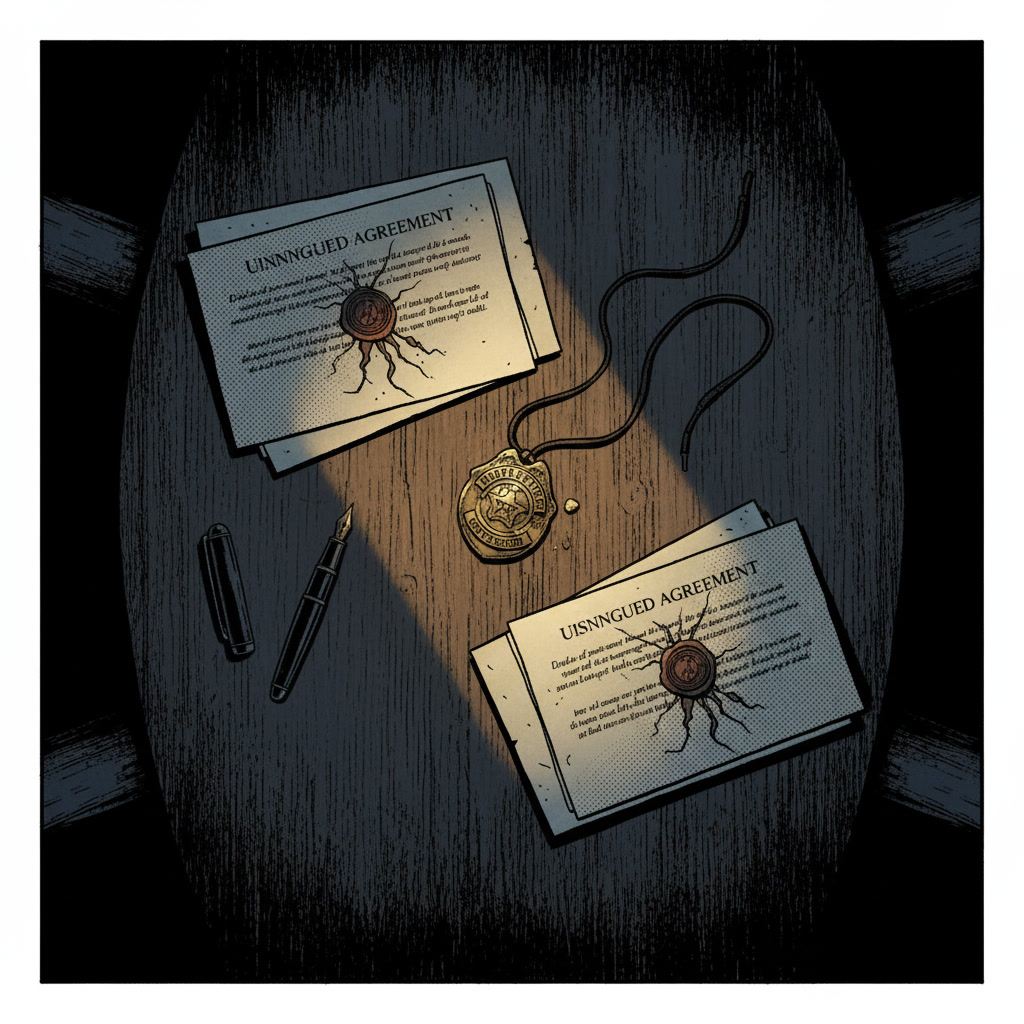
'A War Without Victors.' Now Comes the Proof.
The Plumb Line
Monday, June 15
"'Each side finds a way to claim victory.'" The New York Times published that line this morning to describe the US-Iran nuclear framework — and it is the most analytically precise sentence about a diplomatic agreement the wire has produced in months. Not because it is cynical. Because it is accurate. When both parties to a negotiation can credibly claim they won, it almost always means the hardest question was papered over, deferred, or assigned to a mechanism that doesn't exist yet.
Yesterday's brief held that the structural test of any deal would be whether International Atomic Energy Agency (IAEA) access to Iranian enrichment sites was confirmed before the Hormuz blockade was lifted. That test is now active. The Financial Times confirmed overnight that Iran and the United States have agreed to reopen the Strait and extend the ceasefire. Bloomberg reports the Hormuz passage reopens "this week." Neither wire has published the verification language. The deal has a name. The mechanism does not.
While every major wire led with the framework, Russia struck a UNESCO-protected cathedral in Kyiv, and Ukraine and Moldova formally opened European Union membership talks. Both received roughly one-tenth the column space of the announcement. Today's brief covers all three.
'A War Without Victors.' Now Comes the Proof.
What is confirmed: Iran and the United States have agreed to a framework that extends the ceasefire and schedules the Strait of Hormuz to reopen "this week," per Bloomberg. The Financial Times called it a deal. The New York Times described the result as a framework that "brings relief, but challenges loom" — and separately noted that on the nuclear enrichment question, each side has found a way to claim victory. The G7, meeting in Evian, has been effectively sidelined by the announcement; Bloomberg reports member governments are awaiting Trump's arrival as the deal's architect. No signed text, no IAEA monitoring confirmation, and no implementation timeline has been published by any of the major wire services as of this morning.
The read here. Yesterday this brief named the 1994 US–North Korea Agreed Framework as the closest historical analog — an announcement that permitted both sides to declare success, with verification mechanisms that were never adequately resourced, leading to collapse in 2002 when Pyongyang acknowledged it had continued enriching throughout the compliance period. Today that analog is not refuted. It is activated. The Financial Times' own framing — "a war without victors" — arrives at the same structural problem from a different direction: when neither side concedes the core issue, both sides' victory claims describe the shape of the next conflict, not the end of this one. The read here is that durability turns on a single question: are IAEA inspectors physically present at Iranian enrichment sites before the Hormuz passage reopens? If yes, this brief upgrades its assessment. If the blockade lifts before that confirmation is on the ground, the 1994 analog holds and the next fight has already begun.
What I'd watch for next: three falsifiers. First: does IAEA publicly confirm monitoring access within 72 hours of the announced agreement? Second: Saudi Arabia's and Turkey's official responses — yesterday's brief named these as the regional architecture test, and the flag stands. A hedge from Riyadh is more informative than any ceremony footage. Third, and new today: the Financial Times reports the deal "leaves Trump fighting a war at home," which means domestic political pressure runs toward a faster, cleaner declaration of Hormuz open than the verification timeline can sustain. If Trump publicly announces the blockade lifted before IAEA confirms its presence on the ground, that sequence is the falsifier. Watch the order of events, not the statement.
Three other things worth knowing
Russia struck a UNESCO-protected cathedral in Kyiv. Bloomberg confirmed the strike. The read here is that targeting a site on the UNESCO World Heritage list is not an error of aim — it is a deliberate signal about which norms Moscow has already priced in and accepted the cost of violating. The timing is worth noting: on the day a nuclear framework was being announced with reference to international monitoring bodies, Russia demonstrated its assessment of what those bodies can actually enforce. The read here is that this strike is strategic communication to two audiences at once — to Ukrainians (no archive or sanctuary is safe) and to the international community (Moscow has already calculated the cost of condemnation and decided to proceed anyway).
Ukraine and Moldova formally opened the first phase of EU membership talks. Bloomberg confirmed. European Union accession is a decade-plus process at minimum, and the opening phase is essentially a structured audit of legal and governance alignment. But the political signal is unambiguous: Brussels has decided the war's trajectory is toward Ukrainian survival, not Russian absorption, and is now investing institutional credibility in that outcome. The read here is that accession talks function as a security guarantee that requires no Senate confirmation vote — every month of structured process raises the political cost of reversal, for Europe and for any future American administration.
Severe flooding is hitting Texas, Louisiana, and the central Midwest simultaneously. Flash flood warnings are active across Bexar County (San Antonio), Travis and Hays counties (Austin), the Houston-Galveston coastal corridor, central Louisiana including Lafayette and St. Landry parishes, and a broad swath of counties in Illinois, Indiana, and Oklahoma. Several warnings run through Wednesday morning. The read here is that simultaneous active warnings across four states tracking a single storm system is consistent with the scale that triggers a federal disaster declaration; that determination depends on how rivers crest over the next 48 hours. National coverage remains thin relative to the scope.
Echoes
Russia's deliberate strike on a Kyiv cathedral has a direct predecessor worth naming. In late August 1992, Sarajevo's Vijećnica — the National and University Library, one of the finest Ottoman-era buildings in the Balkans — was shelled and burned by Bosnian Serb forces during the siege of the city. An estimated 1.5 million books and manuscripts were destroyed. The International Criminal Tribunal for the former Yugoslavia (ICTY) later addressed the deliberate destruction of cultural property in the context of broader war crimes proceedings against commanders of the Sarajevo campaign. The historical parallel is this: cultural strikes do not change military outcomes — they don't. They function as dual-audience communication: they tell the civilian population that history itself is a target, and they tell the international community that the attacking party has already calculated the cost of condemnation and accepted it. Moscow made that same calculation overnight.
The quiet things
The Bank of Japan has maintained official silence on Governor Kazuo Ueda's condition or policy succession for six consecutive days. The yen carry trade continues to price policy continuity on inference rather than confirmed evidence. The read here: six days without a statement is not a gap in the communications calendar. It is a posture — deliberate or not — and it is being read as one by the traders who are long yen on the assumption of continuity.
The Siberian fires tracked in this brief since Saturday are intensifying sharply. NASA satellite data this morning records fire radiative power at the Krasnoyarsk region cluster — roughly 58.8 degrees north, 104 degrees east — at levels far exceeding yesterday's readings.
The read here is that mid-June fire behavior at this intensity level in central Siberia is not routine. The cluster is still absent from the international wire.
How I'd act on this
If you watch the Iran file — the next 72 hours are the verification window. Locate IAEA's public statement on monitoring access, or note its absence. "Each side finds a way to claim victory" is not a problem for a deal; it becomes a problem for a verification mechanism that has to hold both claims accountable to the same physical reality at an enrichment site.
If you hold energy positions exposed to the Strait of Hormuz — Bloomberg's language is "this week," not "today." The price-relevant event is not the announcement but the first confirmed transit after the blockade lifts. Watch whether that transit precedes or follows a public IAEA access confirmation. The sequence determines whether you're pricing a verified commitment or a timed announcement.
If you cover EU policy or hold positions in European defense — Ukraine's accession talks are process, not outcome, but process accumulates political mass. Watch the pace Brussels sets for the first screening phase; acceleration beyond the standard timeline signals Brussels' own read on how much runway Ukraine has.
If you are in central Texas, coastal Louisiana, or the Illinois-Indiana river corridors — the 48 hours ahead are the critical window. Several warnings run through Wednesday morning. If rivers crest at or above record stage, federal disaster declaration and Federal Emergency Management Agency (FEMA) engagement typically follow within 24 to 72 hours.
A framework in Evian, a cathedral in Kyiv, accession papers in Brussels, and rising water from Bexar County to the Wabash — four events, one morning, none canceling the others out.
The deal has a name; the verification clause does not.
— *The Plumb Line*. Daily world brief.
Sources
Iran / Hormuz / nuclear framework
- newswire/ft — "Iran and US agree deal to open Strait of Hormuz and extend ceasefire," June 15
- newswire/ft — "FirstFT: Iran and US agree Strait of Hormuz deal," June 15
- newswire/ft — "A war without victors," June 15
- newswire/ft — "Iran deal leaves Trump fighting a war at home," June 15
- newswire/ft — "The consequences of a diminishing global energy shock," June 15
- newswire/bloomberg — "US and Iran Say They've Agreed Deal to Reopen Hormuz This Week," June 15
- newswire/bloomberg — "A Sidelined G7 Awaits Trump's Triumphant Arrival After Iran-US Deal," June 15
- newswire/nyt — "U.S.-Iran Framework Brings Relief, but Challenges Loom," June 15
- newswire/nyt — "The U.S.-Iran Deal: What to Know," June 15
- newswire/nyt — "On the Nuclear Issue, Each Side Finds a Way to Claim Victory," June 15
- newswire/nyt — "China Moves the Price of Oil, Even When It Buys Less," June 15
Russia / Ukraine / EU accession
- newswire/bloomberg — "Russia Strikes UNESCO-Protected Cathedral in Kyiv," June 15
- newswire/bloomberg — "Ukraine and Moldova to Start First Phase of EU Membership Talks," June 15
- newswire/nyt — "Ukraine Is About to Take a Big Step on a Long Road Toward the European Union," June 15
US flooding
- noaa_alerts (multiple IDs) — Flash flood and flood warnings: Texas (Bexar, Hays, Travis, Bandera, Kendall, Medina, Comal, Guadalupe, Burnet, Williamson, Kerr, Blanco, Burleson, Brazos, Washington, Maverick counties); Louisiana (Lafayette, St. Landry, St. Martin, Avoyelles, Evangeline, Rapides, and Gulf Coast parishes); Oklahoma (Cherokee, Ottawa); Illinois (Clay, Richland, Marshall, Putnam, Crawford, Lawrence); Indiana (Parke, Vermillion, Vigo, Knox, Sullivan); multiple warnings through June 17
Siberian fires
- nasa_firms (multiple IDs) — Fire radiative power up to 942.46 MW at 58.76°N, 104.05°E (Krasnoyarsk region, Siberia), morning June 15; same cluster tracked in The Plumb Line since June 13
Bank of Japan continuity
- The Plumb Line, June 13–14 — BoJ Governor Ueda silence; carry trade pricing flagged at days four and five; day six as of this issue
Historical references
- Vijećnica (National and University Library of Bosnia and Herzegovina), shelled and burned August 25–26, 1992, Sarajevo; ICTY proceedings on cultural property destruction
- US–North Korea Agreed Framework, signed October 21, 1994; North Korean enrichment acknowledgment October 2002; named as primary structural analog in The Plumb Line since June 14 issue