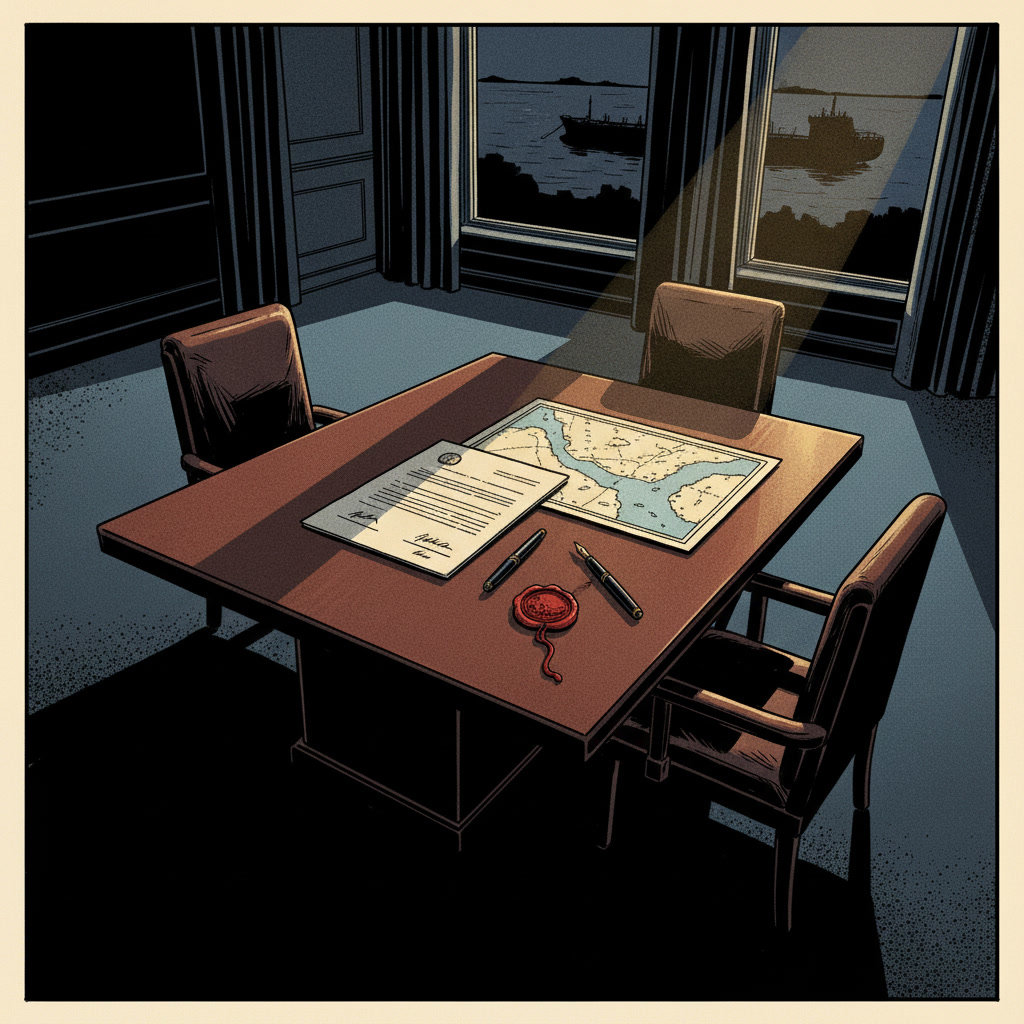
Announce It. Board It. Burn It.
The Plumb Line
Sunday, June 14
"'Mixed signals.'" That is the New York Times' characterization of the state of US-Iran talks this morning — published four hours after the Financial Times reported that Donald Trump says both parties will sign an agreement today to reopen the Strait of Hormuz. The two headlines don't contradict each other; they describe the same situation from opposite ends of the telescope. What they collectively tell you is that there is a political deadline and an unresolved technical question, and one of those is being treated as though it resolves the other.
Secretary of State Marco Rubio is the tell. He spent Saturday morning not previewing a ceremony but actively defending the Hormuz blockade — in response to India's formal diplomatic protest of the US strikes that have disrupted its energy imports. A closing day in a deal process looks like choreography: quiet officials, coordinated press releases, advance texts. Saturday looked like arguments. India's protest is the first formal complaint from a major oil-importing nation that had previously absorbed disruption in official silence. Whether Tokyo or Seoul files a similar representation in the next 48 hours is worth tracking more carefully than the Sunday ceremony itself.
While Iran consumed the wire, UK Royal Marines boarded a Russian oil tanker in the English Channel, and Ukraine struck a fuel depot and a chemical plant deep inside Russian territory. Today's brief covers all three.
Announce It. Board It. Burn It.
The confirmed facts on Iran, as of this writing: the Hormuz blockade is active and was publicly defended by Rubio on Saturday. India has lodged a formal protest. The New York Times' live coverage calls the signals from both sides mixed. Donald Trump has said the parties will sign today; no signed text or verified enrichment freeze has been published by either side.
The read here. Yesterday this brief named the Panmunjom parallel — fighting-while-talking as a mode that produces announcements more reliably than it produces settlements. Today the wires point toward a sharper and more recent analog: the historical parallel is the Agreed Framework the Clinton administration negotiated with North Korea in October 1994. Clinton announced that deal as a genuine breakthrough. North Korean nuclear activity did not stop; the verification mechanisms were never adequately resourced; and the agreement collapsed in 2002 when Pyongyang acknowledged it had continued enriching throughout the compliance period. The mechanism that failed wasn't the diplomatic table — it was the assumption that the announcement was the settlement. The read here: if Sunday's ceremony produces language about "monitoring" and "implementation timelines" without confirmed International Atomic Energy Agency (IAEA) access to Iranian enrichment sites before the blockade lifts, this framework has the same structural vulnerability as 1994.
Yesterday's falsifiers carry forward with one addition. Saudi Arabia's and Turkey's endorsement language within 24 hours of any signing remains the regional-architecture test — silence or a hedge from Riyadh is more informative than the ceremony itself. India's protest is today's new variable: what I'd watch for next is whether Tokyo or Seoul files formally in the next 48 hours. If they do, the political cost of maintaining the blockade rises faster than the verification timeline can accommodate, pushing Washington toward a premature lift. If the blockade is lifted before IAEA monitoring access is confirmed, this brief revises its call downward — that would be a better outcome than the 1994 analog suggests, and this brief will say so plainly.
Three other things worth knowing
UK Royal Marines boarded a Russian oil tanker in the English Channel yesterday. The vessel is part of Russia's shadow fleet — the network of tankers operating under flags of convenience to move Russian crude past Western sanctions. The Financial Times, the New York Times, and Bloomberg all confirmed the boarding. Prior enforcement actions against the shadow fleet have gone through port inspections and flag-state pressure; deploying uniformed military personnel in one of the world's busiest shipping corridors is a deliberate escalation in methodology, not in legal authority. The read here: London is signaling enforcement willingness, not just capacity. Russia cannot credibly counter-board British vessels in the Channel. What I'd watch for next is Moscow's response on cyber or proxy axes — the pressure points it can actually reach.
Ukraine struck a fuel depot and a chemical plant deep inside Russian territory. Bloomberg confirmed both strikes. Fuel depot targeting degrades the operational logistics feeding Russian ground forces directly; chemical plant targeting indicates Ukrainian intelligence is mapping the industrial supply chain behind the Russian war effort, not simply hitting targets of opportunity. These are qualitatively different from front-line exchange in ways the column-inch ratio this week does not reflect. The read here: Ukraine's deep-strike campaign is the one persistent variable disrupting Russian operational planning, and the Iran announcement has absorbed the analytical attention these strikes normally generate.
Germany and Japan are simultaneously rearming, 80 years after the war that demilitarized them both. The New York Times published a side-by-side analysis of both nations' defense buildups. The two countries whose post-1945 constitutional frameworks most explicitly constrained their militaries are, in the same year, increasing defense spending, loosening constitutional interpretations, and acquiring offensive-capable platforms. The UK-Japan-Italy fighter jet program is the specific flashpoint to watch this week — Bloomberg reports funding is sputtering as Prime Minister Starmer meets Japan's Prime Minister Takaichi in Evian. Whether that meeting closes a commitment or extends the language of commitment is the procurement signal European defense industry is reading closely.
Echoes
The Royal Marines' boarding of a Russian tanker in the English Channel has a direct precedent worth naming. In July 2019, British forces seized the Grace 1 off Gibraltar — a supertanker carrying Iranian oil to Syria in violation of EU sanctions. Iran responded within two weeks by seizing the British-flagged Stena Impero in the Strait of Hormuz. The standoff ran three months before diplomatic exchange produced both ships' release. The lesson isn't that the Grace 1 seizure was wrong — the EU sanctions violation was real and the legal authority was sound. The lesson is that maritime enforcement in contested waters produces a retaliatory dynamic that is hard to bound, and that the retaliating party selects the pressure point it can actually reach. Russia, unlike Iran in 2019, does not control a chokepoint Britain depends on. Russia does have demonstrated reach into Baltic subsea infrastructure, European energy networks, and cyber-accessible financial systems. The read here: the escalatory response to yesterday's boarding will not be naval. It will be on those axes, and likely not this week.
The quiet things
The Bank of Japan has now gone five consecutive days without a public statement on Governor Kazuo Ueda's condition or policy succession. Yesterday's brief flagged day four as a non-neutral data point. Day five — with Japan's prime minister attending the G7 in Evian and the yen carry trade still pricing policy continuity on assumption rather than evidence — is the same data point, louder. At this duration, no press conference is not silence. It is a position.
The Siberian fires this brief flagged Saturday continue. NASA satellite data overnight registered fire intensity above 198 megawatts near latitude 60 north, longitude 100 east — the same Krasnoyarsk region cluster as yesterday. A second cluster appeared near latitude 44 north, longitude 94 east: the southern Mongolian plateau, where fire activity at this scale in June carries air-quality implications for northern China. The international wire covers neither.
Flash flood warnings blanketed roughly 30 counties across Missouri, Illinois, Indiana, and Kansas overnight. Cook County, Illinois — which contains Chicago — was under a flash flood warning through early morning. Several Missouri river warnings extend through June 17. Whether this generates a federal disaster declaration depends on how the rivers crest over the next 72 hours. National coverage remains minimal relative to the scale.
How I'd act on this
If you watch the Iran file — the Sunday ceremony, if it occurs, is where the verification fight begins, not ends. The one sentence to locate in any signed text is the monitoring mechanism and which body administers it. IAEA access to enrichment sites before the Hormuz blockade lifts is the technical minimum that distinguishes a verified commitment from a deadline extended. Watch the text, not the footage.
If you hold energy positions tied to the Strait — the oil market has already priced the announcement. Verified blockade removal, which requires a functioning monitoring arrangement, is the next price-relevant event. Rubio's Saturday defense of the blockade suggests the gap between announcement and verified removal is measured in weeks, not hours.
If you cover the Russia-Ukraine war or hold European defense exposure — the UK tanker boarding and Ukraine's deep strikes happened on the same day and will be read in Moscow as coordinated Western pressure regardless of coordination. The G7 in Evian this week is the next moment member states must reconcile their Russia postures publicly. Germany's simultaneous rearmament and its push for Deutsche Börse exemption from EU financial supervision is the internal tension that will surface in any communiqué language on economic coordination.
If you follow UK politics or track sterling — Keir Starmer is at the G7 while Bloomberg's headline on him this morning reads "Diplomacy Is No Longer a Safe Space for UK's Wounded Premier." The fighter jet funding gap with Japan is the specific foreign policy test on his desk this week. A closed deal would be his most visible win in months; an extended process extends the narrative of institutional drift that has defined the last six weeks.
The Hormuz blockade held through Saturday, UK Royal Marines held a Russian tanker in the English Channel, and Ukrainian drones reached Russian industrial infrastructure — three facts the Sunday announcement did not change.
Washington named the date; Tehran named the price; and the verification mechanism, as yet, has no name.
— *The Plumb Line*. Daily world brief.
Sources
Iran / Hormuz blockade / deal talks
- newswire/nyt — "Iran War Live Updates: U.S. and Tehran Send Mixed Signals on Emerging Peace Agreement," June 14
- newswire/ft — "Trump says US and Iran will sign deal on Sunday to reopen Strait," June 14
- newswire/bloomberg — "Rubio Defends Hormuz Blockade After India Protests US Strikes," June 14
UK / Russian shadow fleet tanker seizure
- newswire/ft — "UK intercepts Russian shadow fleet oil tanker in English Channel," June 14
- newswire/nyt — "UK Forces Seize Russian Shadow Fleet Oil Tanker," June 14
- newswire/bloomberg — "UK Forces Board Sanctioned Tanker in Russian Shadow-Fleet Raid"; "UK Royal Marines Board Russian Shadow Fleet Oil Tanker in English Channel," June 14
Ukraine deep strikes
- newswire/bloomberg — "Ukraine Targets Russian Chemical Plant, Fuel Depot in Strikes," June 14
G7 / Germany-Japan rearmament / UK-Japan fighter jet program
- newswire/nyt — "The G7 Summit Is Dogged by Chaos and Divided by Trump," June 14
- newswire/nyt — "Germany and Japan Are Rearming Again, 80 Years After World War II," June 14
- newswire/bloomberg — "Starmer to Meet Japan's Takaichi as Fighter Jet Funding Sputters," June 14
- newswire/bloomberg — "Diplomacy Is No Longer a Safe Space for UK's Wounded Premier," June 14
- newswire/ft — "Macron and Trump test their bruised bromance at G7 summit," June 14
Fires (satellite detection)
- nasa_firms (multiple detection IDs) — High-intensity thermal readings: 60°N 100°E (Krasnoyarsk region, Siberia, continuing from June 13) and 44°N 94°E (southern Mongolian plateau), June 14
US flooding
- noaa_alerts (multiple IDs) — Flash flood and flood warnings: Missouri (28+ counties), Illinois including Cook County, Indiana, Kansas, Oklahoma; warnings extending through June 17
Bank of Japan / continuity
- The Plumb Line, June 13 — BoJ Governor Ueda silence flagged at day 4; Siberian fires; Iran deal falsifiers named (Saudi/Turkey endorsements; enrichment freeze)
Historical references
- US–North Korea Agreed Framework: signed October 21, 1994; North Korean acknowledgment of continued enrichment: October 2002
- Grace 1 seizure off Gibraltar: July 4, 2019; Stena Impero seizure by Iran: July 19, 2019; Stena Impero released: September 27, 2019
- Korean War armistice talks, Panmunjom: July 1951–July 1953 (cited as primary analog in June 13 issue)