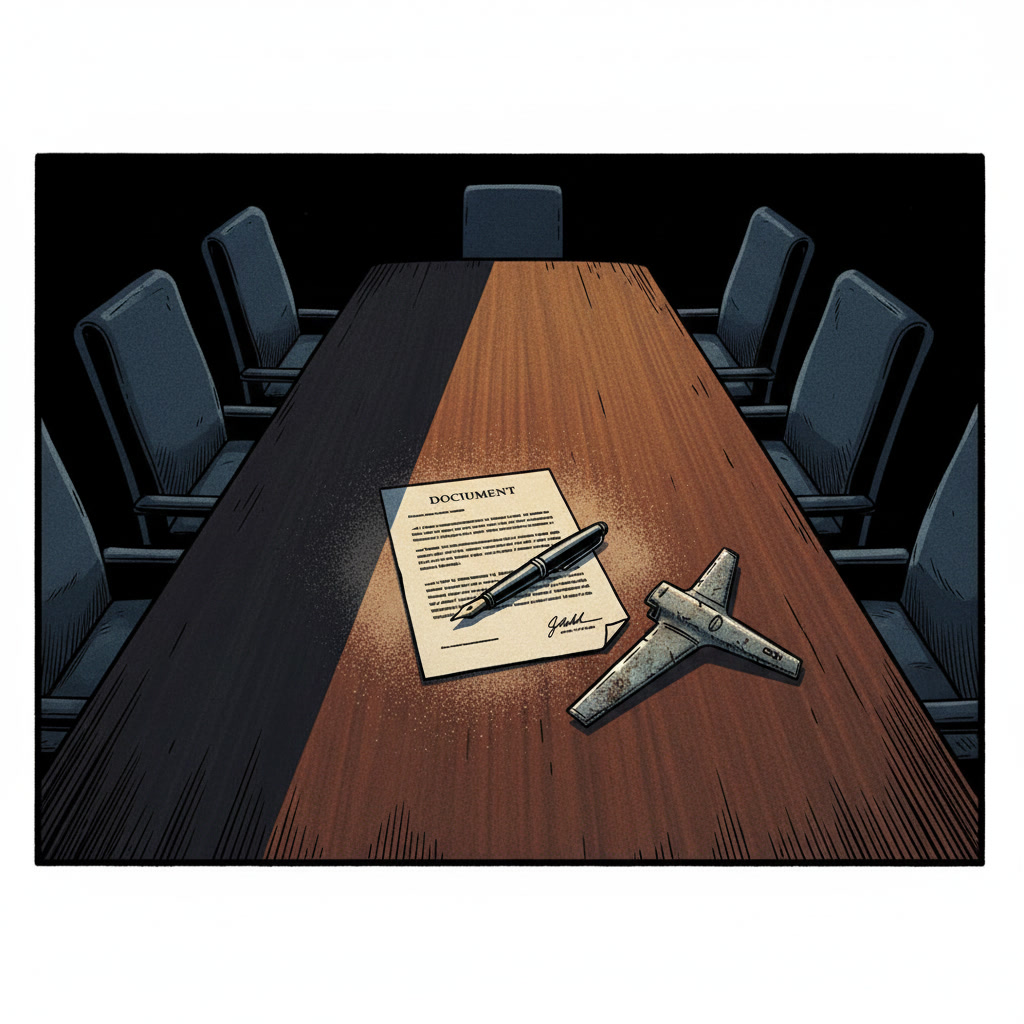
Strike Now, Sign Later
The Plumb Line
Saturday, June 13
The story most people are reading this morning frames it as a diplomatic race: US and Iranian negotiators are working toward an interim deal, the G7 opens Tuesday in Canada, and Poland has already acted on the assumption that peace is coming — Prime Minister Donald Tusk announced yesterday that Warsaw would end its fuel subsidies because the talks are "heating up." What that framing leaves out is Bloomberg's actual headline from last night: "US Strikes Iranian Drones While Talks Continue for Interim Deal." The verb is present tense. The word "while" is doing extraordinary work. The United States is bombing and negotiating with the same country at the same time, and the wire has largely buried the first half of that sentence beneath the second.
The read here: this is not without precedent, and the precedent is not reassuring. Fighting-while-talking is an established mode in American conflict management — the Korean War armistice negotiations at Panmunjom ran for 25 months while combat continued on the front line. But it is a mode that produces announcements more reliably than it produces settlements. The New York Times, in the same cycle running live "deal is close" updates, also published an analysis piece headlined "With a Deal Seemingly Close, the U.S. Faces an Iran More Willing to Withstand Pressure." Read those two headlines together and the picture clarifies: Tehran has calculated that absorbing the drone strikes improves its negotiating position rather than weakens it. That is a sophisticated read of American domestic political dynamics — and the read here is that it is almost certainly correct.
Yesterday's brief named the decisive falsifier: if Iranian enrichment above 60 percent paused before Sunday night, the diplomatic channel had real substance. Today's reporting on Iran's posture suggests enrichment has not paused. The oil market has already priced the deal announcement. Whether the announcement will be matched by a verified change in Iranian behavior is the question that Tuesday's G7 press conference will not answer.
Strike Now, Sign Later
US forces struck Iranian drone assets overnight while American and Iranian negotiators simultaneously worked toward an interim framework — timed, if the talks hold, for announcement at the G7 summit opening Tuesday. The New York Times' live Iran coverage carries the headline "Middle East Awaits Latest on Potential Agreement." Poland announced it would phase out fuel subsidies in direct response to the peace talks — the clearest sign yet that European governments are treating an unannounced agreement as effective policy. Bloomberg separately reported that talks are focused on an "interim deal" structure, not a comprehensive settlement.
Here's the read. The appropriate historical analog is not the JCPOA (Joint Comprehensive Plan of Action) process in Vienna — that required both sides to reduce military provocation as a precondition for the table and took 20 months to produce a text. The analog is Panmunjom: armistice talks began in July 1951 while active combat continued, because each side calculated that military pressure improved its negotiating position faster than genuine concessions would. The mechanism that eventually closed Panmunjom in July 1953 was not a breakthrough — it was mutual exhaustion and a new American administration with a different cost-benefit calculation. The read here: if Trump needs a deal announcement before Tuesday for domestic political reasons, Tehran has every incentive to give him the announcement and protect the substance for the implementation fight later.
Named falsifiers: if Saudi Arabia's and Turkey's foreign ministries issue statements endorsing the framework within 24 hours of any Tuesday announcement, the regional architecture has enough buy-in to give the deal durability beyond the press conference. If either stays silent or issues a "we note the agreement" hedge, the deal is primarily a bilateral political artifact. The second falsifier remains Iranian enrichment posture — if independent monitors confirm any suspension of activity above 60 percent before Monday morning, the deal has a real technical component. If not, Tuesday is a freeze-in-name.
Three other things worth knowing
Washington and Caracas just ran a joint military operation, and investment money is already racing toward Venezuelan oil. The New York Times reported that American and Venezuelan forces killed a leader of Tren de Aragua — the Venezuelan transnational gang designated by the Trump administration as a terrorist organization — in a coordinated strike. The Financial Times simultaneously reported that major investment firms are entering what it calls a "$100 billion race" for Venezuelan crude as the Trump administration signals an opening toward Caracas. The read here: these two stories are one story. The joint strike is the diplomatic proof of concept — Maduro's government demonstrating security cooperation — and the investment race is the economic payoff being structured around it. Washington is offering Venezuela the sanctions-for-cooperation framework that the Biden administration assembled but could never close. What I'd watch for next: whether OFAC — the Treasury's Office of Foreign Assets Control — formally eases restrictions on Chevron's Venezuela operations in the next 30 days. That is the policy signal the investment race is anticipating.
Keir Starmer's hold on the British premiership appears materially weaker this morning. Bloomberg reported overnight that Greater Manchester Mayor Andy Burnham is planning "a swift power grab" as Starmer's premiership "teeters" — specific language that carries analytical weight. Burnham has maintained the most visible independent Labour profile outside the Cabinet; the read here is that his emergence as an active challenger marks a threshold where alternatives are being planned, not merely discussed. Yesterday's brief noted the UK economy contracted 0.1 percent in April. What I'd watch for next: the June retail sales data; a second consecutive negative print would make internal Labour pressure difficult for Starmer to manage and would accelerate whatever succession process is underway in the parliamentary party.
Europe's two flagship joint defense programs are simultaneously in distress. Rheinmetall's chief executive warned this week that France may exit the Franco-German Main Ground Combat System — the joint tank program that has missed every major milestone since its 2012 inception. The Financial Times is concurrently running "Europe's fighter jet fiasco," documenting dysfunction in the continent's air combat successor program. The read here: two flagship joint programs fraying at the same moment is not coincidence; it is the structural consequence of defense spending growing faster than the political will to accept the industrial compromises that joint programs require. As NATO members race toward new spending targets, national champions — Dassault in France, Rheinmetall in Germany — are winning arguments they previously lost. European defense integration is becoming harder to sustain precisely when it should be most valuable.
Echoes
Panmunjom deserves more attention as a cautionary case than it typically receives in discussions of the Iran file. The Korean War armistice talks began in July 1951 — both sides entered expecting a quick resolution. It took 25 months and continued combat before the armistice was signed in July 1953. The final agreement was not produced by a military victory or a diplomatic breakthrough; it was produced when both sides concluded the marginal cost of continued fighting had exceeded the marginal value of any remaining negotiating leverage, and a new American president decided the war's cost was no longer politically sustainable at home. The read here for the Iran file: a G7 deadline does not compress 25 months into 72 hours. What a deadline does is create a political moment for an announcement. Announcements and settlements are different instruments. Panmunjom eventually produced a durable settlement. Tuesday may produce a very consequential announcement.
The quiet things
A major wildfire complex is burning in the Krasnoyarsk region of central Siberia, and the international wire is not covering it. NASA satellite thermal data recorded fire intensity readings above 598 megawatts overnight at coordinates near latitude 59 north, longitude 90 to 91 east — a cluster of detection points across a substantial area of taiga forest roughly 1,500 kilometers east of the Ural Mountains. For scale, sustained readings above 500 megawatts indicate fires comparable in intensity to significant California fire events. Russian state media is not prominently reporting these fires. The read here: the downstream effects — atmospheric carbon loading, regional smoke affecting Kazakhstan and western China, accelerated permafrost thaw in an already-stressed system — develop over weeks, not hours. This is the kind of story that disappears before it becomes undeniable.
The Bank of Japan's silence on Governor Ueda's condition and on policy succession has now entered its fourth day without clarification. Yesterday's brief flagged it as a non-neutral data point at day three. At day four, the BoJ (Bank of Japan) has still provided nothing. The yen carry trade — a large structure of borrowing cheap Japanese yen to invest in higher-yielding assets elsewhere — continues to price policy continuity on assumption rather than on evidence. The G7 summit and Iran coverage are consuming the wire. This story is not on page one of anything. The read here: that is precisely why it warrants attention.
How I'd act on this
If you watch Middle East diplomacy — what I'd watch for next on Tuesday's G7 announcement is in the reaction statements, not the announcement itself. Saudi Arabia and Turkey are the two states whose endorsement language determines whether the deal has regional architecture behind it or is primarily a US-Iran bilateral artifact. Get those statements within 24 hours of any announcement and you'll know which it is before the analysis pieces catch up.
If you track Latin America or hold Venezuelan energy exposure — the Tren de Aragua joint strike and the $100 billion oil investment race are the same transaction, separated by a few news cycles. What I'd watch for next: whether OFAC formally eases Chevron's Venezuela operational restrictions in the next 30 days. That is the policy signal the investment race is running ahead of.
If you follow UK politics or hold sterling positions — Burnham's active positioning changes Starmer's political horizon in a way that internal Labour grumbling had not. The June retail sales data is the next domestic trigger. Watch it.
If you cover European defense procurement or hold European defense equity — the simultaneous dysfunction in the Franco-German tank program and the European air combat program is a structural tell. National champions are winning; joint programs are stalling. Defense budgets are rising; defense integration is retreating. Those two trends are in tension, and the tension is resolving in a specific direction that reshapes the industrial landscape for the next decade.
The United States is bombing and negotiating with Iran on the same morning, Poland is canceling fuel subsidies on the assumption a deal already exists, an unverified enrichment freeze is doing the work of an actual one, and the Bank of Japan has gone four days without explaining where its governor is — Tuesday will produce a headline, but whether "interim deal" means a step toward settlement or a step toward Panmunjom is a question the press conference is not built to answer.
— *The Plumb Line*. Daily world brief.
Sources
Iran / US military action / deal talks
- newswire/bloomberg — "US Strikes Iranian Drones While Talks Continue for Interim Deal," June 13
- newswire/nyt — "Iran War Live Updates: Middle East Awaits Latest on Potential Agreement," June 13
- newswire/nyt — "With a Deal Seemingly Close, the U.S. Faces an Iran More Willing to Withstand Pressure," June 13
- newswire/bloomberg — "Poland to End Fuel Subsidies as US-Iran Peace Talks Heat Up," June 13
Venezuela / Tren de Aragua / oil
- newswire/nyt — "A Tren de Aragua Leader Is Killed in a Joint Strike, U.S. and Venezuela Say," June 13
- newswire/ft — "Investment firms join Donald Trump's $100bn race for Venezuelan oil," June 13
UK politics
- newswire/bloomberg — "Burnham Plans Swift Power Grab as Starmer's Premiership Teeters," June 13
European defense
- newswire/bloomberg — "Rheinmetall CEO Sees Risk of France Exiting Tank Project: WamS," June 13
- newswire/ft — "Europe's fighter jet fiasco," June 13
Siberian fires
- nasa_firms/9e728003ae5793f3c3dba38a94af1197 and related IDs — High-intensity thermal detections, Krasnoyarsk region (~59°N, 90–91°E), June 13
Continuity / prior coverage
- The Plumb Line, June 12 — Iran enrichment falsifier call; UK GDP contraction; Bank of Japan succession silence (day 3)
Historical references
- Korean War armistice negotiations, Panmunjom: July 10, 1951 – July 27, 1953
- JCPOA negotiations, Vienna: November 2013 – July 2015 (cited as contrast case)