Count the Ships at Hormuz.
The Plumb Line
Tuesday, June 9
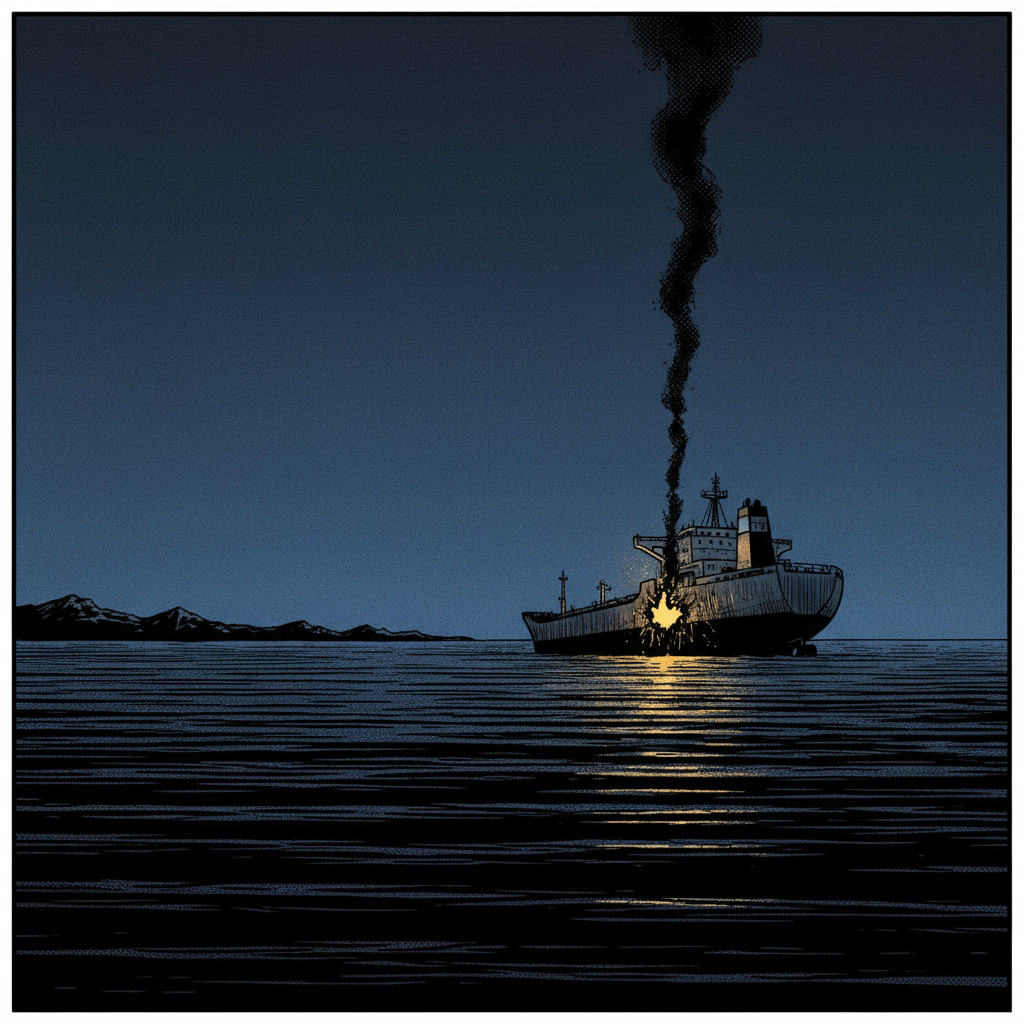
What does it mean when the United States Navy strikes a tanker in the Strait of Hormuz? It means the conflict that started as an Israel-Iran air exchange has acquired a third active combatant — one with a carrier group, an operational legal posture, and the ability to close the chokepoint through which roughly a fifth of the world's seaborne oil moves.
Bloomberg reported this morning that US forces struck an India-crewed tanker that American commanders believed may have been Iran-bound. The New York Times confirmed separately that a US Navy helicopter went down near the Strait of Hormuz; the crew was rescued. And Israel launched new strikes in southern Lebanon overnight. Three military events in or adjacent to the same operational theater, inside a single day. The conflict is no longer bilateral.
Yesterday's brief tracked the uranium accounting gap as the most consequential story running underneath the visible exchange. That story has not resolved — the IAEA (International Atomic Energy Agency) has not escalated publicly, and no accounting has cleared the wire. But today the kinetic story overtook it. You can have a diplomatic crisis over missing nuclear material while conducting parallel military operations. What you cannot do is undo a naval engagement in one of the narrowest international straits in the world.
Count the Ships at Hormuz.
Bloomberg's tanker report is the operative fact today. US forces struck a vessel crewed by Indian nationals on the grounds that it may have been en route to Iran. "May have been" is doing considerable legal and operational work in that sentence — the standard for kinetic interdiction of commercial shipping is not "possibly Iran-bound," and the lawyers who signed off on this engagement will have consequences to manage. India has maintained studied neutrality in the Iran conflict and has been one of the largest continuing buyers of sanctioned Russian oil; New Delhi's response to the loss of its nationals on a struck vessel will be the first real test of whether US operations at Hormuz are creating coalition costs Washington hasn't yet priced.
The read here: the closest historical parallel is Operation Earnest Will, 1987-1988, when the Reagan administration committed the US Navy to escorting reflagged Kuwaiti tankers through the Persian Gulf during the Iran-Iraq War. The commitment was presented as deterrence. Within months, the Navy had traded fire with Iranian vessels in direct combat — Operation Praying Mantis in April 1988 became the largest US naval surface action since World War II. The mechanism then is the mechanism now: each incremental step was framed as proportionate and contained, and the escalation managed itself despite the stated intentions of both parties. What I'd watch for next — the falsifier that would tell me today was noise rather than inflection: if Iran responds to the tanker strike through diplomatic channels without a military counter within 48 hours, Tehran is still trying to keep the United States out of a full shooting war. If Iran conducts any kinetic action against US assets in that window, the conflict has formally tripled in scope.
The US-Iran nuclear negotiations are running simultaneously and are, by the New York Times' account, structurally deadlocked. Both sides demand terms that read as a domestic victory, and neither can grant that to the other without politically visible concession. What I'd watch in the talks is not the headline outcome but the format of the next meeting: a session at foreign-minister level in a neutral country signals genuine intent; a downgrade to technical delegations signals stalling. The helicopter incident at Hormuz will complicate that next session regardless of attribution.
Three other things worth knowing
Bulgaria breaks from the Ukraine arms line. Bloomberg reported this morning that Bulgaria's new government has decided to stop supplying weapons to Ukraine. Sofia's contribution was not the largest in the European coalition, but the precedent is the point: a NATO member on the southeastern flank has concluded that domestic politics outweigh alliance burden-sharing. The read here is that the question is whether any NATO mechanism produces a visible consequence. If it doesn't, the fragmentation has a demonstrated path forward, and Poland, Slovakia, and Hungary — each carrying its own version of the same domestic pressure — are watching.
Indonesia fired an emergency rate hike. The Financial Times reported that Indonesia's central bank unexpectedly raised its benchmark interest rate to defend the rupiah. An emergency move to defend a currency signals that the bank has assessed the downside risk as severe enough to absorb the domestic growth cost of tighter money — a judgment that says something about how regional capital is reading the global risk environment right now. Indonesia controls the Strait of Malacca. The read here: a central bank making emergency decisions in Jakarta while the US Navy conducts kinetic operations near Hormuz is not a coincidence to dismiss; the two chokepoints are linked in every serious maritime risk model.
GSK is paying $10.6 billion for Nuvalent. The Financial Times and a Nuvalent SEC (Securities and Exchange Commission) filing this morning confirm that GSK has agreed to acquire the US cancer biotech focused on precision oncology — treatments targeted at specific genetic mutations in tumors. The deal price is a marker for where the market values next-generation cancer platforms: expensive, and still rising. GSK has been rebuilding its oncology pipeline after years of strategic underinvestment; a $10.6 billion commitment is large enough to bind its near-term capital allocation in ways that smaller acquisitions are not.
Echoes
The 1987-1988 tanker war in the Persian Gulf is the most precise historical analog for today. What is often forgotten is how that episode ended: the sequence of US-Iranian naval engagements contributed to the conditions for the July 1988 ceasefire between Iran and Iraq — but not before the US Navy accidentally shot down Iran Air Flight 655, killing all 290 passengers, in the fog of operations in the same waters. The lesson is not that kinetic naval operations in the Gulf inevitably end in catastrophe. The lesson is that they operate under conditions of high uncertainty, short decision timelines, and real consequences for errors in identification. The Strait of Hormuz in 2026 is more congested than in 1987, with drone surveillance, faster missile systems, and more state and non-state actors operating in the same corridor.
The quiet things
The uranium accounting story from yesterday's brief has not publicly advanced. The IAEA has not requested an emergency session. No formal escalation has cleared the wire. The gap between "declared" Iranian nuclear inventory and "independently verified" inventory remains unresolved. The silence is informative in both directions: the read here is that either the gap is narrower than yesterday's brief suggested, or there is political pressure not to formalize a crisis while US-Iran talks are technically ongoing. Yesterday's brief called an IAEA escalation request by Thursday the test to watch. That test is still running with two days left.
The Philippines aftershock sequence from Monday's M7.8 is still active. Today's USGS (US Geological Survey) data shows at least eight additional events above M4.5 in the Sarangani and southern Mindanao corridor — including a M5.4 near Lumatil, M5.3 near Lumatil again, M5.2 near Sarangani, and M5.1 near Sibagat. No confirmed casualty count has reached the international wire more than 36 hours after the main event. At this lag, the silence is itself a data point: either the damage is better than the USGS orange PAGER alert suggested, or the information pipeline from southern Mindanao is broken in ways that haven't surfaced yet.
Siberia is burning in a way that is not reaching international wire services. NASA satellite fire data shows multiple high-confidence fire detections across Irkutsk Oblast — centered around 56-57 degrees north, 100-103 degrees east — with radiative power readings exceeding 300 megawatts in the most intense clusters. This year's Siberian fire season appears to be starting early and hot. No outlet today is carrying it.
How I'd act on this
If you trade energy or maritime freight — the Strait of Hormuz is the most important geographic coordinate in your book this morning. A US tanker strike changes the risk calculus for every commercial vessel moving through or near that corridor. Insurance and freight pricing will move before most equity positions have adjusted; the gap between those two is where the near-term trade lives.
If you follow NATO policy or European defense — Bulgaria is the indicator to watch, not the loudest story. The Sofia reversal is small in tonnage terms and significant in precedent terms. The next government with a restive domestic base now has a demonstrated path to exiting coalition commitments without an immediate NATO consequence. Watch whether Brussels responds before the next NATO defense ministers' meeting.
If you hold Indonesian assets or emerging-market positions across the Indo-Pacific — Bank Indonesia's emergency rate defense signals that regional capital outflows are acute enough to trigger painful domestic policy response. The combination of Hormuz risk, rupiah pressure, and Malacca proximity puts Jakarta in a uniquely exposed position among this conflict's nominal bystanders.
If you track the Iran nuclear file — yesterday's brief set Thursday as the IAEA escalation test. We are a day closer, with no movement. Follow the IAEA Board of Governors calendar, not the diplomatic press releases.
Today's data comes down to one sentence: the United States moved from posture to kinetics in the Strait of Hormuz, and every other story in the brief — stalled talks, fragmenting coalitions, a central bank in emergency mode — is now being read against that fact.
A US Navy round fired at an India-crewed tanker is the sentence the rest of this week will be diagrammed against.
— *The Plumb Line*. Daily world brief.
Sources
Iran conflict / Strait of Hormuz
- newswire/bloomberg — "US Strikes India-Crewed Tanker That May Have Been Iran-Bound," June 9
- newswire/nyt — "Crew Is Rescued After U.S. Helicopter Goes Down Near Strait of Hormuz," June 9
- newswire/nyt — "Iran War Live Updates: Israel Launches New Strikes in Southern Lebanon," June 9
- newswire/nyt — "A Challenge in the U.S.-Iran Talks: Both Sides Demand Victory," June 9
Bulgaria / Ukraine coalition
- newswire/bloomberg — "Bulgaria's New Government to Stop Supplying Weapons to Ukraine," June 9
Indonesia / rupiah
- newswire/ft — "Indonesia unexpectedly raises interest rate to support rupiah," June 9
GSK / Nuvalent
- newswire/ft — "GSK to buy US cancer biotech Nuvalent for $10.6bn," June 9
- sec_edgar/0001193125-26-262950 — Nuvalent, Inc. 8-K (item 1.01: material definitive agreement), June 9
Philippines aftershock sequence
- usgs_earthquakes/us7000srpu — M5.4, 21 km SSW of Lumatil, Philippines, June 9
- usgs_earthquakes/us7000srh8 — M5.3, 19 km SSW of Lumatil, Philippines, June 8
- usgs_earthquakes/us7000srgq — M5.2, 44 km SSW of Sarangani, Philippines, June 8
- usgs_earthquakes/us7000srpr — M5.1, 6 km SSW of Sibagat, Philippines, June 9
- usgs_earthquakes (multiple additional) — Sarangani / Balangonan corridor, June 8-9
Siberia fires
- nasa_firms (multiple detections) — high-confidence fire activity, Irkutsk Oblast, ~56–57°N 100–103°E, June 9
Xi-Kim summit follow-through
- newswire/bloomberg — "Xi, Kim Both Got What They Wanted From Their Summit," June 9
Historical references
- Operation Earnest Will, 1987–1988: US Navy escort operations and escalation sequence in Persian Gulf
- Operation Praying Mantis, April 18, 1988: US-Iranian naval engagement
- Iran Air Flight 655, July 3, 1988: USS Vincennes incident in Strait of Hormuz