How Do You Test a Ceasefire?
The Plumb Line
Wednesday, June 10
Three things happened in the last 24 hours that need to sit next to each other before you read any single one of them.
First: the United States and Iran traded live fire — strikes and counter-strikes — in an active combat exchange that the New York Times is tracking on a live wire, even while a formal ceasefire remains nominally in place. Second: Bloomberg reports the Strait of Hormuz has effectively shut for commercial oil traffic, with tankers now diverting through the Suez Canal — a physical rerouting of a meaningful slice of the world's seaborne crude. Third: the Bank of Japan's governor, Kazuo Ueda, was hospitalized this morning, injecting acute uncertainty into one of the world's most consequential monetary policy questions.
Three different domains, three different wires. The connection between the first two is direct: you close Hormuz, you reroute oil, you tighten insurance spreads, you stress energy importers from Japan to India to Germany. The connection between the third and the first two is structural: Japan has run near-zero interest rates for decades and only recently began normalizing. Ueda is the architect of that normalization. Any uncertainty about its continuation lands on top of a commodity environment that is already stressed.
No single one of these stories makes full sense without the other two beside it. That's the shape of the day.
How Do You Test a Ceasefire?
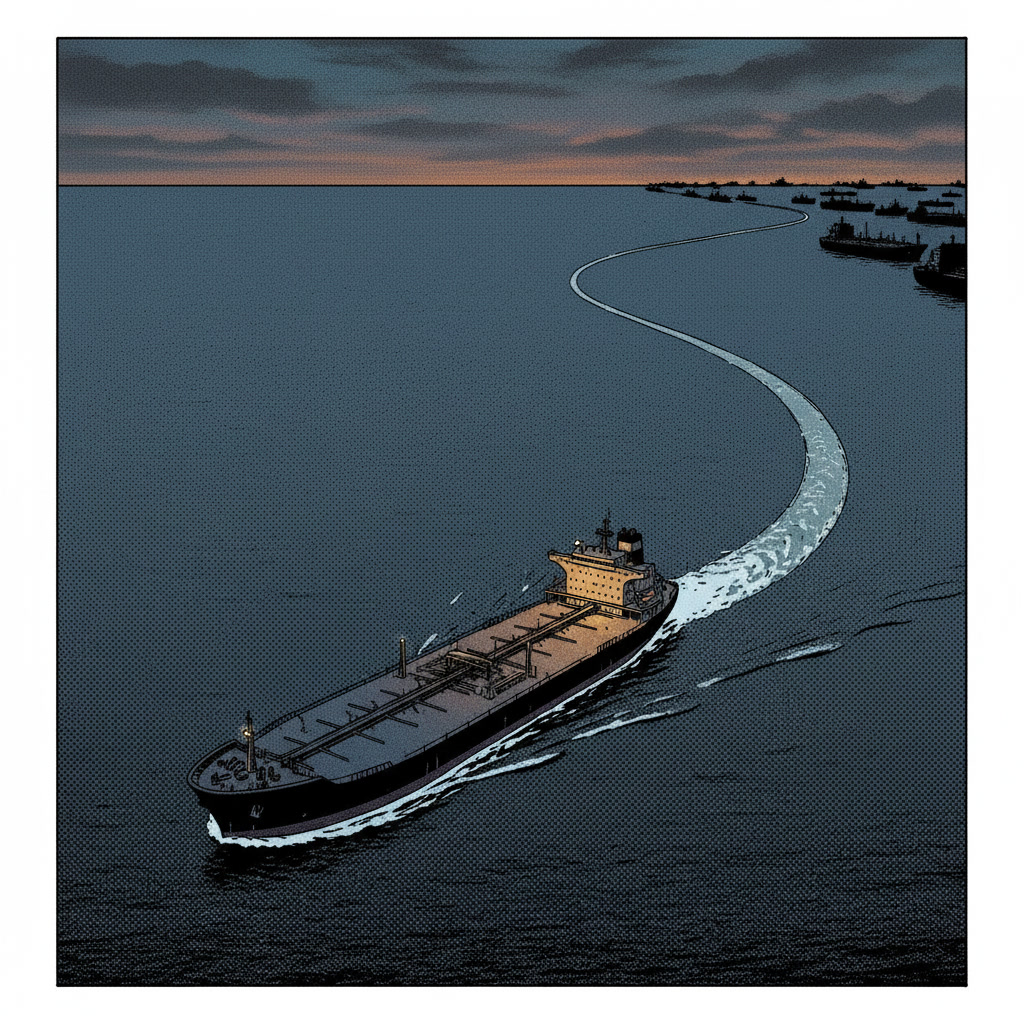
You trade fire and call it proportionate. The New York Times confirmed overnight that US and Iranian forces exchanged strikes — the precise sequencing, initiating party, and full damage assessment were still developing as of this writing, but the directional fact is not in dispute. A ceasefire exists on paper, and both sides have fired within its nominal perimeter. Bloomberg's most concrete data point is the Suez reroute: tankers that would normally transit Hormuz are now going the long way. The market voted on the ceasefire before any diplomat did.
The read here: a ceasefire that both sides are simultaneously fighting within is not a ceasefire — it is managed escalation with a legal cover layer. The historical parallel that fits is not 1988 but the Korean War's final two years, 1951 to 1953, when armistice talks at Panmunjom ran in parallel with combat operations that in some weeks killed more soldiers than the offensive phase that preceded them. Both sides had strong reasons to sit at the table; both sides had equally strong reasons to keep the other bleeding. The mechanism is the same today: Tehran needs to show domestic audiences it isn't capitulating; Washington needs to show Congress it isn't backing down. The ceasefire is the format, not the reality.
What I'd watch for next, and the falsifier: if the next 48 hours produce even a terse joint statement acknowledging the exchanges and recommitting to de-escalation mechanisms, the ceasefire structure is holding despite the fire. If instead either side publicly characterizes the exchange as the other's violation, the framework has collapsed and we are in declared mutual combat rather than managed tension. Watch the language, not the ordnance. One other flag from yesterday's brief: the IAEA (International Atomic Energy Agency) Thursday test on the Iranian uranium accounting gap is still running with one day left and no public escalation has cleared the wire. The kinetic exchanges have buried the arms-control story — which does not mean the arms-control story has gone away.
Three other things worth knowing
Belfast erupted overnight. A stabbing attack triggered a night of racially motivated riots across the city, with families evacuated and police bracing for more disorder, according to both the New York Times and the Financial Times. The FT adds the structural context: Belfast has been building toward this for months — immigration pressures, identity politics, and an environment in which ethno-nationalist grievance has found new channels since Brexit rewired the Irish border question. The read here: this is not 1969 again, but the infrastructure for communal violence in Northern Ireland has proved more durable than the architects of the Good Friday Agreement hoped.
Kazuo Ueda is in the hospital. The Bank of Japan governor's hospitalization was reported by the Financial Times without detail on condition or expected duration. Ueda has been the deliberate, slow-moving hand behind Japan's exit from two decades of near-zero rates — a policy normalization with global reach, because the yen carry trade (borrowing cheap yen to buy higher-yielding assets elsewhere) is one of the largest structural positions in currency markets, and it unwinds fast when rate expectations shift. What I'd watch for next: an emergency deputy-governor statement clarifying policy continuity would be the stabilizing read. Its absence by the Tokyo close tomorrow is the one to watch.
China's bond market is Japanifying. The Financial Times reports that every major slice of China's bond market has now replicated the structural features of Japan's market in its deflationary phase: yields compressed toward zero, domestic demand anemic, monetary policy losing traction. Japan spent the 1990s learning that a real estate and equity bust combined with aging demographics produces a type of stagnation that conventional central bank tools cannot reverse. The read here: China is at an earlier stage of the same curve. The bond market is pricing it in; Beijing hasn't said so publicly.
Echoes
The Korean armistice negotiations are the operative historical parallel for today — not because today's conflict will last two more years, but because the mechanism is identical. For 25 months, UN and North Korean-Chinese delegations sat at Panmunjom while both sides continued active combat. In some periods, the rate of killed-in-action *during* the talks exceeded the rate during the offensive phase that preceded them. The 1953 armistice came not from diplomatic breakthrough but from structural exhaustion: Eisenhower signaled nuclear threat, Stalin died, and both domestic coalitions had absorbed enough. The read here: none of those exhaustion conditions are present in the current US-Iran exchange. We are in the early innings, not the final ones.
The quiet things
Oman's position has become quietly precarious. The New York Times reports that Oman — historically the back channel for US-Iran communication, trusted by both sides for its formal neutrality — has found itself in the Trump administration's cross hairs. The read here: Oman's diplomatic value has always depended on deniability and equidistance. The moment it becomes publicly identified as having taken a side, that architecture breaks. If Oman is no longer a usable intermediary, the structural plumbing for de-escalation narrows in ways that are hard to rebuild quickly. This story is not leading. It should be on more watchlists than it is.
Ukraine's midrange logistics campaign is happening and is almost entirely buried under the Hormuz exchange. The New York Times reports that a tactical evolution in Ukrainian drone operations — targeting Russian logistics nodes at midrange rather than front-line positions — is, in the assessment of Ukrainian commanders, "really hurting" Russian sustainment. The front is not static. Adaptation continues.
How I'd act on this
If you trade energy or shipping — the Suez reroute is the live price signal. Tanker rates on the longer alternative routes and Suez transit premiums will move before most equity positions adjust. The Brent-WTI differential and insurance spreads on Persian Gulf-origin cargoes are the reads for the next 48 hours.
If you hold yen-denominated positions or assets correlated with the carry trade — the Ueda hospitalization is an unresolved variable. Watch for a Bank of Japan deputy governor clarification before tomorrow's Tokyo open. Absence of statement by then is not neutral information.
If you follow Northern Ireland or UK domestic politics — the Belfast sequence has enough structural depth that this is not a one-night story. The FT's longer piece on the preconditions for communal violence there is the useful read; those preconditions haven't been removed.
If you track the Iran nuclear file — the IAEA Thursday test from yesterday's brief is still running. One day left. The kinetic exchange has consumed the wire; the arms-control process is quieter. Those two facts don't cancel each other out — they compound.
Today gave you a shooting war inside a nominal ceasefire, a strait closed to commercial oil traffic, a central banker in a hospital, a capital in riots, and the world's second-largest economy quietly repricing itself toward deflation. On most days, any one of these would lead.
The tankers didn't wait for a press release. They rerouted through Suez.
— *The Plumb Line*. Daily world brief.
Sources
US-Iran / Hormuz / ceasefire
- newswire/nyt — "Iran War Live Updates: U.S. and Iran Trade Strikes in New Test of Cease-Fire," June 10
- newswire/bloomberg — "US & Iran Trade Strikes, Testing Ceasefire Agreement | Daybreak Europe," June 10
- newswire/bloomberg — "Suez Canal Gets Oil-Tanker Boost Amid Hormuz Strait Shutdown," June 10
- newswire/ft — "FirstFT: US and Iran trade fire after downing of American helicopter," June 10
- newswire/nyt — "Here's the latest" [live wire update], June 10
Oman
- newswire/nyt — "How Quiet Oman Landed Itself in Trump's Cross Hairs," June 10
Belfast riots
- newswire/nyt — "Night of Violence Grips Belfast After Stabbing Attack," June 10
- newswire/ft — "Belfast braced for more racially motivated riots after families evacuated," June 10
- newswire/ft — "How Northern Ireland became a breeding ground for riots," June 10
Bank of Japan / Ueda
- newswire/ft — "BoJ governor Ueda hospitalised," June 10
China bond markets
- newswire/ft — "Every slice of China's bond market has now succumbed to Japanisation," June 10
Ukraine
- newswire/nyt — "A Twist in Ukraine's Drone Campaign Is 'Really Hurting the Russians'," June 10
Historical references
- Korean War armistice negotiations, Panmunjom, July 1951–July 1953: parallel-track combat and negotiation
- Operation Earnest Will / Tanker War, 1987–1988: prior Hormuz escalation sequence (from prior brief)