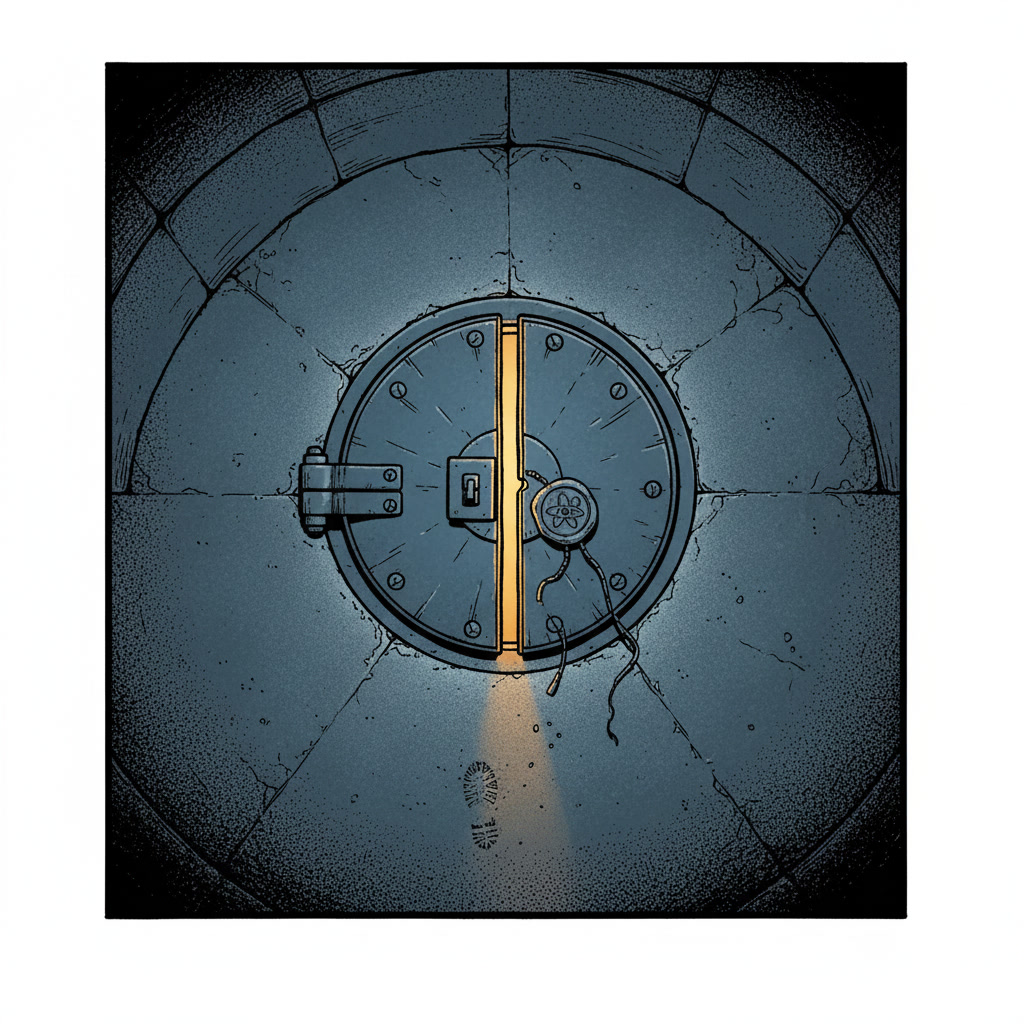
Find the Uranium.
The Plumb Line
Monday, June 8
Three things happened since yesterday's brief that you need to hold together. Israel and Iran exchanged air strikes overnight, with explosions confirmed in central Tehran and Trump calling publicly on both sides to stop. A magnitude-7.8 earthquake struck the southern Philippines, generating an aftershock sequence that is still running. And the United States is pushing for a formal international rebuke of Iran over nuclear material that has gone unaccounted for since Israel's bombing campaign against Iranian nuclear facilities began.
The read here is that the third item does not belong in the background. An air exchange between regional adversaries has a rhythm this war has now established — strikes, calls for restraint, more strikes. Uranium that cannot be independently verified does not have a rhythm. Every hour the accounting gap persists is an hour during which the material could be dispersed, moved, or placed beyond the reach of international inspection. Bloomberg's report on the US rebuke push is a formal signal that Washington believes the gap is real and closure is not assured.
Yesterday's brief called Netanyahu's resumption of the conflict a near-certainty given his political incentives. The New York Times confirmed it this morning: "Resuming War Is a Short-Term Political Boon for Netanyahu, but Grim Choices Await." The difference today is that the grim choices now include an active nuclear accountability failure running underneath the visible exchange.
Find the Uranium.
Israel and Iran traded air strikes overnight, with multiple explosions reported in central Tehran by both the Financial Times and the New York Times. Trump called publicly on both governments to stop. Neither stopped.
Here is the read. The air exchange is visible and follows an established pattern. The uranium story underneath it is not visible and follows no pattern we can rely on. Bloomberg reported that the United States is pushing for a formal international rebuke of Iran over nuclear material that has gone missing since Israel's bombing campaign against Iranian nuclear facilities began. The mechanisms for that disappearance each carry serious consequences. If the material was physically destroyed or dispersed in airstrikes, that is a contamination event — geographically bounded and slow-moving, but real. If Iran moved the material ahead of strikes and has not disclosed the new location to the International Atomic Energy Agency (IAEA), that is a safeguards breach of the most consequential kind — the kind that ends the international inspection regime's credibility for a generation. If the accounting gap reflects destroyed IAEA monitoring equipment — cameras, seals, sensors — the problem is epistemological: the agency cannot verify what it cannot see, and "we don't know" is itself a finding, not a placeholder. The historical parallel is the 2003 invasion of Iraq, when international inspectors lost physical access to declared nuclear sites during combat operations. When access resumed, physical dispersal had occurred even without a reactor event. The interim period was when second- and third-order actors moved. What I'd watch for next — the test that falsifies the severity of this situation, or confirms it: whether the IAEA requests an emergency special session by Thursday. That request would formally acknowledge that normal safeguards verification has broken down. If the agency does not escalate in that window, either the accounting gap is narrower than it appears, or there is political pressure not to formalize the crisis. Both signals are informative.
Three other things worth knowing
The Philippines took a serious hit overnight. A magnitude-7.8 earthquake struck 26 kilometers southwest of Kablalan in southern Mindanao late Sunday local time. The US Geological Survey issued an orange alert — its second-highest impact tier, indicating probable casualties in the range of 100 to 1,000 people and widespread structural damage. The aftershock sequence is still active: a M6.5 struck within 90 minutes, followed by M6.0 events and more than a dozen additional quakes through the Sarangani and Balangonan areas. The southern Philippines houses more than 25 million people; the Sarangani region has limited road infrastructure, which constrains early search-and-rescue. No confirmed casualty count had reached the wires at writing time — which more likely reflects communication disruption than a clean outcome.
Armenia voted West, and voted clearly. Yesterday's brief noted the Armenian election result had not yet surfaced in coverage, displaced by the Chornobyl strike story and the Iran aftermath. It surfaced this morning: Nikol Pashinyan won re-election, and the Financial Times' framing is precise — "Armenians back pivot from Moscow." Pashinyan's mandate is for continued EU orientation, a path he has pursued since Russia's failure to prevent the Nagorno-Karabakh catastrophe. The read here is that his win extends a defection sequence from Russia's post-Soviet periphery — Moldova toward the EU, Georgian street resistance, and now Armenia ratifying Western alignment at the ballot box — at precisely the moment Russian military capacity is under maximum strain in Ukraine. Moscow has levers in Armenia (energy prices, diaspora remittances, trade routes) and an incentive to demonstrate that pro-Western ballots have costs.
South Korean markets broke, and the AI sell-off widened it. Global equities fell Monday, led by what the Financial Times described as a market "meltdown" in Seoul. The FT separately flagged an AI sell-off spooking broader markets. The read here is that the proximate causes appear to run in parallel rather than chain from each other: South Korean equities carry heavy exposure to global export demand and Northeast Asian geopolitical risk, and the resumed Iran conflict would rationally reprice both. The AI correction may be an entirely separate valuation event — without a confirmed specific catalyst in the wires, there isn't enough to call it. What both moves together suggest is that investor risk tolerance for Asia-Pacific equities is narrowing under compounding pressures at once.
Echoes
The historical parallel for Netanyahu's current position is Ariel Sharon entering the Second Intifada in late 2000 — a leader for whom domestic political consolidation and security escalation were mutually reinforcing, at least in the short term. The Times' framing today maps almost exactly onto the analysis of Sharon's calculus at the time: short-term political boon, long-term grim choices. What broke that calculus was not a single dramatic reversal but the slow accumulation of costs the supporting coalition could no longer absorb. The question for Netanyahu's current coalition is whether the "grim choices" the Times names arrive on a timeline that creates political pressure before the next election, rather than after — and the uranium accountability thread, if it develops into a formal international crisis, is the variable most likely to compress that timeline.
The quiet things
Eight separate arms sales notifications appeared in today's Federal Register in a single batch.
The notifications don't specify recipients or materiel in their title lines, but the volume and timing fit the profile of emergency approvals signed over the weekend and publishing today. The read here is that this is circumstantial but not coincidental.
Xi Jinping's meeting with Kim Jong Un — which yesterday's brief flagged as the most underleveraged story of the week — produced a formal vow of "deeper ties" from Beijing while, Bloomberg notes, "again avoiding the nuclear issue." The word "again" is the tell. The read here is that a senior partner who cannot raise the nuclear question with his most strategically dependent client is not leading the relationship; he is performing it. Kim left Pyongyang with Xi's visible endorsement and no new constraints.
NATO jets shot down a drone that entered Latvian airspace, Bloomberg reported. The incident has not been attributed to a specific source in available reporting. Latvia borders both Russia and Belarus; a drone that entered its airspace is a test of the alliance's willingness to engage kinetically on its eastern edge. The alliance passed the test. The source question remains open.
How I'd act on this
If you cover nuclear security or nonproliferation policy — the uranium accounting story is the most consequential sentence in today's brief. Pull the IAEA's last published safeguards verification report on Iran and compare declared inventory to what inspectors last physically confirmed. The gap between "declared" and "independently verified" is where this story lives, and that gap just widened.
If you hold regional equities or energy positions — Singapore's prime minister said this morning that the full economic impact of the Middle East conflict "has yet to come." Singapore does not use that phrase as diplomatic boilerplate; it runs one of the world's critical maritime chokepoints and its leadership reads oil and shipping risk earlier than most. That statement, paired with the Seoul market movement, is a leading indicator worth pricing before it fully arrives.
If you have operational exposure in Mindanao or follow Asia-Pacific disaster response — the Philippines M7.8 will likely generate an international humanitarian assistance request within 72 hours if the USGS orange alert casualty estimate holds. Logistics will route through Davao City; air bridges from Manila are the first-response pathway. The Philippine government's disaster management agency is capable, but a M7.8 with an ongoing aftershock sequence stresses any national system.
If you track post-Soviet political dynamics — Armenia's election is the one result this week that tells you something unambiguous about the future of Russia's near-abroad. Pashinyan ran explicitly on the EU pivot and won explicitly. Moscow's response, when it comes, will tell you whether Russia still has credible leverage over neighbors who have decided to leave.
Overnight, Iran and Israel exchanged strikes, Mindanao absorbed a magnitude-7.8 earthquake, and Seoul's equity market posted its sharpest single-session drop of the year — but the thread running through all of it is a uranium inventory the IAEA cannot currently verify. The air exchange will end. The accounting gap will outlast it.
— *The Plumb Line*. Daily world brief.
Sources
Iran / Israel / uranium
- newswire/nyt — "Live Updates: Iran and Israel Trade Strikes as Trump Calls on Them to Stop," June 8
- newswire/nyt — "Resuming War Is a Short-Term Political Boon for Netanyahu, but Grim Choices Await," June 8
- newswire/ft — "Explosions heard in central Tehran as Israel and Iran trade air strikes," June 8
- newswire/bloomberg — "US Pushes Iran Rebuke Over Uranium Missing Since Bombings Began," June 8
- newswire/bloomberg — "Singapore's PM Warns Full Impact of Mideast Conflict Yet to Come," June 8
Philippines earthquake
- usgs_earthquakes/us7000srb1 — M7.8, 26 km SW of Kablalan, Philippines; orange PAGER alert; depth 55km; June 7 23:37 UTC
- usgs_earthquakes/us7000srcg — M6.5 aftershock, 19 km SW of Balangonan; June 8 00:55 UTC
- usgs_earthquakes (multiple) — ongoing aftershock sequence through Sarangani / Balangonan corridor, June 8
Armenia election
- newswire/ft — "Armenians back pivot from Moscow in Pashinyan election win," June 8
- newswire/nyt — "Nikol Pashinyan Wins Re-election in Armenia," June 8
South Korea / global markets
- newswire/ft — "Global stocks slide led by meltdown in South Korea," June 8
- newswire/ft — "FirstFT: AI sell-off spooks global markets," June 8
Xi / Kim
- newswire/bloomberg — "Xi Vows Deeper Ties With Kim While Again Avoiding Nuclear Issue," June 8
Arms sales / Federal Register
- federal_register/2026-11399 through 2026-11406 — eight Arms Sales Notifications, Defense Department Office of the Secretary, June 8
Latvia / NATO drone
- newswire/bloomberg — "Latvia Says NATO Jets Shot Down Drone That Flew Into Latvian Airspace," June 8
Historical references
- Second Intifada, September 2000: Ariel Sharon's political-escalation calculus and its eventual limits
- Iraq WMD inspection period, March–April 2003: IAEA and UNMOVIC access disruption during combat operations; post-conflict material dispersal findings