1986. Russia Just Hit Chernobyl Again.
The Plumb Line
Sunday, June 7
The story everyone is tracking today is the Iran aftermath — the inflation read, the diplomatic fallout, Washington's conspicuous silence after missiles fell on Bahrain and Kuwait. But three things happened overnight that the Iran frame is actively obscuring.
A Russian drone struck a nuclear fuel storage facility near Chornobyl — the site of the 1986 reactor explosion that remains history's worst nuclear disaster. Xi Jinping flew to Pyongyang to meet Kim Jong Un, a visit Bloomberg characterized explicitly as an attempt to "reassert influence over an emboldened Kim." And a multi-state flood emergency is unfolding across the central United States, with 25 simultaneous federal weather alerts spanning from Dallas and Fort Worth through Oklahoma, Kansas, Missouri, Indiana, Iowa, and Illinois — a slow-moving storm system that has put river basins from the Arkansas to the Missouri into active flood warning.
The Chornobyl strike is the story that demands the most attention this morning. Yesterday's brief found that the kinetic track in Ukraine is now dominant after Putin's formal rejection of Zelenskyy's peace overture. Today we know what dominant means in practice: Russia is targeting nuclear infrastructure in territory it previously occupied, at a site with global symbolic weight and with actual nuclear fuel stored on-site.
1986. Russia Just Hit Chernobyl Again.
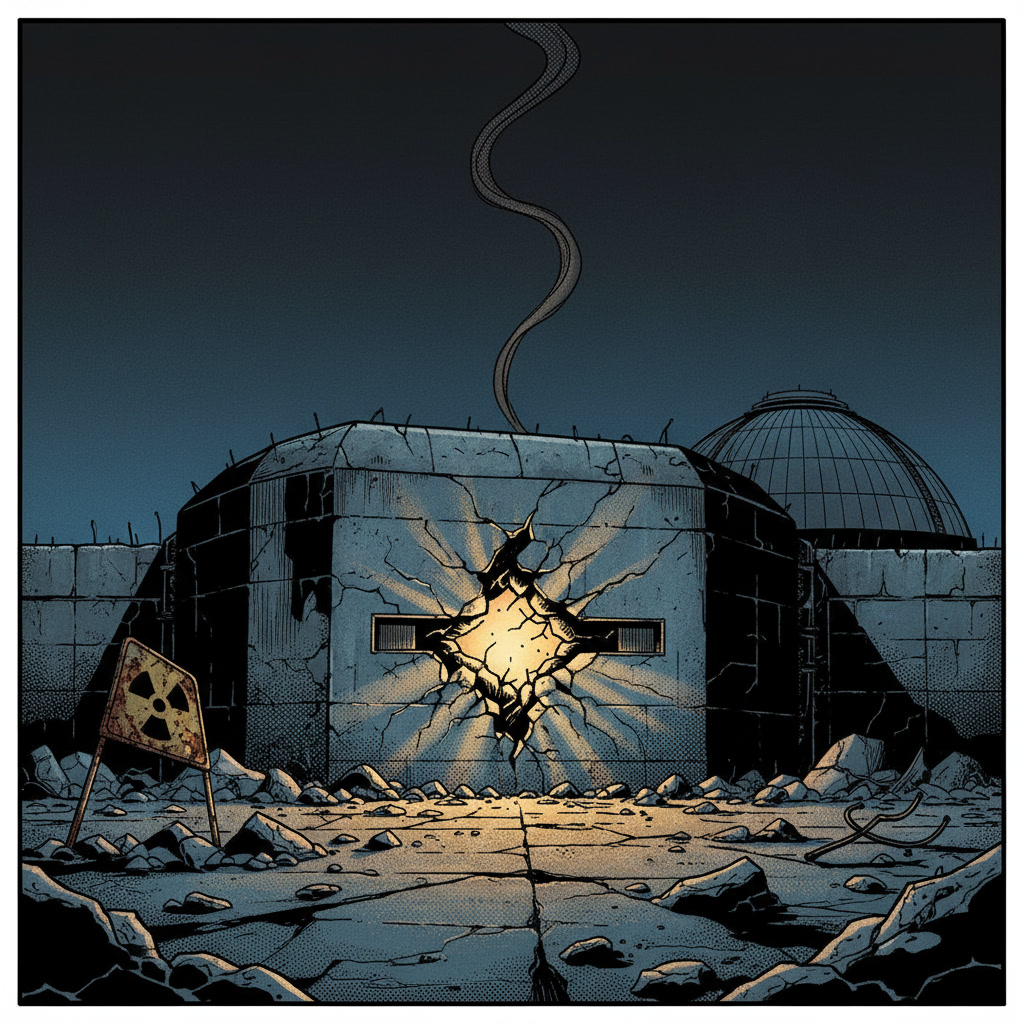
A Russian drone struck a nuclear fuel storage facility near Chornobyl overnight, confirmed by both Bloomberg and the Financial Times. Ukrainian authorities disclosed the strike publicly and immediately. The facility sits within the exclusion zone established after the 1986 reactor explosion — the same zone Russia seized during the opening days of its 2022 invasion before withdrawing under pressure. Spent and active nuclear fuel rods are stored at the site.
The read here is that the instinct will be to wait for IAEA (International Atomic Energy Agency) confirmation before calibrating the response — and that's correct as a matter of radiation assessment, but it misses what happened regardless of the contamination outcome. Russia deliberately struck a facility holding nuclear material at a site the entire world knows for a nuclear catastrophe. The historical parallel is not another nuclear incident; it is the 1991 Iraqi Scud campaign against Israel — strikes designed not primarily for military effect but to force an international response, to widen the conflict's frame, and to demonstrate that no target is categorically off-limits. Russia appears to be sending the same message with considerably higher physical stakes.
What to watch for next: IAEA statements in the next 24 hours are the primary signal. If the agency confirms radiation release above background levels, this triggers reporting obligations under the 1986 Vienna Convention on Early Notification of a Nuclear Accident — an international emergency mechanism. If IAEA says containment held, the diplomatic consequence is still severe, but the physical stakes are lower. The falsifier for the "deliberate nuclear escalation" read: if Ukrainian authorities cannot produce evidence of a direct strike on containment structures — as opposed to peripheral buildings within the zone — yesterday's attack may have been designed for maximum psychological impact with minimum actual nuclear risk. Russia has done this before. But the difference between "designed for psychological impact" and "catastrophically miscalculated" is not one you can verify in advance.
Three other things worth knowing
Xi in Pyongyang is a signal of leverage lost. Bloomberg reported that Xi Jinping has arrived in North Korea for meetings with Kim Jong Un — a visit framed by Beijing as a friendship call and by Bloomberg as an effort to "reassert influence over an emboldened Kim." The diplomatic tell is in that word: you do not reassert influence you already hold. North Korea has spent the last 18 months supplying Russia with artillery shells and ballistic missiles, earning hard currency and real battlefield data without asking Beijing's permission first. The read here is that Xi's trip signals China's most important strategic client is no longer behaving as a client — and that Beijing is now trying to reclaim the relationship before Kim decides he has outgrown the need for it. For anyone tracking the Taiwan contingency or the US-South Korea alliance, this is the week's most consequential diplomatic movement.
Pakistan is running a mediation track between Iran and Washington. Anadolu Agency reported that Pakistan's interior minister met Iran's foreign minister in Tehran explicitly amid mediation efforts — the first named intermediary to surface since Iran struck Bahrain and Kuwait on Saturday. Pakistan has standing to run this channel: it has hosted US-Taliban negotiations, back-channel Saudi-Iran conversations, and maintains intelligence relationships with both Washington and Tehran. The read here is not that the channel will succeed, but that its existence suggests neither the United States nor Iran wants Saturday's strikes to become a sustained military exchange. Mediation tracks run alongside escalation; they do not pause it. What I'd watch for next is whether a second Iranian strike wave materializes before the week is out.
Central US flooding will become a federal cost story by midweek. Twenty-five simultaneous weather alerts are active across the central United States — flash flood warnings in Dallas and Fort Worth, multi-day river flood warnings along the Missouri corridor covering Carroll, Chariton, Linn, and Livingston counties in Missouri, and flood watches blanketing most of Oklahoma, southern Kansas, and extending into Indiana, Iowa, and Illinois. The storm system is slow-moving over already-saturated soil. The read here on infrastructure: prolonged river flooding stresses bridges, rural roads, and water treatment in ways that produce FEMA (Federal Emergency Management Agency) major disaster declarations — and the associated federal cost calculations — within a week of peak inundation. This event is large enough to clear that threshold.
Echoes
Forty years after the Chornobyl reactor exploded, the Soviet Union's first instinct was to suppress the information — delayed evacuation, delayed international notification, delayed acknowledgment. That information failure compounded the physical disaster and became the second, slower catastrophe. Ukraine today is doing the opposite: immediate public disclosure, immediate IAEA notification. That transparency is itself a lesson absorbed from the original event, and it is the correct response under the Vienna Convention that the disaster produced. The open question is whether the physical damage is as serious as the information suggests, or whether Russia calculated that striking near the site — rather than at containment — would produce maximum psychological effect with managed physical risk. Russia's troops dug trenches in contaminated soil during the 2022 occupation without radiation protection. The read here is that this suggests either profound ignorance of the site's nuclear significance or profound indifference to it. Neither interpretation should be reassuring.
The quiet things
Yesterday's brief promised an Armenian election result by this morning. It has not surfaced in today's coverage. If Nikol Pashinyan won under the information-warfare conditions we described Saturday, the international wire isn't covering it — which is exactly what we said would happen. The Iran and Chornobyl stories are consuming all available bandwidth. The result and its significance will need a dedicated read when it surfaces.
Trump told reporters that Iran has made a "big" nuclear promise. The New York Times reported this morning that the promise is not new — it echoes language Iran has used in prior diplomatic rounds without altering its actual enrichment posture. The read here is that the gap between the president's characterization and the underlying diplomatic record is consequential: if the negotiating track collapses publicly, the framing of Saturday's Gulf strikes shifts from "coercive bargaining" to "opening phase of a campaign." What I'd watch for next is how the State Department characterizes the Iranian posture in briefings this week.
The Ebola story, which this brief has tracked for the past several days, has two new developments today: CBC reported that US aid cuts have materially slowed containment efforts in central Africa, and the US government has unveiled a new Ebola response strategy, partly in response to a Kenyan court blocking construction of a quarantine facility in Laikipia. The outbreak's geographic spread — now explicitly framing Uganda, Tanzania, and Kenya alongside the Democratic Republic of Congo — has not slowed. The response architecture has.
How I'd act on this
If you track nuclear security or work at an organization with interests in nonproliferation — the IAEA's next public statement on Chornobyl is the read. Watch for whether it characterizes the damage as affecting containment structures or peripheral buildings within the exclusion zone. The agency's language will be deliberately calibrated, and the distinction matters.
If you hold energy positions or trade in markets exposed to the Gulf — Pakistan's mediation track is a meaningful signal that an off-ramp is being sought. The FT is already asking how high the Iran war will push US inflation; British Airways' chief told reporters separately that fuel costs will keep fares elevated. The mediation track does not guarantee de-escalation, but its existence argues against pricing in a full sustained campaign.
If you cover European politics — Germany's neo-Nazi party reaching a mayoral runoff is a local story with a national calculus. How mainstream parties choose to handle the runoff without amplifying the candidate will be watched closely in Austria, France, and the Netherlands for a template.
If you follow China-Northeast Asia dynamics — Xi's Pyongyang visit is the most underleveraged story of the week. A China that has to fly to its own client state to reclaim influence is a China whose deterrence posture over Kim is visibly weakening. The downstream implications for US-South Korea security coordination and for Taiwan contingency planning are significant and will develop slowly.
Russia targeted nuclear fuel near the site of history's worst reactor disaster, and the IAEA's next statement will tell us whether this was reckless provocation or something considerably worse.
Forty years after the disaster, Russia turned the exclusion zone into a target.
— *The Plumb Line*. Daily world brief.
Sources
Ukraine / Russia / Chornobyl strike
- newswire/ft — "Russian drone hits nuclear fuel site near Chornobyl," June 7
- newswire/bloomberg — "Ukraine Says Drone Hit Nuclear Fuel Facility Near Chernobyl," June 7
Iran / mediation / inflation
- newswire/ft — "How high will the Iran war push US inflation?" June 7
- [gdelt/aa.com.tr (Anadolu Agency)](https://aa.com.tr (Anadolu Agency)) — "Pakistani interior minister meets Iran's top diplomat in Tehran amid mediation efforts," June 7
- newswire/nyt — "Trump Says Iran Has Made a 'Big' Nuclear Promise. It Isn't New." June 7
- newswire/ft — "British Airways chief says air fares will rise again if fuel costs stay high," June 7
Xi / North Korea
- newswire/bloomberg — "Xi Visits North Korea to Reassert Influence Over Emboldened Kim," June 7
US flooding
- noaa_alerts — 25 simultaneous weather alerts across TX, OK, KS, MO, IN, IA, IL, MS; June 6–7
Germany
- newswire/nyt — "Member of Neo-Nazi Party Reaches Mayoral Runoff in German Town," June 7
Ebola
- gdelt/cbc.ca — "Aid cuts have slowed fight to contain Ebola in central Africa, doctors say," June 7
- gdelt/kenyan-post.com — "US unveils new Ebola response strategy after Kenyan High Court suspends quarantine facility construction," June 7
Historical references
- Chernobyl nuclear disaster, April 26, 1986: Soviet reactor explosion; Soviet information suppression compounded disaster
- Russia's 2022 Chornobyl zone occupation, February–March 2022: troops reported digging trenches in contaminated soil without radiation protection; withdrew under international pressure
- Vienna Convention on Early Notification of a Nuclear Accident, 1986: international reporting obligations triggered by radiation release
- Iraq Scud campaign, January–February 1991: strikes on non-belligerents designed to widen conflict frame and force side-taking