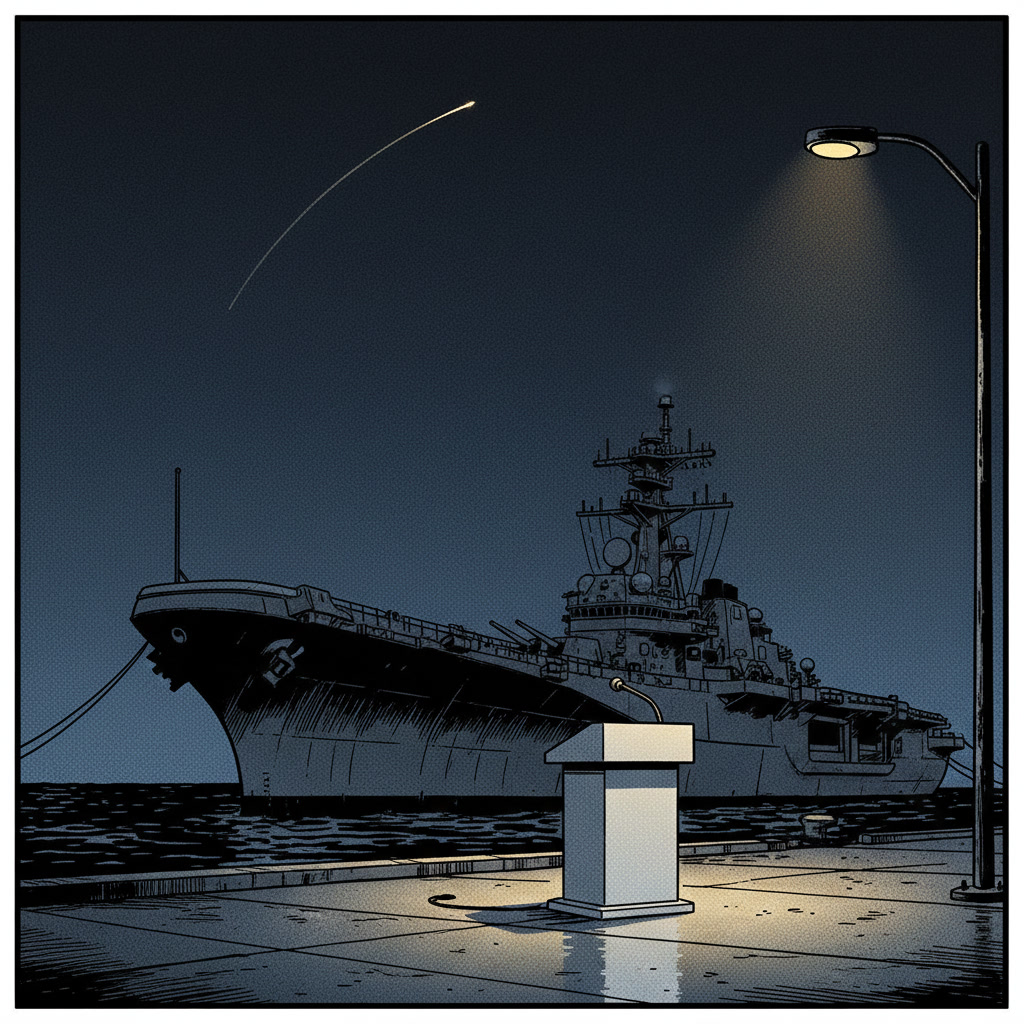
Eighty-Two Years On. Iran Fires at Arab Neighbors.
The Plumb Line
Saturday, June 6
Three things happened overnight that the wire will spend the next week processing. Iran launched missiles and drones toward Gulf Arab states — air raid sirens sounded in Bahrain, Kuwait briefly suspended air traffic before clearing it after Iranian attacks. Ukrainian drones hit St. Petersburg, Russia's second city, after Vladimir Putin formally refused Zelenskyy's peace overture. And today is June 6: the 82nd anniversary of D-Day, with commemorations beginning in Normandy as these fires spread across two other theaters.
The read here: these three events are not confusion but a new and specific configuration. The war in Europe has crossed a threshold — strikes on St. Petersburg are not the same category as strikes on Kherson or Kharkiv. The confrontation in the Middle East has crossed a different one: Iran is no longer acting through Houthi proxies in Yemen or Hezbollah in Lebanon; it is firing directly at Arab neighbors who host American military infrastructure. And the Western alliance is gathering at Normandy on an anniversary that is doing double work today — commemorating the last decisive democratic coalition and implicitly auditing whether that capacity still exists.
Yesterday's brief set a specific falsifier: if Russia responded to Zelenskyy's peace letter with anything other than silence or dismissal within 72 hours, the diplomatic track had genuine momentum. Putin answered faster than the window allowed — not with talks, but with formal refusal. Ukraine's response was St. Petersburg. The read: the kinetic track is dominant.
Eighty-Two Years On. Iran Fires at Arab Neighbors.
Iran launched missiles and drones toward Gulf Arab states overnight. Air raid sirens sounded in Bahrain. Kuwait briefly suspended air traffic following Iranian attacks before restoring normal operations. The Supreme Leader's advisor told the press that "Trump must break the negotiation deadlock" — a line that reads simultaneously as a message toward Washington and a public rationale for the military escalation.
The read here. Iran directly firing on Bahrain and Kuwait is not the same category as proxy strikes through Houthi forces in Yemen or Hezbollah in Lebanon. This is a sovereign state launching munitions at Arab neighbors who host American military infrastructure — the US Fifth Fleet is based in Manama, Bahrain. The historical parallel that fits is Iraq's 1991 Scud campaign against Saudi Arabia and Israel during the Gulf War: a party under pressure used missile strikes against non-belligerents to widen the conflict, force other actors to declare sides, and complicate the coalition arrayed against it. Iran is not trying to defeat Bahrain militarily. It is forcing every actor in the region — Saudi Arabia, the UAE, Jordan, Egypt — to declare whether this is their war. Washington's response in the next 24 hours, or the absence of one, is the most consequential variable in this picture.
What I'd watch for next: if Saudi Arabia's air defense systems engage Iranian projectiles, or if the GCC (Gulf Cooperation Council) issues a collective condemnation naming Iran as the aggressor, this has formally become a multi-state conflict. If Washington announces a posture change for its forces in Bahrain, the escalation ladder has gained a new rung. The falsifier running in the other direction: if Iran issues no second strike wave within 48 hours and signals through back channels that the strikes were coercive rather than the opening of a sustained campaign, this follows the 2019 Abqaiq pattern — a sharp shock designed to be absorbed, not escalated. You will know which read is right by Monday.
Three other things worth knowing
Ukraine struck St. Petersburg after Putin rejected talks. Bloomberg reported that Ukrainian drones targeted St. Petersburg — Russia's second city and cultural capital — hours after Putin formally refused to engage with Zelenskyy's peace overture. A separate Anadolu Agency report confirmed a fire at an oil depot in a southern Russian city from another Ukrainian drone strike. Zelenskyy's peace letter, which yesterday's brief read as strategic positioning aimed at Western audiences as much as Moscow, produced a documented answer: Putin said no, and Kyiv hit closer to Moscow's identity than it ever has before.
The Ebola story has moved geographically. Yesterday's brief flagged the Ebola outbreak as at risk of disappearing from the diplomatic agenda while Iran and Lebanon consumed bandwidth. Today the New York Times is framing the crisis explicitly as an East Africa story — a shift from the earlier Congo-centered coverage that implicates Uganda, Tanzania, and Kenya in ways the DRC (Democratic Republic of the Congo) frame did not. A separate NYT piece asks whether China will step up to fund containment — the first time Beijing's role has been explicitly named in the public record. The policy gap persists; the journalism is getting sharper and is now asking harder questions.
Mali's rebel alliance has seized key cities. The New York Times reported that a rebel coalition has captured several major urban centers, operating against both the military junta and jihadist forces from JNIM (Jama'at Nusrat al-Islam wal-Muslimin, the Sahel's dominant al-Qaeda affiliate). Mali's military government has been aligned with Russian Wagner Group forces since 2021; the rebel advance raises a direct question about whether Wagner's operational presence can hold the territory it was contracted to defend. The Sahel is not on most morning briefings today. The read: by next week it may be unavoidable.
Echoes
June 6 carries its own echo today, and it lands differently than it usually does. Eighty-two years ago, Allied forces landed at Normandy to open a second front against a power that had made itself dominant on the European continent — the culmination of two years of coalition-building, industrial mobilization, and coordinated strategy. Today, commemorations begin at those beaches while Ukraine strikes Russia's cultural capital and Iran fires on Arab states hosting American military bases. The read here: the structural contrast is not accidental. D-Day represented the maximum expression of democratic coalition capacity — unified command, shared sacrifice, a defined objective. What is being attempted today — containing Russia through Ukrainian capacity, managing Iranian escalation through negotiation, policing the Sahel through partnerships with juntas — is the opposite architecture. The anniversary raises an honest question about whether the institutional stamina exists for the longer, costlier, less legible version.
The historical parallel that fits the Iran picture more closely is the 1984–1988 Tanker War, when Iran struck commercial shipping in the Persian Gulf and eventually targeted Kuwaiti tankers specifically. Kuwait's request for American naval protection — and the subsequent reflagging of Kuwaiti tankers under US colors in 1987 — was the moment Washington became a de facto belligerent in the Iran-Iraq War. The mechanism then: Iran calculated it could pressure Kuwait into neutrality by raising the cost of Gulf commerce. The mechanism today may be the same logic applied to political calculation rather than shipping lanes. What I'd watch for next week: whether Washington re-runs some version of the 1987 reflagging decision.
The quiet things
Armenia voted today. Saturday's election — which yesterday's brief called one of the most consequential votes in the post-Soviet space in years — is taking place as the Iran and Ukraine stories consume the international wire. Prime Minister Nikol Pashinyan is running against a Kremlin-aligned opposition with Russian disinformation active in the information environment. Results are not yet in as of this morning. The read here: if Pashinyan wins despite the noise, it is a meaningful data point about the ceiling of Russian election interference when an electorate has direct recent experience of what Moscow's preferences cost. If he loses, the coverage will be thin — the wire is on Iran all day — and the significance will be underweighted for at least 48 hours.
The US response to Iranian attacks on Bahrain and Kuwait is conspicuously absent as of this morning. No White House statement, no Fifth Fleet posture announcement, no named American official on the record. That silence in a 12-hour window following missile strikes on a country hosting roughly 6,000 US military personnel is itself a signal. The read: either the administration is in active back-channel contact with Tehran and does not want to escalate publicly, or it is caught between its Iran negotiating track and its Gulf partner commitments — two positions that, today, are pointed in opposite directions.
How I'd act on this
If you trade energy or hold positions tied to Persian Gulf shipping — the Iranian strikes at Bahrain and Kuwait are the data point that turns the Strait of Hormuz conversation from abstract to operational. Tanker insurance rates and Brent-versus-WTI spreads are the instruments to watch before Monday's open.
If you cover US foreign policy or the Gulf security architecture — the absence of a public American statement after attacks on a country hosting the Fifth Fleet is the story. Not the missiles; the silence.
If you follow the Sahel — the Mali rebel advance deserves a read before it resolves badly. Wagner's operational posture is being tested against a capable coalition in real time, and the outcome will shape French, EU, and African Union policy options for the rest of the year.
If you track the Armenia election — results come later today. A Pashinyan win under these information-warfare conditions would be the year's most underreported signal of Russian influence's limits. A loss would be its quietest victory.
If you hold European pharmaceutical exposure — the AstraZeneca chief's threat to withhold new drugs from European markets, reported by the Financial Times this morning, is the kind of pricing-and-access escalation that moves slowly and then all at once. It has direct precursors in COVID vaccine sequencing and in insulin access disputes in the United States; it carries the same multi-year litigation tail.
D-Day at eighty-two is not just a commemoration — it is an accidental audit of coalition capacity, taken at the moment three separate fires are burning on two continents with no coordinated response visible.
Iran fired at Bahrain on the anniversary of the Normandy landings, and Washington has not yet spoken.
— *The Plumb Line*. Daily world brief.
Sources
Iran / Gulf strikes
- gdelt/abcnews.com — "Air raid sirens in Bahrain as Iranian missiles and drones head for Gulf neighbors," June 6
- gdelt/mynorthwest.com — "Air raid sirens in Bahrain as Iranian missiles and drones head for Gulf neighbors," June 6
- [gdelt/aa.com.tr (Anadolu Agency)](https://aa.com.tr (Anadolu Agency)) — "Air traffic resumes in Kuwait following brief suspension over Iranian attacks," June 6
- gdelt/theshillongtimes.com — "Trump must break negotiation deadlock, says Iranian Supreme Leader advisor," June 6
Ukraine / Russia
- newswire/bloomberg — "Ukrainian Drones Target St. Petersburg After Putin Refuses Talks," June 6
- gdelt/aa.com.tr — "Fire breaks out at oil depot in southern Russian city following Ukrainian drone attack," June 6
D-Day anniversary
- gdelt/wirralglobe.co.uk, eveningnews24.co.uk, guardian-series.co.uk, andoveradvertiser.co.uk, eadt.co.uk — "Commemorations to mark 82nd anniversary of D-Day in Normandy begin," June 6
Ebola
- newswire/nyt — "What to Know About the Ebola Outbreak," June 6
- newswire/nyt — "As Ebola Spreads in East Africa, Will China Step Up?" June 6
- newswire/nyt — "The World Has Learned From the Last Ebola Outbreak, but Gaps Remain," June 6
Mali
- newswire/nyt — "Mali Conflict Escalates as Rebel Alliance Seizes Key Cities," June 6
Armenia
- gdelt/dailygazette.com, gdelt/clickondetroit.com — "Armenia prepares for an election that could reshape ties with Moscow and the West," June 6
AstraZeneca
- newswire/ft — "AstraZeneca chief warns group could withhold new drugs in Europe," June 6
Historical references
- Iraq Scud missile campaign, January 1991: strikes against Saudi Arabia and Israel designed to fragment the coalition and force side-taking among non-belligerents
- Persian Gulf Tanker War, 1984–1988: Iranian strikes on Kuwaiti shipping; US reflagging operation, 1987; mechanism of coercive neutrality-pressure
- Operation Overlord, June 6, 1944: referenced for coalition capacity contrast