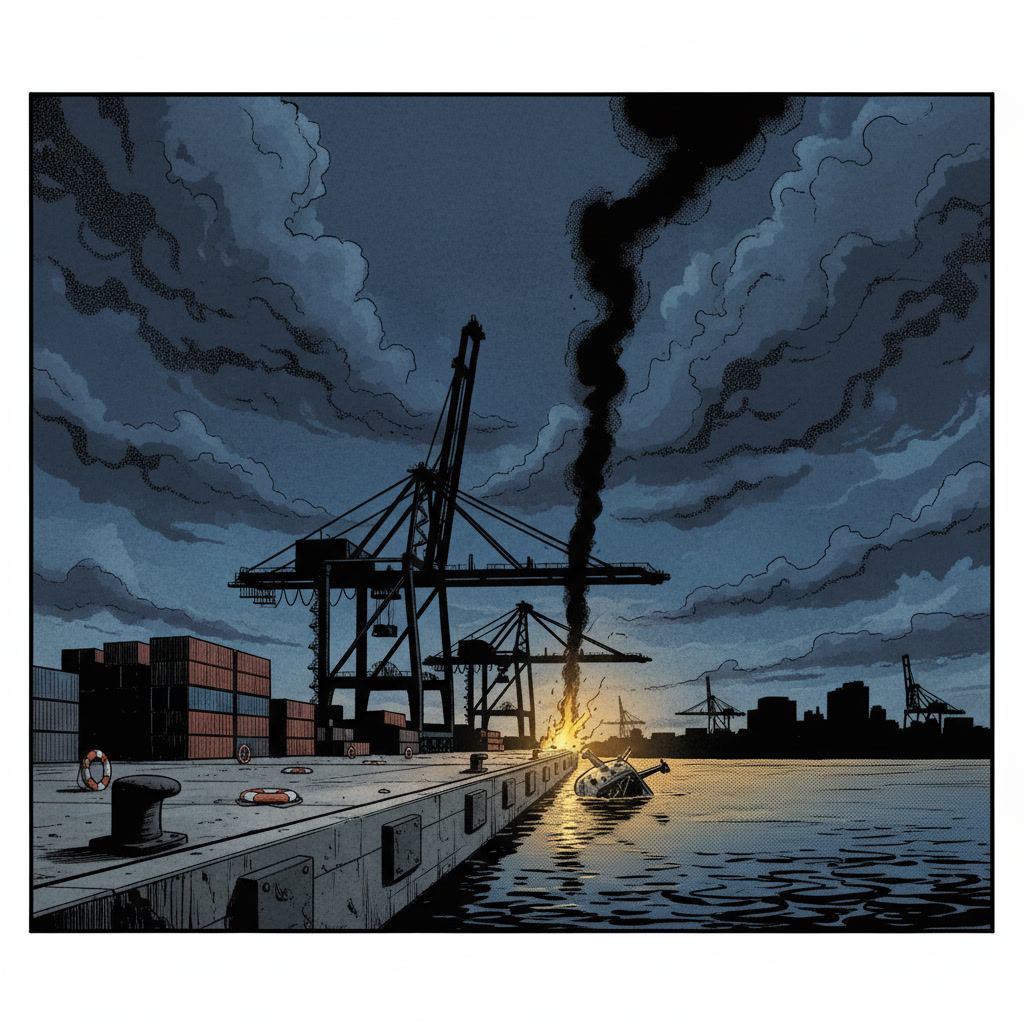
Peace Talks and Drone Strikes. Watch the Black Sea.
The Plumb Line
Friday, June 5
What does it mean when five Azerbaijani citizens are killed by drone strikes in the Sea of Azov, Romania evacuates a Black Sea port after a marine drone explosion, and the UK, France, and Germany simultaneously announce a meeting with Zelenskyy on peace talks — all before noon on the same day? The read here: the war in Ukraine has stopped being a land story and become a maritime and diplomatic story simultaneously, and the two tracks are moving in opposite directions at speed.
The peace-talks headline is real: Bloomberg confirmed that leaders from London, Paris, and Berlin will meet Zelenskyy to discuss a negotiated framework. Zelenskyy himself published an open letter to Putin mixing taunts with a formal offer of direct talks — a document unusual enough in its tone that it deserves to be read as an act of strategic communication aimed at Western audiences as much as Moscow. At the same time, Azerbaijan's government announced that drone strikes in the Sea of Azov killed five of its nationals, and Romania evacuated the Black Sea port of Constanța after a marine drone detonated in the harbor. The read here: these are not coincidental clusters. The war's kinetic perimeter is expanding precisely when its diplomatic perimeter is also, unusually, opening.
There is more to track today. The U.S. Senate passed a $70 billion immigration enforcement bill — the largest single-year appropriation for Immigration and Customs Enforcement (ICE) in American history. China launched ten new Qianfan broadband satellites this morning on a Long March 8 rocket from Wenchang, adding to a low-Earth-orbit constellation that is now accumulating faster than Starlink did at the equivalent stage of its buildout. And the Ebola story in eastern Congo, which yesterday's brief flagged as at risk of disappearing from the diplomatic agenda, has now produced a second major New York Times report — this one on how gold mining is driving the outbreak's spread. The journalism remains ahead of the policy.
Peace Talks and Drone Strikes. Watch the Black Sea.
Zelenskyy's open letter to Putin, published overnight, offered direct talks while simultaneously cataloguing Russian war crimes — an unusual rhetorical combination that Bloomberg described as mixing "taunts and peace talks." The same morning, Bloomberg confirmed that the leaders of the United Kingdom, France, and Germany will travel to meet Zelenskyy to discuss a negotiated framework. No date was specified and no Russian response has been reported.
Here's the read. The diplomatic track and the kinetic track are not contradictions — they are, historically, the expected configuration of a war moving toward its negotiating phase. The historical parallel is the autumn of 1918 on the Western Front: Germany sought armistice talks while its forces were still conducting tactical withdrawals, and the Allies intensified pressure precisely because they understood that a negotiating adversary is not yet a defeated one. The mechanism here is the same. Zelenskyy's letter is a bid to control the narrative of who offered talks first — essential political positioning for any eventual settlement, and essential leverage over Western partners who want an off-ramp. The European leaders' visit signals that London, Paris, and Berlin are not waiting for Washington to set the pace, which is itself a change from the first three years of the war.
What I'd watch for next: if Russia responds to Zelenskyy's letter with anything other than silence or dismissal within 72 hours, the diplomatic track has acquired genuine momentum. If Russia stays silent and the drone strikes on Azerbaijani nationals go unattributed — Azerbaijan has not said who fired — the kinetic track is still dominant and the peace talks are positioning, not process. The Romania port evacuation is the detail worth holding: Constanța is NATO territory, and a marine drone detonation there is a different category of event than a strike in contested waters.
Three other things worth knowing
The U.S. Senate passed a $70 billion bill funding immigration enforcement. Bloomberg confirmed the passage, noting the bill avoided placing limits on the Trump administration's settlement fund — a provision that had been the primary sticking point for months. Seventy billion dollars for a single enforcement agency in a single fiscal year has no modern precedent; the prior record annual appropriation for ICE was roughly $8 billion. The read here: this is not an enforcement budget, it is an enforcement infrastructure investment, and the institutions being built with it will outlast any single administration.
China's Qianfan constellation added ten more satellites this morning. The Long March 8 rocket carrying the SpaceSail Polar Group 12 payload launched successfully from Wenchang at 6:34 a.m. UTC, and the new satellites have been cataloged by U.S. Space Command. Yesterday's brief noted the Qianfan buildout was accelerating; today's launch confirms the pace. The constellation now has enough cataloged objects to begin meaningful beta service in polar orbits — coverage geometries that are specifically valuable for maritime surveillance and high-latitude communications, including in the Arctic. The read here: that is not an accident of orbital mechanics.
Armenia's election is tomorrow, and Russia is flooding the zone. The New York Times published a detailed report on Russian disinformation operations targeting Armenian voters ahead of Saturday's vote. Prime Minister Nikol Pashinyan — who has pivoted Armenia toward the West and away from Moscow since 2022 — is running for his political life against a Kremlin-aligned opposition. The NYT separately reported that Trump has backed Pashinyan. The read here: a Pashinyan loss on Saturday would be Moscow's most significant political gain in the South Caucasus since the 2020 Nagorno-Karabakh war, achieved without a single Russian soldier crossing a border.
Echoes
The Black Sea drone picture has a specific historical echo that is worth naming. In the First World War, the Black Sea was the theater where Ottoman and German naval forces used mine warfare and submarine operations to constrain Russian supply lines — eventually contributing to the collapse of Russian logistics to the Caucasus front. The mechanism was not decisive military victory; it was persistent, low-cost attrition of a geography that everyone nominally respected as contested. Today's marine drone detonation at Constanța rhymes with that pattern. The Black Sea is not a symmetrical theater: NATO controls its western shore, Ukraine holds significant naval access from the north, and Russia is operating from Crimea under persistent Ukrainian pressure. The read here: the consistent expansion of drone and mine warfare into ports and shipping lanes — including ports on NATO member soil — is the slow redistribution of risk that changes political calculations before it changes military ones.
The quiet things
Yesterday's brief called the Ebola outbreak in Congo a story at risk of disappearing while senior diplomats were consumed by Gulf and Lebanon. Today the New York Times published two pieces — one on how gold mining is driving the spread, and an accompanying video — that represent some of the most substantive coverage of the outbreak to date. The journalism has not gone quiet. What remains quiet is the policy. No updated containment posture from Washington, the African Union, or the World Health Organization has appeared since the original declaration. The read here: when the narrative infrastructure exists but the policy response doesn't, outbreaks accelerate into the gap. This is the story to watch for the next two weeks if Iran, Ukraine, and Armenia consume the diplomatic bandwidth.
The U.S.-Iran nuclear talks are also worth flagging as a notable quiet. Bloomberg reported this morning that talks are showing "little progress" after a week of clashes, and that Hezbollah has formally rejected a truce. Yesterday's brief set a falsifier: if Iran publicly endorsed the Lebanon ceasefire and signaled willingness to return to the negotiating table within 72 hours, Washington's gambit was working. Seventy-two hours have not yet elapsed, but the Hezbollah rejection of a truce and the "little progress" language from Bloomberg are not encouraging signs for that thesis.
How I'd act on this
If you follow European security or NATO affairs — the Romania port evacuation is the data point most likely to be underweighted today relative to the peace-talks headline. The read here: a marine drone detonating at Constanța activates Article 3 conversations in NATO, even if no one says so publicly yet. Watch whether Bucharest requests a NATO consultation.
If you track the Armenia vote — Saturday's result is one of the most consequential elections in the post-Soviet space in years, and it will get roughly one news cycle of coverage before the Ukraine and Iran stories reassert. If Pashinyan loses, block time to understand what it means for Georgia, Azerbaijan's alignment calculus, and the southern flank of the Black Sea picture.
If you cover immigration or federal spending — the $70 billion ICE appropriation deserves a longer look than one news cycle. The prior high-water mark was roughly $8 billion annually. The read here: the institutional infrastructure that gets built with twelve times that figure does not get dismantled in a budget negotiation.
If you invest in satellite communications or track the space economy — the Qianfan polar launch this morning is the read. Polar orbit coverage is the commercially valuable coverage geometry that Starlink has been slower to develop. China now has a direct competitive track to beat SpaceX to meaningful high-latitude broadband, and it launched ten more satellites while everyone was reading the Ukraine peace letter.
Google Chrome users should update their browser today — Google released version 149.0.7827.53 overnight, patching two browser-escape vulnerabilities serious enough to earn the top severity rating. The update is in the standard auto-update channel; the action is just to restart your browser.
Zelenskyy mailed Putin a peace offer and a marine drone detonated in a NATO harbor before lunch. Constanța is the line to watch — not the letter.
— *The Plumb Line*. Daily world brief.
Sources
Ukraine / peace talks / Black Sea
- newswire/bloomberg — "UK, France and Germany to Meet Zelenskyy on Peace Talks," June 5
- newswire/bloomberg — "Zelenskyy Proposes Peace Talks in Open Letter to Putin" (video), June 5
- newswire/nyt — "Zelensky Mixes Taunts and Peace Talks Offer in Letter to Putin," June 5
- newswire/bloomberg — "Romania Evacuates Black Sea Port After Marine Drone Explosion," June 5
- newswire/bloomberg — "Azerbaijan Says Drone Strikes Kill Five Nationals in Sea of Azov," June 5
- newswire/nyt — "House Passes Ukraine Aid in Defiance of Republican Leaders," June 5
U.S.-Iran talks
- newswire/bloomberg — "US and Iran Show Little Progress in Talks After Week of Clashes," June 5
- newswire/bloomberg — "US-Iran Talks at a Standstill as Hezbollah Rejects Truce" (video), June 5
- newswire/bloomberg — "The Key Sticking Points for a US-Iran Peace Deal," June 5
- gdelt/nuclear-news.net — "Iran Suspends U.S. Talks as Israel Kills 8 More in Lebanon," June 5
U.S. Senate / immigration
- newswire/bloomberg — "Senate Passes Immigration Bill, Avoids Axing Weaponization Fund," June 5
- gdelt/krwg.org — "Senate passes $70B immigration enforcement bill," June 5
Armenia election
- newswire/nyt — "Backed by Trump, Opposed by Putin, and Fighting for His Political Life," June 5
- newswire/nyt — "Russia Floods Armenia With Disinformation Ahead of Election," June 5
China / Qianfan / space
- launch_library/3dd21d77 — Long March 8 / SpaceSail Polar Group #12, launch successful, Wenchang, June 5
- celestrak/69075–69326 — Qianfan-129 through Qianfan-164, cataloged June 5
Congo / Ebola
- newswire/nyt — "How Gold Is Driving the Spread of Ebola," June 5
- newswire/nyt — "How Ebola Spreads Through Gold Mining" (video), June 5
Google Chrome security update
- nvd_cve/CVE-2026-10881, CVE-2026-10886 — Chrome prior to 149.0.7827.53, sandbox-escape class, June 4–5
Historical references
- Western Front armistice negotiations, autumn 1918: parallel between kinetic pressure and simultaneous diplomatic approach
- Black Sea / Ottoman-German mine and submarine operations, 1914–1917: persistence of low-cost maritime attrition in contested geography
- UN Security Council Resolution 1701, August 2006: referenced for Lebanon ceasefire continuity from yesterday's brief