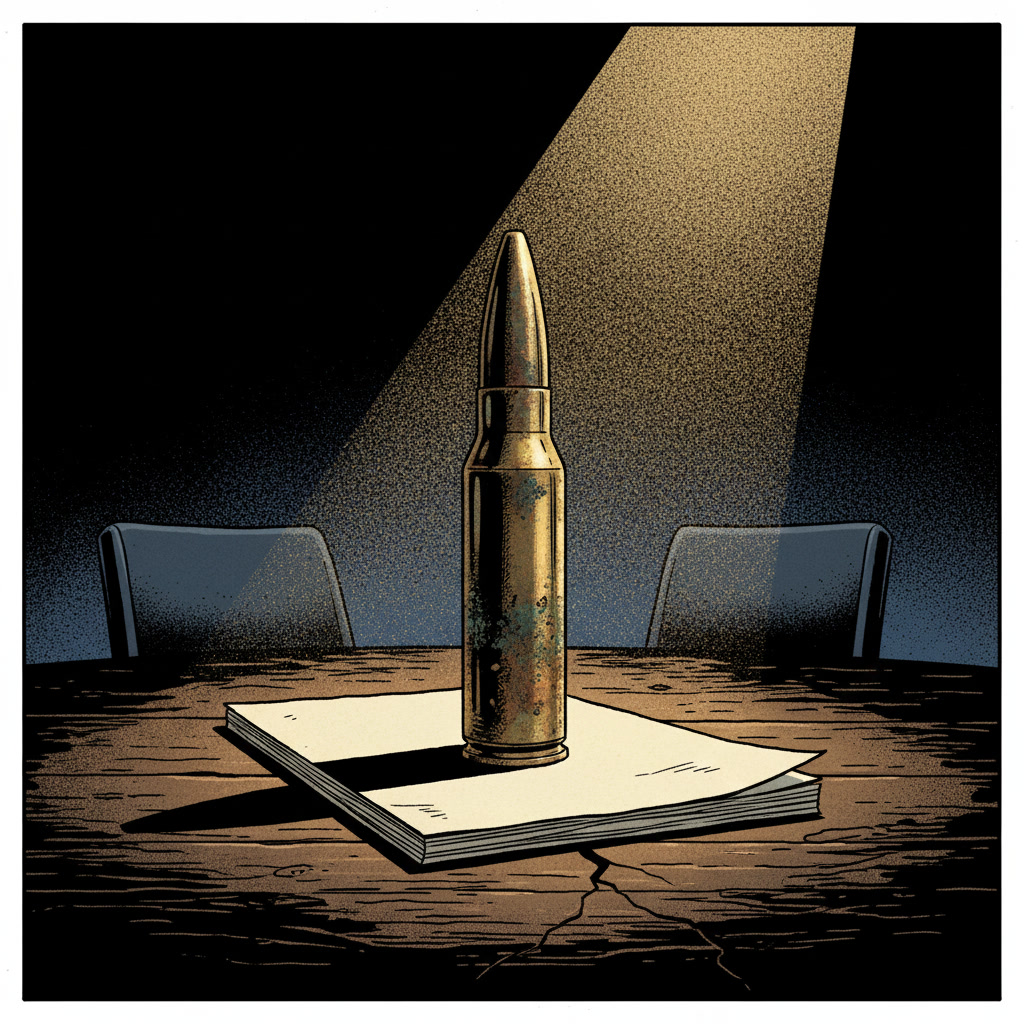
Israel and Lebanon Agree. But the Question Is Tehran.
The Plumb Line
Thursday, June 4
Three things happened in the last 24 hours that pull in the same direction, even though the wires are treating them as separate stories: Israel and Lebanon struck a new ceasefire agreement as the U.S. simultaneously sought to revive nuclear talks with Iran; Broadcom lost more than $300 billion in market value in a single session after its revenue forecast disappointed; and China's Qianfan broadband constellation added at least ten more satellites to low Earth orbit overnight. One is a diplomatic pivot, one is a market shock, and one is a slow-motion infrastructure race. The read here: they sketch the same underlying dynamic — the old order being stress-tested in real time, and the new one being built while everyone is watching the fires.
The ceasefire is the most urgent piece. Bloomberg and the Financial Times both confirmed that Israel and Lebanon have agreed to implement a ceasefire, with the U.S. explicitly framing it as part of an effort to revive Iran nuclear talks. Yesterday's brief identified the Lebanon front as the variable most likely to break the Iran deal track — and specifically predicted that any Iranian linkage of Lebanon to the broader deal would be the tell. Today the tell has arrived in the opposite direction: Washington appears to be using Lebanon as the *entry point* back into the Iran negotiation, not the exit. Whether that logic holds depends entirely on Tehran, and Tehran has not confirmed anything.
The Broadcom number belongs on today's agenda alongside the geopolitics — not because the stock market always matters, but because a $300 billion single-session loss in a company that supplies the semiconductor substrate for much of the AI buildout is a signal about how fragile the AI revenue thesis looks when any single earnings line disappoints. File it next to Indonesia's new radical export controls on raw minerals, which took effect today according to Bloomberg. The read here: the two stories share a mechanism — chokepoints on the physical layer of the global technology economy are suddenly worth re-examining.
Israel and Lebanon Agree. But the Question Is Tehran.
Israel and Lebanon have agreed to implement their ceasefire, Bloomberg and the Financial Times confirmed this morning, with the United States explicitly linking the deal to its effort to revive negotiations with Iran over its nuclear program. The ceasefire covers southern Lebanon and is described as conditional. Separately, the New York Times reported that Hezbollah's fiber-optic drone program has exposed specific gaps in Israeli air defense — a detail that matters because it signals Hezbollah has been refining its tactics even during nominal lull periods. The NYT Iran war live update tracker describes the ceasefire as fragile and notes the U.S. is "seeking" to revive Iran talks, not that it has scheduled them.
Here's the read. The historical parallel that fits here is the August 2006 UN Security Council Resolution 1701 ceasefire, which ended the Lebanon war between Israel and Hezbollah — a ceasefire that held in form while Hezbollah rebuilt its rocket stockpile and cross-border tunnel infrastructure at pace. The mechanism was the same: both sides accepted the pause because neither had achieved its maximal objective, and both used the quiet to reconstitute. The difference today is that Iran's nuclear timeline is the constraint that didn't exist in 2006. If Washington is trading ceasefire stabilization in Lebanon for Iranian flexibility on enrichment, it is offering Tehran something tangible — reduced pressure on its most capable proxy — in exchange for something highly uncertain. The falsifier here is straightforward: if Iran publicly endorses the Lebanon ceasefire and signals willingness to return to the negotiating table within the next 72 hours, Washington's gambit is working. If Iran stays silent or issues a statement that makes no mention of nuclear talks, the ceasefire is a tactical pause and nothing more.
Yesterday's brief called the Kuwait strike a qualitative escalation that put Gulf neutrality under terminal stress. Today's ceasefire announcement does not change that assessment — Kuwait is still processing a direct Iranian attack, and no Iranian statement has addressed it. What's changed is the U.S. posture: Washington appears to be pulling the Lebanon thread as a de-escalation handle, betting that cooling one front reduces Iranian incentive to heat others. The read here: the bet is not obviously wrong, but it requires Iran to behave like a unitary actor with coherent strategic preferences — an assumption the last 48 hours have complicated considerably.
What I'd watch next: the specific falsifier is whether Hezbollah observes the ceasefire's terms over the next 48 to 72 hours, and whether Iran's foreign ministry says anything about nuclear talks by end of week. If Hezbollah fires into northern Israel before Friday and Iran says nothing about Geneva, the ceasefire is theater. If both hold quiet, the U.S. has bought itself a negotiating window.
Three other things worth knowing
Broadcom's market value fell by more than $300 billion after its revenue forecast disappointed. The Financial Times reported the loss this morning — a staggering single-session figure for a company that has become one of the central suppliers of custom artificial intelligence chips to hyperscale cloud operators. The read here is not that AI is finished, but that the market had priced Broadcom for a trajectory that its own management wouldn't confirm. When the company whose chips sit inside Google's tensor processing units can't beat a revenue forecast, the AI infrastructure investment thesis gets a lot harder to hand-wave past.
India is seeking deeper oil ties with Venezuela after Nicolás Maduro's foreign minister, Delcy Rodríguez, met with Prime Minister Modi. Bloomberg reported the meeting and India's interest in expanding Venezuelan crude purchases. The read here: New Delhi is doing what it has done with Russian oil since 2022 — buying discounted barrels from a sanctioned producer and pricing the geopolitical risk as acceptable given its import needs. Venezuela's oil is sanctioned differently than Russia's, but the logic is identical. What I'd watch for next is whether the U.S. trade talks with India, already snagged on steel according to Bloomberg's separate report today, acquire a new irritant.
Trafigura, one of the world's largest commodity traders, reported bumper first-half profits and warned that oil is at an "inflection point" because of the Iran war. The Financial Times reported the warning this morning. The read here: Trafigura's language is notable because commodity traders have a financial interest in uncertainty — so when they call something an inflection point rather than a buying opportunity, they are signaling that the direction of price movement is genuinely unclear to people who trade this for a living. That is a more honest signal than most analyst notes, and it aligns with the OECD's "dark scenario" language from yesterday.
Echoes
The Israel-Lebanon ceasefire-then-rearmament pattern has a specific historical rhythm that is worth naming. After the 2006 war, Resolution 1701 created a framework in which the Lebanese Armed Forces were supposed to deploy to the south and UNIFIL — the UN Interim Force in Lebanon — was supposed to prevent Hezbollah rearmament. Neither happened in any meaningful sense. By 2024, Hezbollah had a larger and more accurate arsenal than it had possessed in 2006, including the fiber-optic drone program the NYT reported on today. The read here: ceasefires are not useless — the 2006 ceasefire bought eighteen years of no major war — but they are time-purchases, not problem-solutions. The question for today's agreement is whether eighteen months of quiet, let alone eighteen years, is even available given Iran's nuclear timeline and the U.S. election cycle.
The quiet things
The Ebola outbreak in eastern Congo remains off the diplomatic agenda. Yesterday's brief flagged it as a story at risk of disappearing while senior officials were consumed by Gulf escalation. Today, the New York Times published a second report — a piece on a priest's death in the Congolese epicenter, and separately a video from the treatment zone. The journalism is present; the policy response is not. No statement from Washington, the African Union, or the WHO (World Health Organization) has updated the public containment posture since the original declaration. The read here: that silence, in a week when every senior diplomat is tracking Lebanon and Tehran, is the kind of gap through which outbreaks historically accelerate.
Ireland's defense posture also surfaced quietly today. The New York Times reported that Dublin — long the NATO-adjacent neutral, the country that has hosted U.S. tech giants precisely because it positioned itself as outside the alliance's harder commitments — is now actively trying to bulk up its military capacity. The read here: European rearmament has now reached the one country that built its entire economic and political identity around staying out of it.
How I'd act on this
If you follow Middle East or Iran policy — the ceasefire is the top read, but the operative question is not whether Lebanon is quiet. It is whether Iran's foreign ministry issues any statement about nuclear talks by Friday. That is the signal that tells you whether Washington's gambit has any purchase in Tehran. Absent that signal, the ceasefire is a pause, not a pivot.
If you track energy markets or Hormuz risk — Trafigura's "inflection point" language, sitting alongside the OECD's "dark scenario" from yesterday, is the analytical frame to hold. Two institutions with different incentive structures used different words to describe the same uncertainty this week. That convergence is worth pricing. The next data point is whether Iranian crude loading at Kharg resumes at volume in the next 48 hours — the supertanker mooring yesterday was one ship; sustained loading would be the tell.
If you invest in semiconductors or track the AI infrastructure buildout — Broadcom's $300 billion loss deserves a longer look than one earnings cycle. The company is not in trouble; its technology is still central to the AI stack. But the market has been running ahead of confirmed revenue, and a correction of this magnitude at a company this central to the sector is a recalibration signal, not a blip.
If you cover European security or Irish affairs — the NYT's Ireland defense story is undersourced relative to its importance. Ireland joining the European defense conversation is not a small thing. It is the last major piece of the EU's geographic coherence on security, and it is moving faster than most Brussels watchers expected.
A ceasefire signed in Beirut and a crater at Kuwait International Airport, both dated June 4 — that is the gap between tactical de-escalation and structural instability, in one day's dateline.
— *The Plumb Line*. Daily world brief.
Sources
Israel / Lebanon / Iran / ceasefire
- newswire/ft — "Israel and Lebanon agree to implement ceasefire," June 4
- newswire/bloomberg — "Israel, Lebanon Reach Ceasefire as US Seeks to Revive Iran Talks," June 4
- newswire/nyt — "Iran War Live Updates: Israel and Lebanon Renew Cease-Fire," June 4
- newswire/nyt — "Hezbollah's Fiber-Optic Drones Expose Cracks in Israeli Defenses," June 4
Broadcom / semiconductors / AI
- newswire/ft — "Broadcom to lose more than $300bn in market value as revenue forecast disappoints," June 4
India / Venezuela oil
- newswire/bloomberg — "India Seeks Deeper Venezuela Oil Ties After Rodríguez and Modi Meet," June 4
India / U.S. trade
- newswire/bloomberg — "Kyle Refuses to Set India Deal Timeline Amid Spat Over Steel," June 4
Trafigura / oil markets
- newswire/ft — "Trafigura warns oil at 'inflection point' as Iran war stokes bumper half-year profits," June 4
Ireland defense
- newswire/nyt — "Ireland, Seen as a Weak Link in Europe's Defense, Is Trying to Bulk Up," June 4
Congo / Ebola
- newswire/nyt — "Priest's Ebola Death Stirs Fear and Doubt in Congolese Town," June 4
- newswire/nyt — "A Death at the Epicenter of Ebola," June 4 (video)
China / space
- celestrak/69073–69088 — Qianfan-127 through Qianfan-142, cataloged June 4
- launch_library/cfff5e89 — Falcon 9 / Starlink Group 10-43, launch in flight June 4
- launch_library/5db6b0f1 — Long March 6A, Go for Launch, Taiyuan, June 4
Historical references
- UN Security Council Resolution 1701, August 2006: Israel-Hezbollah ceasefire framework and subsequent Hezbollah rearmament
- Kuwait / Gulf state neutrality: yesterday's brief (June 3), Iran airport strike coverage