Kuwait Struck. The Gulf Is In It Now.
The Plumb Line
Wednesday, June 3
What does it mean when Iran strikes Kuwait's main airport? It means the war that Washington has been trying to manage as a bilateral U.S.-Israel-Iran affair has just become a Gulf-wide event.
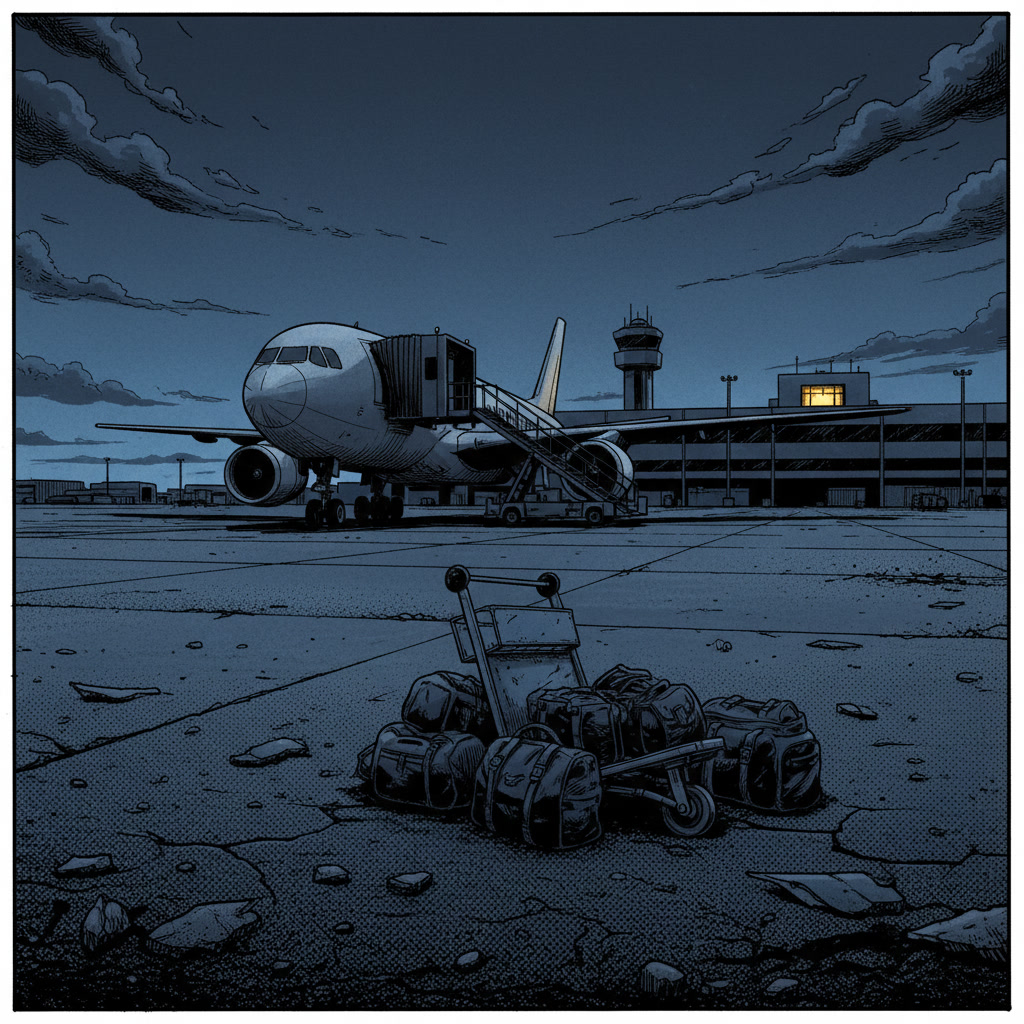
Bloomberg confirmed this morning that an Iranian attack damaged Kuwait International Airport, forcing a suspension of all flights. Kuwait — a country that hosts roughly 13,500 U.S. troops at Ali Al Salem Air Base, that has carefully cultivated neutrality since the 1990 Iraqi invasion, that is not a party to this conflict — is now absorbing direct Iranian fire. The read here is that this is a qualitative escalation, not an incremental one. The first oil supertanker to moor at Iran's Kharg Island in nearly a month did so this morning, Bloomberg also reports, suggesting Tehran still wants its oil revenue flowing — which makes the airport strike look less like economic desperation and more like deliberate geographic expansion of the pressure campaign.
Yesterday's brief called the Lebanon front the variable most likely to break the Iran deal track, and predicted that linkage — if it appeared in official Iranian language — would be the tell. Today the tell arrived in a different form: not in a diplomatic statement, but in a missile landing 500 miles southwest of Tehran on a country that had nothing to do with the fight.
Kuwait Struck. The Gulf Is In It Now.
Iran struck Kuwait International Airport overnight, Kuwait confirmed, forcing the suspension of all commercial flights. The New York Times live updates page and Bloomberg both report the attack as confirmed by Kuwaiti authorities. Iran's trajectory here has moved from striking Israel directly, to targeting Israeli-adjacent infrastructure in Lebanon via Hezbollah, to now hitting a Gulf Arab state that has maintained formal neutrality and hosts substantial U.S. military assets. The OECD warned this morning of a "dark scenario" if the Gulf energy crisis drags on — and separately, Bloomberg reported that the first oil supertanker in almost a month moored at Iran's Kharg Island, the loading terminal for roughly 90 percent of Iranian crude exports.
Here's the read. The historical parallel is Iraq's 1980 Scud escalation into the Gulf states during the Iran-Iraq War — the moment when a bilateral conflict weaponized the entire Gulf's neutrality and forced Saudi Arabia, Kuwait, and the UAE to choose sides visibly. The mechanism then was the same: a regional power under military pressure expanding its target set to coerce neighbors into constraining the other side's support. Kuwait financed Iraq during that war. Today the implicit ask from Tehran is different — stay out, apply pressure on Washington to pull Israel back, or face consequences. The supertanker mooring at Kharg is the tell that Iran is not trying to collapse its own economy; it is trying to reshape the political map of the Gulf. The 13,500 U.S. troops at Ali Al Salem now complicate every Iranian escalation calculus, but they also complicate Washington's: any U.S. response that looks retaliatory against Iran on behalf of Kuwait puts American forces at risk in a country that didn't ask to be a battlefield.
What I'd watch for next: the critical falsifier is Kuwait's formal response. If Kuwait files a complaint at the UN Security Council and requests an emergency session, this has entered a new legal and diplomatic register and the deal track is severely damaged. If Kuwait's government instead issues a muted statement and quietly accepts U.S. security assurances, Tehran has learned that Gulf states will absorb strikes without triggering a coalition response — and will almost certainly strike again. Watch also for Saudi Arabia and the UAE: if either issues a statement explicitly condemning Iran by name, the Gulf Cooperation Council's fragile neutrality is over.
Three other things worth knowing
Ukraine struck St. Petersburg on the opening day of Putin's signature economic forum. The Financial Times and New York Times both confirmed that Ukraine hit St. Petersburg precisely as the St. Petersburg International Economic Forum — Putin's annual showcase of Russia's economic resilience — got underway. The read here is that the symbolism was deliberate: Kyiv is now projecting force into Russia's second city while Putin attempts to convene foreign investors and project normalcy. Yesterday's brief noted Putin was spending military capital he couldn't easily replace; today Ukraine is spending diplomatic capital in a different direction, demonstrating to the forum's attendees that no Russian city is a safe backdrop for business-as-usual.
The U.S. is proposing tariffs of at least 10 percent on 60 countries after a forced-labor investigation. The Financial Times reported this morning that Washington is moving toward broad new tariffs following a probe into forced labor in supply chains — China immediately denied the findings and called the investigation a "tariff pretext," Bloomberg reported. The read here is that this is a significant broadening of the trade war's legal framing: rather than Section 232 national security or Section 301 trade practice designations, forced-labor grounds create a different litigation posture and are harder for trading partners to challenge at the World Trade Organization (WTO). Sixty countries is not a targeted action; it is a structural reshaping of U.S. import policy that will ripple through procurement and sourcing decisions for years.
Denmark has tapped a former prime minister to resolve the U.S. dispute over Greenland, and separately cut corporate tax. Bloomberg reported that Copenhagen is sending a former head of government to lead talks with Washington on Greenland's status — the read here is that Denmark is treating this as a heads-of-state-level problem rather than a foreign ministry file. Separately, the new Danish government announced a corporate tax cut, reported by the Financial Times. Taken together, the two moves suggest Denmark is trying to both appease Washington on strategic terrain (Greenland) and attract capital by lowering its tax burden — a small-country hedging strategy in an era when the U.S. is making explicit demands of its formal allies.
Echoes
The Kuwait strike rhymes with a specific moment in the 1980s Gulf War of Tankers — specifically 1987, when Iran attacked a Kuwaiti tanker convoy and the Reagan administration responded by re-flagging Kuwaiti tankers under the Stars and Stripes and ordering U.S. Navy escorts through the Strait of Hormuz. The lesson from that episode is that once a regional power starts hitting neutral Gulf states, the United States faces a binary: absorb the implicit challenge and lose deterrence credibility, or escort and risk direct confrontation. Reagan chose escort. The result was Operation Earnest Will, which kept the oil flowing but put U.S. warships in direct contact with Iranian naval forces and eventually produced the shoot-down of Iran Air Flight 655. The lesson that applies today: neutrality of Gulf states has never been self-enforcing; it has always required a visible U.S. posture to hold. The question is whether that posture is currently visible enough to deter the next strike.
The quiet things
The Ebola outbreak in eastern Congo has not dropped off the wires, but it has dropped out of the diplomatic conversation. Yesterday's brief flagged it as a crisis in formation — Kenya's protest deaths, no approved vaccine for the Bundibugyo strain. Today the New York Times ran a video report on treatment efforts in Congo, but no government statement from Washington, Kinshasa, or the African Union has updated the public response posture since yesterday. The read here is that when a public health emergency with an unapproved vaccine strain goes quiet in official channels during a week when every senior diplomat is consumed by a Gulf escalation, the containment window can close before the attention returns. Worth noting before it disappears entirely.
Also quiet: Iran's crude export figures. Bloomberg reports that no Iranian oil cleared the U.S. blockade in May — confirmed by the United Against Nuclear Iran advocacy group's tracking — which sits in deep tension with this morning's supertanker mooring at Kharg Island. The read here is binary: either the blockade is about to be tested again, or the Kharg mooring is a gesture rather than a resumption. The market hasn't priced either interpretation cleanly yet.
How I'd act on this
If you follow U.S. Middle East or Gulf policy — the Kuwait strike is today's read, full stop. The question for Capitol Hill and the National Security Council is whether Ali Al Salem Air Base is now effectively a frontline installation rather than a logistics hub. If a U.S. asset in Kuwait is struck, even incidentally, the Iran deal track doesn't just bend — it breaks, and probably takes the broader regional architecture with it.
If you hold energy positions or track Hormuz risk — the OECD's "dark scenario" language this morning is the signal, not the noise. Gulf insurance and shipping rates will move before the diplomacy does. The Kharg supertanker is a single data point; what I'd watch for next is whether Iranian crude loading resumes at volume over the next 72 hours, which would suggest Tehran is compartmentalizing its escalation from its revenue needs. If loading stays suppressed despite the mooring, the pressure calculus is more extreme than currently priced.
If you cover trade or supply-chain policy — the 60-country forced-labor tariff proposal is the domestic U.S. story that will take weeks to fully digest. The legal theory matters: forced-labor grounds are considerably more durable at the WTO than national-security grounds, and 60 countries means this touches virtually every major manufacturing supply chain simultaneously. The comment period and implementation timeline are the next data points.
If you invest in or track European banking — a trio of EU states broke ranks today to push further banking reform, Bloomberg reported. In a week dominated by Gulf escalation and tariff news, that story will be underread. The read here is that the EU banking union has been stalled for a decade; any movement on it, even fractional, changes the sovereign-bank doom loop calculus for peripheral eurozone debt.
A week ago, Kuwait International was handling 200-odd commercial flights a day and the OECD was talking about soft landings. Today the airport is closed and Geneva is using the word "dark." Every regional calculation built on Gulf neutrality has to be rebuilt by Friday.
— *The Plumb Line*. Daily world brief.
Sources
Iran / Kuwait / Gulf escalation
- newswire/nyt live — "Iran War Live Updates: Kuwait Says Iranian Attack Has Damaged Its Main Airport," June 3
- newswire/bloomberg — "Kuwait Suspends Flights After Iranian Attack Damaged Airport," June 3
- newswire/bloomberg — "First Oil Supertanker Moors at Kharg Island in Almost a Month," June 3
- newswire/bloomberg — "Iran Didn't Get Any Crude Oil Past US Blockade in May, UANI Says," June 3
- newswire/ft — "OECD warns of 'dark scenario' if Gulf energy crisis drags on," June 3
Ukraine / Russia / St. Petersburg
- newswire/ft — "Ukraine strikes St Petersburg as Putin's forum gets under way," June 3
- newswire/nyt — "Ukraine Strikes St. Petersburg on First Day of a Marquee Putin Event," June 3
U.S. Tariffs / Forced Labor
- newswire/ft — "US proposes tariffs of at least 10% after forced labour probe," June 3
- newswire/ft — "FirstFT: US proposes tariffs on 60 countries after forced labour probe," June 3
- newswire/bloomberg — "China Denies Forced Labor, Slams US Probe as Tariff 'Pretext'," June 3
- newswire/bloomberg — "Trump Tariffs: China, UK, Europe Among US Trade Partners Targeted," Daybreak Europe, June 3
Denmark / Greenland
- newswire/bloomberg — "Denmark Taps Ex-Premier to Resolve US Dispute Over Greenland," June 3
- newswire/ft — "New Danish government to cut corporate tax," June 3
EU Banking
- newswire/bloomberg — "Trio of EU States Break Ranks to Push Further Banking Reforms," June 3
Congo Ebola
- newswire/nyt — "Battling a Deadly Ebola Outbreak in Eastern Congo," June 3 (video report)
OECD / Energy
- newswire/ft — "OECD warns of 'dark scenario' if Gulf energy crisis drags on," June 3
Historical references
- Iran-Iraq War, 1980–1988: Gulf state neutrality erosion and tanker war escalation
- Operation Earnest Will, 1987–1988: U.S. re-flagging of Kuwaiti tankers, direct Iran-U.S. naval confrontation, Iran Air Flight 655