The Lebanese Flank Opens While the Talks Crawl
The Plumb Line
Tuesday, May 27
Three things happened in the last 24 hours that pull in the same direction, and reading them together changes what the Iran picture looks like.
First, fighting has flared in Lebanon — Israeli strikes intensifying as U.S.-Iran diplomatic talks grind on, Bloomberg and the New York Times both reported this morning. Second, a South Korean government probe has concluded that Iranian-made missiles struck a vessel in the Strait of Hormuz, per Bloomberg and UPI — the first official government attribution of the Hormuz attack to Iranian weapons. Third, the European Central Bank issued a public warning that Trump risks triggering a financial crisis through the Iran war. Each of these would be a notable data point alone. The read here: together, they describe a conflict that is simultaneously widening geographically, acquiring a documented evidentiary record, and beginning to register systemic financial risk warnings from allied institutions.
Yesterday's brief argued the strikes-while-talking structure resembled Libya 2003 — coercive pressure maintenance with a diplomatic off-ramp running in parallel. Today's news forces an update: the Lebanon escalation and the South Korean ship attribution are two developments the Libya parallel cannot absorb. Libya was a bilateral drama. What's visible today is a regional drama with multiple active theaters, a physical casualty event in a major shipping lane now officially attributed to Iranian weapons, and a former CENTCOM (Central Command) commander telling Bloomberg he expects a "prolonged" U.S. mission.
The Lebanese Flank Opens While the Talks Crawl
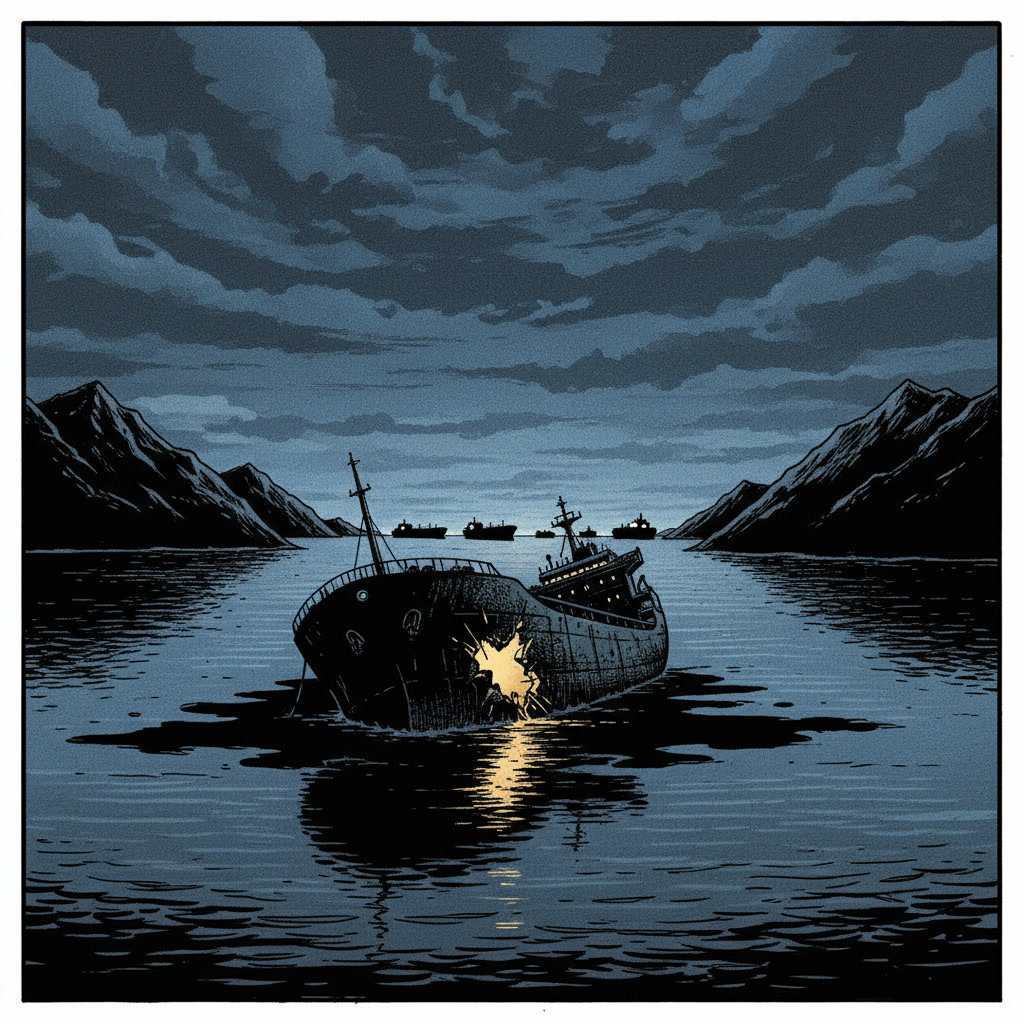
Israel increased its attacks on Lebanon yesterday and overnight even as Washington and Tehran continue to describe diplomatic channels as open. Bloomberg confirmed the escalation. Simultaneously, Seoul's foreign ministry announced its investigation has found that Iranian-manufactured missiles struck the South Korean vessel HMM Namu in the Hormuz region — a finding UPI and Bloomberg both reported this morning. The ECB warned, in terms unusual for a central bank, that the Trump administration's conduct of the Iran war risks triggering a broader financial crisis.
Here's the read. The Lebanon flank opening while the nuclear talks continue is not a surprise — Israel has structural incentives to keep military pressure on Hezbollah regardless of what Washington and Tehran are negotiating — but the timing creates a genuine complication for U.S. diplomacy. Tehran can use Israeli operations in Lebanon as domestic justification for hardening its own negotiating position, and it will. The South Korean ship attribution is a separate and more durable problem: it transforms what was a contested incident into a documented act of war against a treaty ally's commercial vessel. Seoul now has a formal evidentiary basis for demanding compensation and accountability, and Washington has a new obligation it cannot quietly paper over. The historical parallel here — allied ship attacks complicating a simultaneous diplomatic negotiation with the attacking party — is the tanker war of 1987-88, when Iraqi and Iranian attacks on Gulf shipping kept pulling Washington deeper into a conflict it was simultaneously trying to manage through back-channels. The mechanism then was the same: every incident generated a new set of domestic political obligations for Washington that constrained what diplomats could quietly offer. The falsifier for that analog is speed: if a U.S.-Iran framework agreement is reached within the next ten days, the attribution findings get absorbed into a settlement framework rather than hardening into a legal and political obstacle course. If it takes longer, the South Korean finding becomes a floor on what any deal must address — and floors complicate negotiations.
What I'd watch for next is the Iranian internet. The New York Times reported this morning that Iran's internet shutdown — in place since the opening of U.S. strikes — has begun to ease. That is a meaningful signal. The read here: governments that are preparing their populations for a face-saving compromise typically restore information flows before the announcement, not after. It reduces the shock and allows state media to shape the narrative in advance. This is not a confirmation that a deal is near; it is a necessary precondition that is now present when it wasn't 48 hours ago. If Iranian state media, in the next 48 to 72 hours, begins framing any potential agreement in terms of what Iran "extracted" from the talks rather than what it conceded — the signal I flagged yesterday as the key tell — the combination of restored internet plus that framing shift becomes a strong leading indicator. If the internet eases but the state media language stays hard, the timeline is longer.
Three other things worth knowing
The Lebanese theater is the surgical complication. Israel's expanded strikes on Lebanon, confirmed by Bloomberg this morning, put Washington in an awkward position: the U.S. is simultaneously asking Tehran to accept a diplomatic framework and watching its closest regional ally conduct military operations against Tehran's most important remaining proxy. The practical effect is that the Revolutionary Guards have domestic ammunition to argue that any deal Washington offers is made in bad faith. That's not an insurmountable obstacle — Iran has navigated that dynamic before — but it raises the internal alignment cost for Khamenei, whose problem, as yesterday's brief noted, has always been domestic sequencing rather than the terms themselves.
Hungary reversed its ICC withdrawal. Bloomberg reported this morning that Budapest has reversed its decision to exit the International Criminal Court (ICC). This is Viktor Orbán stepping back from a position he took publicly — and doing so quietly, without a press conference. The read here is that the ICC withdrawal was always more useful as a diplomatic lever than as a durable policy. What changed is unclear from public reporting, but the most likely explanation is that the reversal was part of a broader negotiation with the EU over funding access or sanctions relief. What I'd watch for next: whether the reversal comes with any side conditions that haven't been publicly disclosed.
Spain's governing party is under direct police pressure. Spanish police raided the offices of Prime Minister Pedro Sánchez's Socialist Party in Madrid, Bloomberg and the Financial Times both confirmed, as part of a widening corruption investigation. This is a significant domestic political event in the EU's fourth-largest economy. Sánchez has survived previous scandals through a combination of coalition management and aggressive counter-framing, but a physical raid on party headquarters is a different order of visibility. The read here: this raises the probability of early elections in Spain, which would shift the EU's internal center-of-gravity at an already complicated moment for European political cohesion.
Echoes
The tanker war of 1987–88 is worth holding in mind today — not as a precise template but as a warning about how documented ship attacks acquire political mass. In that conflict, Iranian and Iraqi strikes on Gulf shipping eventually pulled Washington into direct naval engagement (Operation Earnest Will, Operation Praying Mantis) even as U.S. diplomats were simultaneously managing Iraqi relationships and trying to keep the war from metastasizing. The lesson: once allied commercial vessels start accumulating body counts and evidentiary records, the political obligation to respond grows faster than diplomatic timelines can absorb. Seoul's formal attribution today is the moment that dynamic starts running on the current crisis. It doesn't determine the outcome — Libya 2003 closed despite real military friction — but it narrows the space for quiet resolution.
The quiet things
Israel's public silence on the U.S.-Iran deal framework is now three days running — first flagged in Monday's brief, still holding. The read here: at a certain point, a silence this sustained from the party most directly affected by any Iran nuclear agreement stops being ambiguity and starts being a negotiating position. Jerusalem either hasn't been shown the framework's core terms, or has been shown them and declined to endorse them. Either reading creates a complication for Washington.
The ECB's financial crisis warning deserves more attention than it will receive. Central banks issue warnings of this kind rarely, and when they do about geopolitical rather than purely financial risks, the warning itself becomes a market signal — it licenses institutional risk managers to mark down exposure in a way they couldn't do on their own authority. What I'd watch for next: any revision in sovereign risk spreads on Gulf-exposed European bank portfolios in the next few sessions.
How I'd act on this
If you follow the Iran negotiations, the internet restoration is today's most actionable data point — more revealing than any official statement. Track Iranian state media framing over the next 48 to 72 hours. The shift from "we are resisting" to "we extracted concessions" is the tell.
If you cover or trade around energy markets, the South Korean ship attribution to Iranian weapons is a new floor on disruption risk. It's no longer just a contested incident; it's a documented one with treaty-ally status attached. That changes the political economy of any quick resolution.
If you hold European bank equities or follow EU political risk, the Sánchez raid and the ECB's financial-crisis language are the two underreported stories of the morning. The read here: Spain moving toward political instability and the ECB publicly flagging Iran-war financial risk in the same news cycle is not a coincidence — it's a picture of European institutional stress.
If you watch German trade policy, Germany's economy minister Katharina Reiche told the EU this morning to avoid measures that would harm German exports to China. That's Berlin publicly breaking from a harder EU China-trade line at a moment when Washington wants European solidarity on technology controls. File it.
The through-line today is that yesterday's bilateral negotiation looks increasingly like a regional war with a diplomatic track attached — Lebanese strikes, a formally attributed Hormuz ship attack, an ECB financial crisis warning, and a former CENTCOM commander forecasting a prolonged mission, all arriving before noon.
The lights coming back on in Tehran is the only thing in today's news that points toward an exit.
— *The Plumb Line*. Daily world brief.
Sources
Iran / Lebanon / Hormuz / Diplomacy
- newswire/nyt — "Iran War Live Updates: Fighting Flares in Lebanon, Complicating U.S.-Iran Peace Talks," May 27
- newswire/bloomberg — "Israel Increases Attacks on Lebanon as US-Iran Talks Crawl On," May 27
- newswire/bloomberg — "South Korean Probe Suggests Iran-Made Missiles Hit Ship in Hormuz," May 27
- gdelt/upi.com — "Iran-linked missiles behind attack on S. Korean vessel in Hormuz," May 27
- newswire/bloomberg — "Former Centcom Head Sees 'Prolonged' US Mission in Iran," May 27
- newswire/ft — "Trump risks triggering financial crisis with Iran war, warns ECB," May 27
- newswire/nyt — "Iranians Emerge From a 'Black Hole' as Internet Shutdown Eases," May 27
- newswire/ft — "FirstFT: Trump's Board of Peace is stuck in limbo," May 27
- gdelt/ncr-iran.org — "Iran News in Brief – May 27, 2026," May 27
Hungary / ICC
- newswire/bloomberg — "Hungary Reverses Decision to Exit International Criminal Court," May 27
Spain / Sánchez
- newswire/ft — "Spanish police raid offices of PM Pedro Sánchez's party," May 27
- newswire/bloomberg — "Spanish Police Search Socialist Party HQ in Widening Graft Probe," May 27
Germany / EU Trade
- newswire/bloomberg — "Germany's Reiche Tells EU to Avoid Harming Exports to China," May 27
Historical reference
- Operation Earnest Will / Operation Praying Mantis (1987–88) — standard historical record