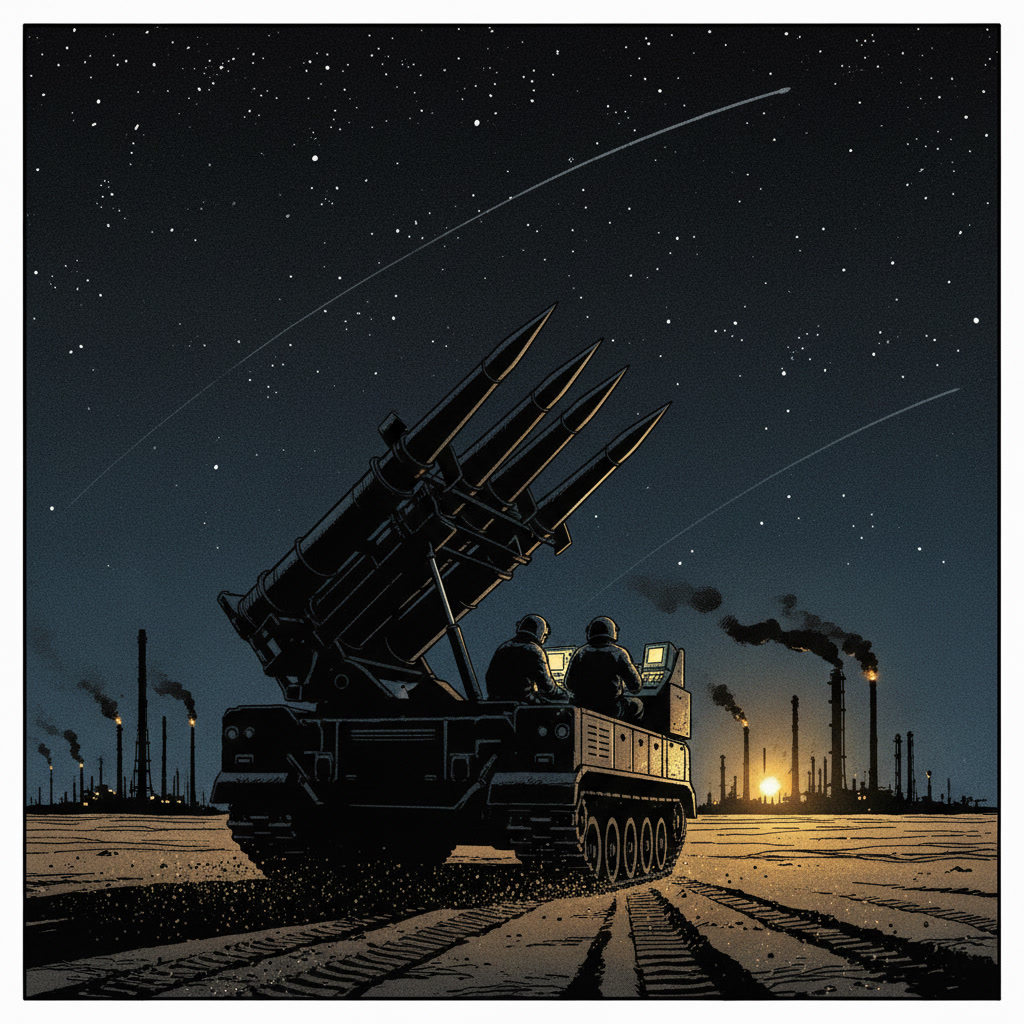
U.S.-Iran: The Ceasefire That Isn't
The Plumb Line
Wednesday, May 28
"I can wait longer than Iran."
Those are Donald Trump's words, as reported today by Baltic News Network and confirmed in framing across multiple wire services. He said it publicly, which means it wasn't meant for a negotiating back-channel — it was meant for an audience. The question is which one.
Trump's patience statement lands on the same morning that the U.S. struck Iranian military sites for the second time in three days, that Kuwait reports its air defenses downed incoming missiles and drones, that Tehran condemned what it called U.S. ceasefire violations, and that NPR confirmed Iranian internet access — restored as we noted yesterday as a potential pre-deal signal — is operating again but under heavy state restriction. The internet easing is confirmed. The state media narrative shift toward "we extracted concessions" that yesterday's brief flagged as the key tell has *not* appeared. If anything, Tehran's public language hardened overnight.
The read here: two governments are simultaneously conducting a military exchange and a negotiation, each using the violence to calibrate what the other will accept. That is not unusual in coercive diplomacy. What is unusual is the regional spread — Kuwait's air defenses activating, Israeli strikes hitting Tyre in southern Lebanon overnight per the Financial Times, and the broader Gulf on visible alert. The Libya 2003 parallel that has structured this coverage is now strained beyond its useful life. The historical parallel that fits better, as I'll argue below, is Korea 1951.
U.S.-Iran: The Ceasefire That Isn't
Second strikes in three days; Kuwait's air defenses activate
The U.S. conducted its second round of strikes on Iranian military sites in 72 hours, the New York Times and Bloomberg both confirmed this morning. Simultaneously, Kuwait announced its air defenses had intercepted incoming missiles and drones — a significant escalation in geographic footprint that moves the conflict from an Iran-specific theater into the broader Gulf. Tehran called the strikes a "blatant violation of international law" and condemned what it described as U.S. ceasefire breaches, per ANI News. The U.S. also sanctioned an Iranian body accused of Strait of Hormuz extortion, per Arutz Sheva. Oil prices rose on the news, Bloomberg reported, with no deal framework visible on the wire.
Here's the read. What's happening structurally is a pattern that analysts call "fight-and-talk" — both parties maintain military pressure to improve their negotiating position while keeping a diplomatic channel technically open. The historical analog that fits better than Libya 2003 at this point is the Korean War armistice negotiations of 1951–53, where active fighting continued for two full years alongside truce talks, and where neither side stopped shooting because diplomacy was underway. The mechanism is identical: each side calculates that pausing military pressure before a deal is signed surrenders leverage it will never recover. The falsifier for a near-term deal is Trump's own patience framing — a leader who publicly declares he can wait longer than his adversary is not signaling imminent compromise. What I'd watch for next: if a deal framework is announced within the next 72 hours, today's public posture was a last-minute negotiating bluff. If the strikes continue past the weekend without a framework, the fight-and-talk structure is consolidating into something more durable.
Watch the Kuwait escalation more than the Iran strikes themselves. The read here: Gulf Cooperation Council (GCC) members activating air defenses changes the regional politics in ways that are hard to reverse. Kuwait's government now has a domestic obligation to account for the threat publicly, which constrains how quietly any broader settlement can be managed. If Saudi Arabia or the UAE report similar intercepts in the next 48 hours, the regional containment assumption — that this stays a U.S.-Iran bilateral — is formally broken.
Three other things worth knowing
Ebola fear closes the Congo-Uganda border. The New York Times reported this morning that Uganda has closed its border with the Democratic Republic of Congo as Ebola concerns rise. This is a consequential public health decision — the Congo-Uganda border is one of the most transit-intensive in Central Africa — and the read here is that Ugandan health authorities believe community transmission risk is real enough to justify the economic and humanitarian costs of closure. The World Health Organization (WHO) has not yet issued a formal emergency declaration on this outbreak as of this morning's wires, but a border closure by an adjacent country is typically the event that precedes such a declaration by days, not weeks.
China's Qianfan constellation keeps expanding. Space-track data cataloged overnight shows at least eight new Qianfan satellites — numbered Qianfan-127 through 143 — entering orbit following a Long March 6A launch. Qianfan is Shanghai Spacecom Satellite Technology's low-Earth orbit broadband constellation, China's direct competitive answer to Starlink. The pace of cataloging suggests a single batch launch. The read: at this deployment rate, Qianfan is on track to reach meaningful coverage density within 18 months. The competitive and geopolitical implications — a Chinese-operated global broadband alternative, with the access-control and intelligence implications that entails — are underreported relative to the technical milestones.
The EU fined Temu €200 million. The Financial Times confirmed the European Commission levied a €200 million fine against Temu, the Chinese e-commerce platform, for failing to prevent the sale of illegal goods on its marketplace. This is the first major Digital Services Act (DSA) enforcement action against a non-European platform at this scale. The read: the EU is establishing that DSA enforcement has real financial teeth, and that the target need not be a European company. Amazon, which has faced similar illegal-goods complaints, is watching this closely.
Echoes
The Korean War armistice negotiations are the structural parallel worth holding today — not for the outcome but for the pace. Talks began in July 1951 with both sides still actively fighting; they concluded in July 1953, 25 months later. The fighting didn't stop because negotiations started; negotiations started because both sides had reached a rough military equilibrium they couldn't break. The read here: the current U.S.-Iran dynamic has not reached equilibrium — the U.S. retains overwhelming strike capacity — but the political costs of continued strikes are accumulating faster than the military costs to Iran. That's the condition that eventually made Korea's armistice possible: not military parity, but the moment when one side's political cost curve intersected the other's pain tolerance. What I'd watch for is the first sign that domestic Iranian politics — not Khamenei's stated position, but the factional signaling below it — shifts toward accommodation language.
The quiet things
Yesterday's brief flagged that Iranian state media's narrative shift toward "we extracted concessions" language would be the key tell for an imminent deal. That shift has not arrived. The internet restored, as we noted, but the framing remained adversarial overnight. The tell is still pending.
Israel has now maintained public silence on the U.S.-Iran deal framework for four consecutive days. The read here: that silence is no longer ambiguous — it is a position. Jerusalem is either excluded from the framework's core terms, or has seen them and is signaling displeasure without triggering a public rupture with Washington. Either reading means the deal, if it comes, will face an immediate Israeli response that Washington has not publicly prepared for.
How I'd act on this
If you cover the Gulf or trade energy markets — Kuwait's air defense activation is the most underreported development of the morning. It shifts the conflict's geographic footprint in ways that will be hard to walk back even if a ceasefire comes. Watch for Saudi or UAE intercept reports in the next 48 hours; that's your escalation tripwire.
If you follow public health — the Uganda-Congo border closure is your leading indicator. A formal WHO Ebola emergency declaration, if it comes, typically follows a neighboring-country border closure within days. The closure happened this morning; set your calendar accordingly.
If you invest in or cover the satellite and telecom sector — the Qianfan batch launch overnight deserves more attention than it's getting. Eight satellites in a single cataloging event, on a consistent launch cadence, means China's Starlink competitor is no longer a concept; it is an infrastructure buildout. The access and intelligence implications of a Chinese-operated global broadband layer are a policy and market story that hasn't been written yet.
If you track EU regulatory enforcement — the Temu DSA fine sets a precedent for what the Commission will do to non-European platforms that fail goods-compliance standards. The next question is whether the Commission moves against a larger target. Amazon's EU counsel is reading the Temu decision today.
The through-line today: a conflict declared bilateral is behaving like a regional one, a ceasefire declared in place is being violated by both sides, and a negotiation declared active has produced no framework.
Trump says he can wait longer than Iran. Kuwait's air defense crews, who spent last night tracking incoming drones, are now part of the answer to a question Washington and Tehran haven't asked them.
— *The Plumb Line*. Daily world brief.
Sources
Iran / Gulf / Diplomacy
- newswire/nyt — "U.S. Strikes Military Sites in Iran for Second Time in 3 Days," May 28
- newswire/nyt — "Iran War Live Updates: U.S. and Iran Trade Strikes, Further Threatening Negotiations," May 28
- newswire/bloomberg — "US Strikes Iran Targets, Oil Gains With No Accord in Sight," May 28
- newswire/bloomberg — "Hezbollah Turns the Tables as Iran Talks Creak," May 28
- gdelt/aninews.in — "Blatant violation of international law: Tehran condemns alleged US ceasefire breaches," May 28
- gdelt/bnn-news.com — "Trump: I can wait longer than Iran," May 28
- gdelt/pakobserver.net — "Kuwait on high alert as air defenses shoot down incoming missiles, drones," May 28
- gdelt/israelnationalnews.com — "US sanctions Iranian body accused of Strait of Hormuz extortion," May 28
- [gdelt/kvpr.org / npr.org](https://kvpr.org / npr.org) — "Iranians are back online after a monthslong shutdown but face heavy restrictions," May 28
- newswire/ft — "Israel attacks Tyre in new strikes on southern Lebanon," May 28
Ebola / Uganda-Congo
- newswire/nyt — "Uganda Closes Border With Congo as Ebola Fears Rise," May 28
Space / Qianfan
- celestrak/69073–69089 (batch) — Qianfan-127 through 143 cataloged, May 28
- celestrak/69091 — CZ-6A R/B (Long March 6A rocket body), May 28
EU / Temu
- newswire/ft — "EU fines China's Temu €200mn for failing to prevent sale of illegal goods," May 28
Historical reference
- Korean War armistice negotiations, July 1951–July 1953 — standard historical record