Strikes, Talks, and the Hormuz Premium
The Plumb Line
Monday, May 26
"No going back."
That's Ayatollah Khamenei's phrase, published this morning by Bloomberg. He said it about the Middle East broadly — not about the nuclear talks specifically — but the timing matters. Yesterday's brief tracked the gap between Trump's "no rush" and Tehran's "many issues resolved" as the space where the actual negotiation was happening. Today Khamenei filled that space with something harder: a public declaration that the regional order has been permanently altered by war. The read here is that this is not the language of a man preparing his domestic coalition for a compromise. It is the language of a man managing his domestic coalition's expectations of what any compromise will cost.
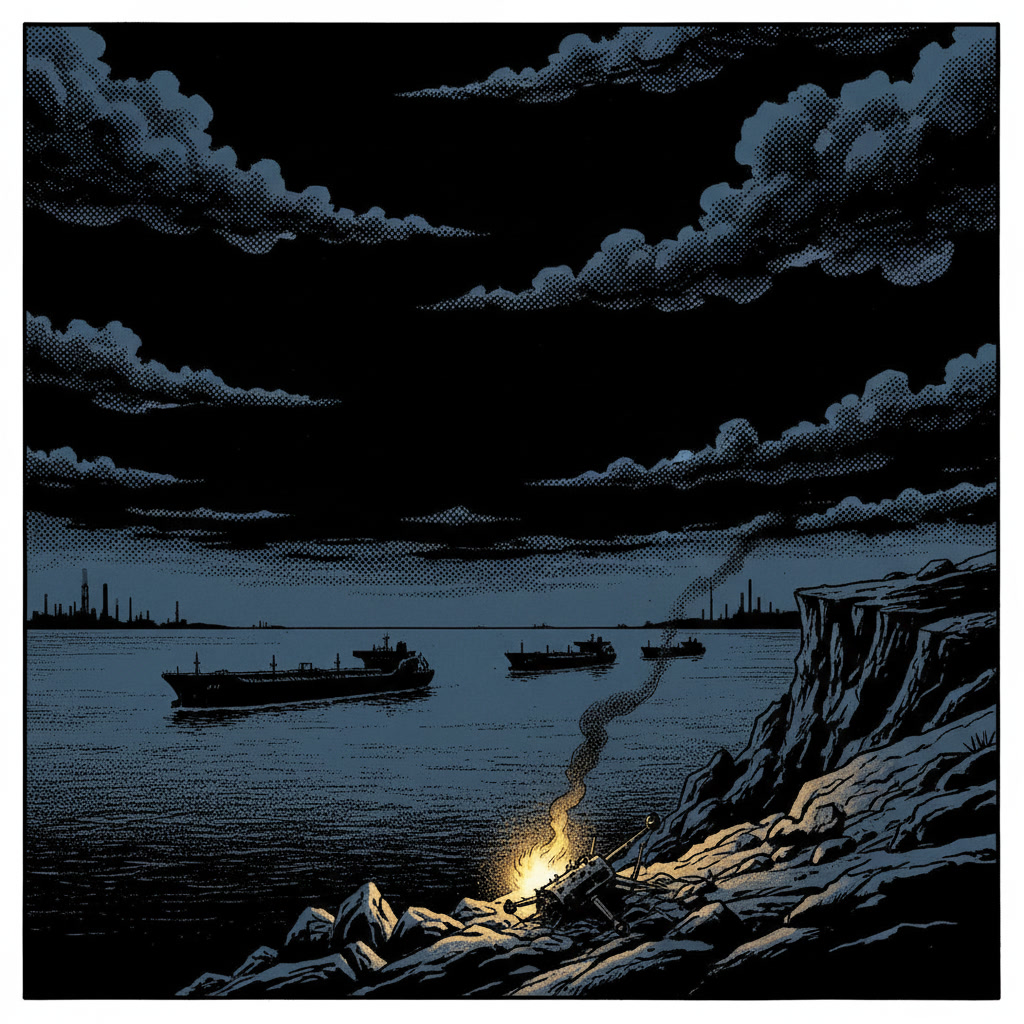
The news today is that the U.S. carried out renewed strikes against Iranian missile sites in the south, per the New York Times, even as both sides continue to describe the talks as alive. Bloomberg reports a clash near the Strait of Hormuz. Iran's Revolutionary Guards claim they shot down a U.S. MQ-9 drone. And QatarEnergy has extended its force majeure — its formal declaration that it cannot meet contracted supply obligations — through mid-August, a six-week extension that puts a hard number on how long the energy market expects disruption to continue.
The read here: the strikes, the talks, the drone shoot-down, and the force majeure extension are not competing narratives. They are all the same negotiation conducted through different instruments at once.
Strikes, Talks, and the Hormuz Premium
The U.S. struck Iranian missile sites in southern Iran while diplomatic channels remain formally open. Iran's Revolutionary Guards claim to have downed an American MQ-9 drone near the Strait of Hormuz. QatarEnergy extended its supply force majeure through mid-August. And Supreme Leader Khamenei declared the Middle East has reached a point of "no going back."
Here's the read. Yesterday's brief argued the negotiation had entered its hardest phase — not on facts, but on Iranian domestic sequencing, with Khamenei needing to deliver a face-saving off-ramp to the Revolutionary Guards before any deal could close. Today's pattern updates that read in an important direction: the strikes-while-talking structure now looks less like a managed pause and more like what diplomats call "coercive pressure maintenance" — Washington signaling it will not simply wait out Tehran's internal alignment process. The historical parallel is not Vienna 2015 anymore. It is Libya 2003, when the Bush administration maintained military pressure and covert signals simultaneously while Gaddafi's regime ran its own internal debate over surrendering its weapons program. The mechanism was identical: strikes as a credibility tax, talks as the off-ramp. Libya 2003 closed in roughly eight weeks from first serious contact to Gaddafi's public announcement. The falsifier for this analog is the drone shoot-down. In Libya 2003 there was no direct kinetic exchange between American and Libyan forces during the diplomatic stretch. If the MQ-9 claim is confirmed and Washington responds with additional strikes above the current tempo, the Libya parallel breaks. We are then in different territory.
What I'd watch for next: QatarEnergy's force majeure extension through mid-August is the market's revealed estimate of how long this runs. If a deal closes before then, that extension gets rescinded — a significant supply signal. If it doesn't, European buyers are pricing alternatives through summer. The next visible inflection point is whether Iran's state media, in the next 48 to 72 hours, begins framing any potential agreement as a strategic extraction rather than a concession — the signal, as noted yesterday, that internal alignment is resolving. If the language instead hardens further after Khamenei's "no going back" statement, the read is that the timeline stretches and the coercive track intensifies.
Three other things worth knowing
Deregulation hands top U.S. and U.K. banks $1.3 trillion in freed capital. The Financial Times reported this morning that the combined effect of U.S. and U.K. banking deregulation — relaxed capital buffer requirements, unwinding of post-2008 constraints — has effectively released $1.3 trillion in capital across the largest institutions. That is not a future projection; it is a current measurement of regulatory headroom now available for lending, buybacks, or risk-taking. The read here is straightforward: freed capital in a high-rate environment tends to find yield rather than credit creation. What I'd watch for next is buyback announcements from the major U.S. and U.K. banks in the next two earnings cycles.
China is locking its top AI talent in place. Bloomberg reported this morning that Beijing has expanded travel restrictions to cover leading artificial intelligence researchers at private firms — not just state institutions. The mechanism is exit permit controls. The read here is dual: China is treating its AI talent pool as a strategic asset subject to export control logic, and the policy signals Beijing's assessment that the talent competition with the United States is close enough to warrant this kind of friction cost. ByteDance simultaneously offered its AI team special stock compensation to fend off poaching, the Financial Times reported. The two moves together — state travel controls and private retention packages — describe a talent market under genuine pressure.
Texas Republican primary runoff voters go to the polls today, with Trump having endorsed Ken Paxton. The race will shape the Senate primary trajectory and signal how much of the Texas GOP's institutional apparatus has fully aligned with the Trump-era party structure. Thomas Massie, defeated last week in Kentucky, has opened the door to a 2028 run without specifying which office. The read here: the arc from the Massie loss to the Paxton runoff is the same story — the Trump coalition is consolidating its primary apparatus while the institutionalist wing of the Republican Party is finding there is very little primary terrain left to defend.
Echoes
The strikes-while-talking structure has one more precedent worth naming beyond Libya 2003: the U.S. air campaign against Serbia in 1999, specifically the Rambouillet-to-Dayton arc. NATO bombed Serbian positions for 78 days while diplomatic back-channels remained open through Finland and Russia. The lesson analysts draw from that case is that coercive diplomacy with an authoritarian government works when the leadership calculates the military cost of continued resistance exceeds the political cost of concession — and crucially, when the off-ramp is framed publicly as the adversary's *choice* rather than its *defeat*. The Milosevic government accepted terms only when Russian envoy Viktor Chernomyrdin provided the face-saving framework that allowed Belgrade to claim it had extracted something. The read here is that China is playing the Chernomyrdin role for Tehran, as Bloomberg noted this morning with its report on Beijing's quiet mediation role in the U.S.-Iran talks. That parallel is not decorative — it describes the mechanism by which a deal, if one comes, is most likely to close.
The quiet things
Israel remains publicly silent on the U.S.-Iran deal framework — now two days in a row, as yesterday's brief first flagged the absence. A Netanyahu endorsement of the talks' structure would resolve the ambiguity about whether Jerusalem has been read in. The read here: its continued absence suggests either that the terms being discussed include elements Jerusalem has not yet accepted, or that Netanyahu is preserving optionality against domestic pressure from Finance Minister Smotrich, who is demanding harder deterrent action. The silence is now long enough to be a diplomatic signal rather than a scheduling gap.
The Securities and Exchange Commission's significant proposed rule on Registered Offering Reform landed in the Federal Register this morning — a capital markets structural change that will affect how public companies raise money in registered offerings. On a Monday that leads with Iran strikes and bank deregulation, it will receive minimal coverage. That is worth noting for anyone who works in securities law or equity capital markets; the comment period clock starts today.
How I'd act on this
If you trade energy or hold positions sensitive to Hormuz transit — QatarEnergy's mid-August force majeure extension is the market's best current estimate of disruption duration. The coercive-pressure maintenance structure we're now in is not a short-timeline signal. Size accordingly.
If you follow foreign policy or cover the Iran brief — the drone shoot-down claim from the Revolutionary Guards is the fact to run down first this morning. Confirmed or denied, it changes the escalation calculus in either direction.
If you hold U.S. or U.K. bank equities, the $1.3 trillion in freed regulatory capital is the earnings-cycle story the Iran coverage is crowding out. Watch for deployment signals — buyback authorizations, dividend raises, leveraged lending volumes — over the next two quarters.
If you cover Texas politics or U.S. Senate positioning, today's Paxton runoff result is the next hard data point on how completely the Trump alignment has absorbed the Texas GOP's institutional machinery.
If you work in securities law or equity capital markets, the Registered Offering Reform rule in today's Federal Register is your action item — the comment clock is running.
The day's through-line is coercive diplomacy in live execution: strikes and talks running in parallel, a drone claimed downed near the world's most important oil chokepoint, and a Qatari force majeure that puts August as the market's current estimate of when this resolves — or doesn't.
Khamenei said "no going back." The open question is whether he means the region, or the talks — and whether mid-August, the date QatarEnergy just put on the table, is the deadline by which we find out.
— *The Plumb Line*. Daily world brief.
Sources
Iran / Hormuz / Strikes / Diplomacy
- newswire/nyt — "U.S. Carries Out Renewed Strikes in Southern Iran," May 26
- newswire/nyt (live) — "Iran War Live Updates: Tensions Rise as Iran Threatens to Retaliate Against U.S. Strikes," May 26
- newswire/bloomberg — "US and Iran Clash Near Hormuz Even as Both Tout Talks Progress," May 26
- newswire/bloomberg — "Iran's Khamenei Says No Going Back for Middle East Rocked by War," May 26
- newswire/bloomberg — "China Plays Quiet Role in US-Iran Talks," May 26
- newswire/ft — "US strikes Iranian missile sites as peace talks continue," May 26
- newswire/ft — "FirstFT: US strikes Iranian missile sites," May 26
- gdelt/samaa.tv — "Iran claims downing of US MQ-9 Drone," May 26
- gdelt/oedigital.com — "QatarEnergy Extends LNG Force Majeure Into Mid-August," May 26
- gdelt/rte.ie — "QatarEnergy extends force majeure until August," May 26
- gdelt/abc.az — "Iran threatens to raise oil prices up to $200 amid tensions with U.S.," May 26
- gdelt/thebulletin.org — "Why Congress and senior officials must deny Trump a nuclear escape in Iran," May 26
- newswire/nyt — "What to Know About the Potential U.S.-Iran Peace Deal," May 24
Banking / Deregulation
- newswire/ft — "Deregulation hands top US and UK banks $1.3tn," May 26
China AI / Talent Controls
- newswire/bloomberg — "China Expands Travel Curbs to Top AI Talent at Private Firms," May 26
- newswire/ft — "ByteDance offers AI team special stock to fend off poaching," May 26
Texas / U.S. Politics
- newswire/bloomberg — "Texas Voters Get Final Say After Trump Backs Paxton in Runoff," May 26
- gdelt/kmxt.org — "Texas GOP voters vote in race that could shape future of the party and the Senate," May 26
- gdelt/hawaiitribune-herald.com — "After defeat, Massie opens door to a 2028 run," May 26
Federal Regulatory
- federal_register/2026-10373 — Registered Offering Reform (SEC), significant rule, May 26
Israel / Regional silence
- Continuity from May 25 brief — no public Israeli statement on deal framework confirmed in today's newswire intake
Markets / Energy
- gdelt/orlandosentinel.com — "World stocks and oil prices are mixed after the US launches strikes in southern Iran," May 26