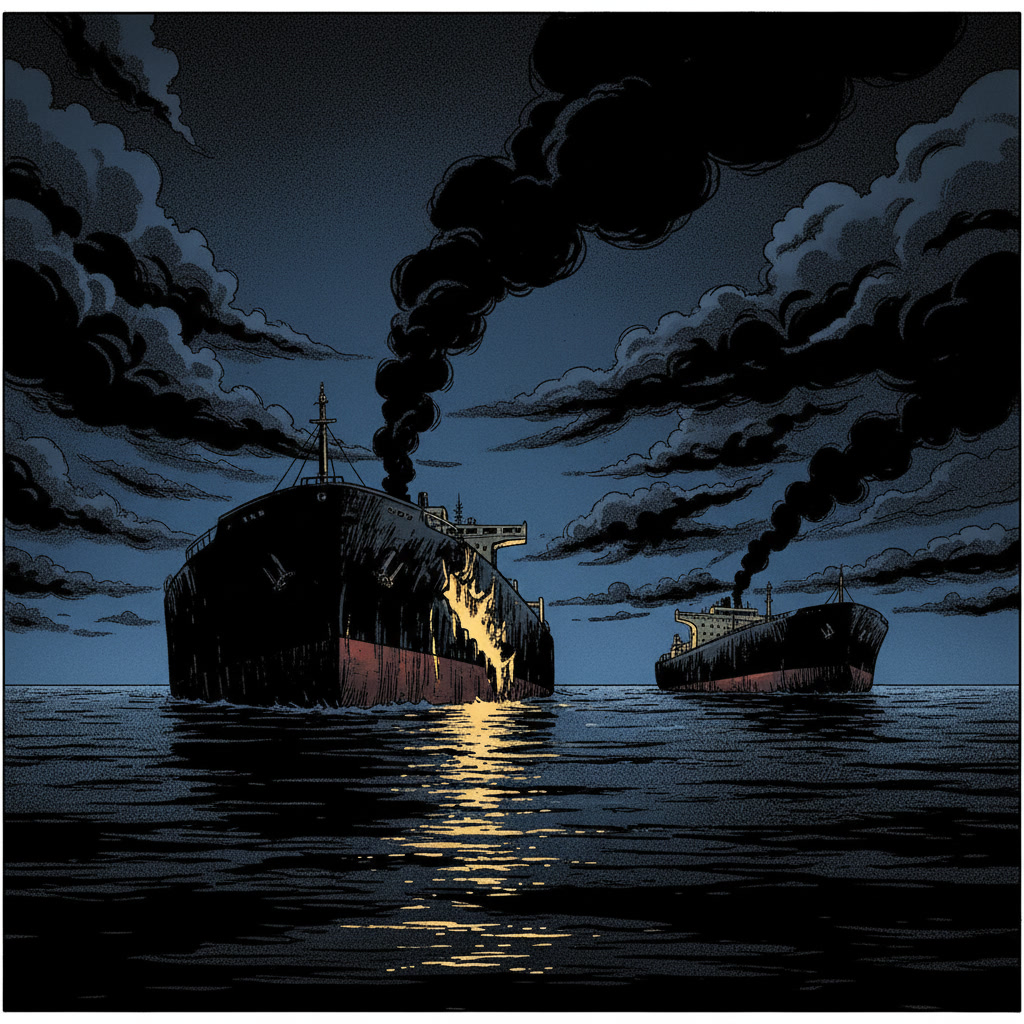
Saudi Ships Under Attack. Oil Crosses $98.
The Plumb Line
Thursday, July 23
Three dollars sounds like a rounding error in a year that has already seen oil move from the mid-seventies to the mid-nineties. It is not a rounding error. The $3 move produced by overnight attacks on two Saudi tankers was sufficient to push Brent to its highest level since the current conflict began *and* to trigger a multi-continent bond sell-off before New York opened. Those are two different things. The read here: when an oil shock produces a bond move, investors are not pricing a supply interruption — they are repricing the duration of the war.
Yesterday this brief named the precise falsification trigger: if the Houthis formalized their entry into the conflict, "the equilibrium read is wrong — that is escalation, not stasis." Today they attacked two Saudi tankers. The equilibrium is broken.
Saudi Ships Under Attack. Oil Crosses $98.
Two Saudi Arabian oil tankers were struck by Houthi forces in the Red Sea overnight, the Financial Times confirmed. Brent crude jumped to $98 a barrel — the Financial Times separately reported that the price surge triggered a global bond sell-off across Asian and European markets. A third FT piece described the attacks as a threat to cut off Saudi Arabia's oil lifeline entirely.
Here's the read. The historical parallel that fits is the Tanker War of 1984 through 1988, when Iran and Iraq attacked each other's shipping and the vessels of neutral trading partners to externalize the economic cost of their war onto the outside world. The logic was never "sink ships to win the war" — it was "make the shipping lanes expensive enough to force outside powers to intervene." In 1987, the United States entered under Operation Earnest Will, reflagging Kuwaiti tankers and providing naval escorts. That intervention stabilized tanker flows in the short term but drew the US into the Gulf theater in ways that produced the accidental shoot-down of Iran Air Flight 655 in July 1988 and left a residue of entanglement that, forty years later, still has the Fifth Fleet homeported in Bahrain. The read here is that the Houthis are running the same play against Saudi Arabia — and the play's endgame is not to destroy Saudi oil exports but to force a great-power response that changes the shape of the war.
What I'd watch for next, with specific falsification triggers: if the US Navy announces an expanded escort posture for Saudi commercial shipping in the Red Sea, the conflict has formally widened — that is the 2026 equivalent of Operation Earnest Will, with all the structural entanglement it implies. If Brent settles above $96 on Friday and the bond sell-off holds through the week, the market has made a duration call, not a disruption call. The falsifying scenario: Saudi Arabia responds with sufficient force to deter further attacks, oil retreats below $95 by early next week, and no change in US naval posture follows. That would mean today was painful but bounded. None of those conditions are in place as of this writing.
Three other things worth knowing
Ukraine crossed a new line in its long-range targeting doctrine. The New York Times reported this morning that Ukrainian strikes have targeted Wildberries — Russia's largest online retailer, often described as its version of Amazon — as part of a deliberate campaign against the civilian commercial infrastructure that sustains Russian domestic morale and consumer confidence. Fuel depots and rail yards are military-logistics targets; an e-commerce giant is a different category entirely. The read here: Ukraine's calculation is that Russia has been hitting Ukrainian civilian infrastructure since 2022 and the principle of reciprocity now extends to the civilian economy. Moscow will call it terrorism; Kyiv will call it economic warfare. Both frames will circulate simultaneously in the information environment, which is part of the strategy.
The US-Saudi nuclear deal has an unresolved enrichment question — and it matters. Two separate New York Times investigations published today document that the Trump administration's nuclear cooperation framework with Saudi Arabia has not settled whether Riyadh will be permitted to enrich its own uranium on Saudi soil. That single unresolved clause is the difference between a civil nuclear program and a latent weapons capability. Egypt, the UAE (United Arab Emirates), and Turkey are all watching the agreement's final language with alarm, according to the Times. Saudi Arabia has been explicit that its nuclear interest is partly an insurance policy against a nuclear-capable Iran. What I'd watch for next: if the enrichment right is granted, at least one other Gulf state demands the same standard within 24 months.
The EU fined Google €890 million — and went through with it anyway. The fine, confirmed by the Financial Times this morning, came despite explicit Trump administration pressure to protect American technology companies from European enforcement action. €890 million is meaningful but not existential for Alphabet; the read here is that the more important signal is what Brussels just demonstrated it is willing to do over Washington's objections. The EU blinked on several regulatory confrontations with US tech in the early Trump years; this one it did not. Whether that represents a durable posture or a one-time stand becomes clearer as subsequent enforcement actions move through the European pipeline.
Echoes
The Tanker War lesson is worth stating plainly because it is the one most likely to be ignored this morning. From 1984 through 1988, attacking shipping worked in the narrow tactical sense: it raised insurance rates by hundreds of percent, complicated the logistics of both belligerents' trading partners, and eventually drew the United States into active Gulf naval operations. What it did not do — in eight years of attacks — was produce a negotiated settlement of the underlying Iran-Iraq conflict. That war ended in 1988 not because the tanker campaign forced a deal but because both countries were exhausted and accepted a UN ceasefire after approximately one million total casualties. The read here: the Houthis may understand this and may not care. Their goal is not to end this war on terms, it is to make the war legible to the outside world as a crisis requiring outside intervention. Attacking Saudi tankers accomplishes that. The risk is that the outside intervention, when it arrives, brings its own irreversibility — as four decades of US naval presence in the Gulf have already demonstrated.
The quiet things
Yesterday's brief tracked tropical storm warnings across Lake Pontchartrain and the Alabama coast. Overnight the storm's footprint shifted decisively west. As of early Thursday, active warnings cover Galveston Bay, the Texas coastal waters from High Island to Freeport, and the Louisiana coast from Port Fourchon to the Lower Atchafalaya River. Lake Charles has warnings across Cameron, Vermilion, Iberia, and Jefferson parishes. The storm that was a Louisiana-Alabama story yesterday is a Houston-area story this morning. It is not receiving coverage proportionate to its footprint because the Red Sea is consuming every available editorial line.
The New York Times published a dispatch from displacement camps in the Democratic Republic of Congo where Ebola is spreading through a densely packed internally displaced population with limited access to clean water or medical care. The dateline includes the sentence: "We will all die from Ebola here." The story received one wire placement today. The rest of the wire is covering the Red Sea.
The White House published four separate trade executive orders today: three targeting Canada specifically — new duties on Canadian motor vehicles, dairy products, and alcoholic beverages — and one strengthening aluminum import tariffs broadly. Four Canada-specific trade actions on a single day, during a formally declared "Made in America Week," is a coordinated cluster rather than a coincidence. The read here is structural escalation of the Canada trade relationship, not an isolated measure. No Canadian retaliation was reported on the wire as of this writing.
How I'd act on this
If you trade energy or watch rate markets — $98 oil with a confirmed multi-continent bond sell-off means the market has made a duration call on this war, not a disruption call. The next clean data point is Friday's Brent settlement. Watch whether the Fifth Fleet announces any posture change; that is the variable that moves oil from the $98–$105 band to somewhere above it.
If you follow Gulf security or Middle East policy — the decision to watch is whether Washington announces a Saudi tanker escort mission in the Red Sea. That announcement, if it comes, is the moment the conflict formally widens to include direct US operational contact with Houthi forces, with all the escalation pathways the Tanker War precedent implies.
If you cover nuclear nonproliferation or Gulf affairs — read today's two Times pieces on the Saudi nuclear deal before the final agreement text is published. The enrichment question is the one that sets the regional proliferation clock, and it is currently unresolved.
If you are on the Texas Gulf Coast this morning, from Galveston to Freeport — the storm is yours now. Tropical storm warnings are active. The national wire is pointing east.
Houthi forces struck two Saudi tankers overnight, oil crossed $98, a bond sell-off spread across three continents before New York opened, and a storm that hit Louisiana yesterday is now at Houston's door — all of it happening simultaneously while Ebola spreads uncovered through displacement camps in Congo.
Yesterday this brief named the falsification trigger; today it fired, and Brent settled the argument at $98.
— *The Plumb Line*. Daily world brief.
Sources
Newswire — Houthi Attacks / Oil / Bond Sell-Off
- newswire/ft (1ddfbe42) — "Oil jumps to $98 after Houthis attack two Saudi Arabian tankers," FT, July 23
- newswire/ft (66bf810f) — "Oil price surge drives global bond sell-off," FT, July 23
- newswire/ft (02bf3e4d) — "Houthi attacks threaten to cut off Saudi Arabia's oil lifeline," FT, July 23
- newswire/nyt (iran-war-strikes-oil-trump, live) — "Here's the latest," NYT live wire, July 23
Newswire — Ukraine / Wildberries
- newswire/nyt (russia-ukraine-wildberries-attacks) — "A New Target for Ukraine's Long-Range Attacks: Russia's Version of Amazon," NYT, July 23
Newswire — U.S.-Saudi Nuclear Deal
- newswire/nyt (us-saudi-deal-nuclear-hedging) — "U.S.-Saudi Deal Prompts Fears of a Nuclear Arms Race," NYT, July 23
- newswire/nyt (us-saudi-arabia-nuclear-deal-123-agreement) — "How the Trump Administration's Nuclear Deal With Saudi Arabia May Work," NYT, July 22
- newswire/nyt (saudi-arabia-nuclear) — "Oil-Rich Saudi Arabia Isn't Short on Energy. Here's Why It's Going Nuclear," NYT, July 23
Newswire — EU / Google
- newswire/ft (c836e73b) — "EU fines Google €890mn in test of Trump's threats to protect Big Tech," FT, July 23
Newswire — Congo / Ebola
- newswire/nyt (ebola-camps-congo-water-aid) — "'We Will All Die From Ebola Here': Virus Stalks Crowded Camps in Congo," NYT, July 23
NOAA Alerts — Gulf Coast Tropical Storm
- noaa_alerts (9e4a65fd, NWS Houston/Galveston TX) — Tropical Storm Warning: Galveston Bay, coastal waters High Island to Freeport TX, July 23
- noaa_alerts (3362d110, NWS Houston/Galveston TX) — Tropical Storm Warning: Coastal Galveston, Chambers, Brazoria Islands, July 23
- noaa_alerts (41dc355e, NWS Lake Charles LA) — Tropical Storm Warning: West/East Cameron, Lower Vermilion, Lower Iberia, Lower Jefferson, July 23
- noaa_alerts (6161a2ef, NWS New Orleans LA) — Tropical Storm Warning: Terrebonne Bay, Port Fourchon to Lower Atchafalaya River, July 23
Federal Register — Trade Executive Orders
- federal_register/2026-14997 — Imposing Additional Duties: Canadian Motor Vehicles (Executive Office of the President), July 23
- federal_register/2026-14992 — Imposing Additional Duties: Canadian Dairy (Executive Office of the President), July 23
- federal_register/2026-14991 — Imposing Additional Duties: Canadian Alcoholic Beverages (Executive Office of the President), July 23
- federal_register/2026-14990 — Further Strengthening Aluminum Import Adjustments (Executive Office of the President), July 23
- federal_register/2026-14999 — Made in America Week, 2026 (Executive Office of the President), July 23
Background / Context
- newswire/nyt (jordan-iran-us-forces) — "U.S. Military Presence in Jordan Makes It Iranian Target," NYT, July 23
- newswire/nyt (saudi-nuclear-deal-trump-houthis) — "Saudi Arabia's Nuclear Plans," NYT, July 22