Kyiv Changed Its General. Rubio Changed Nothing.
The Plumb Line
Wednesday, July 22
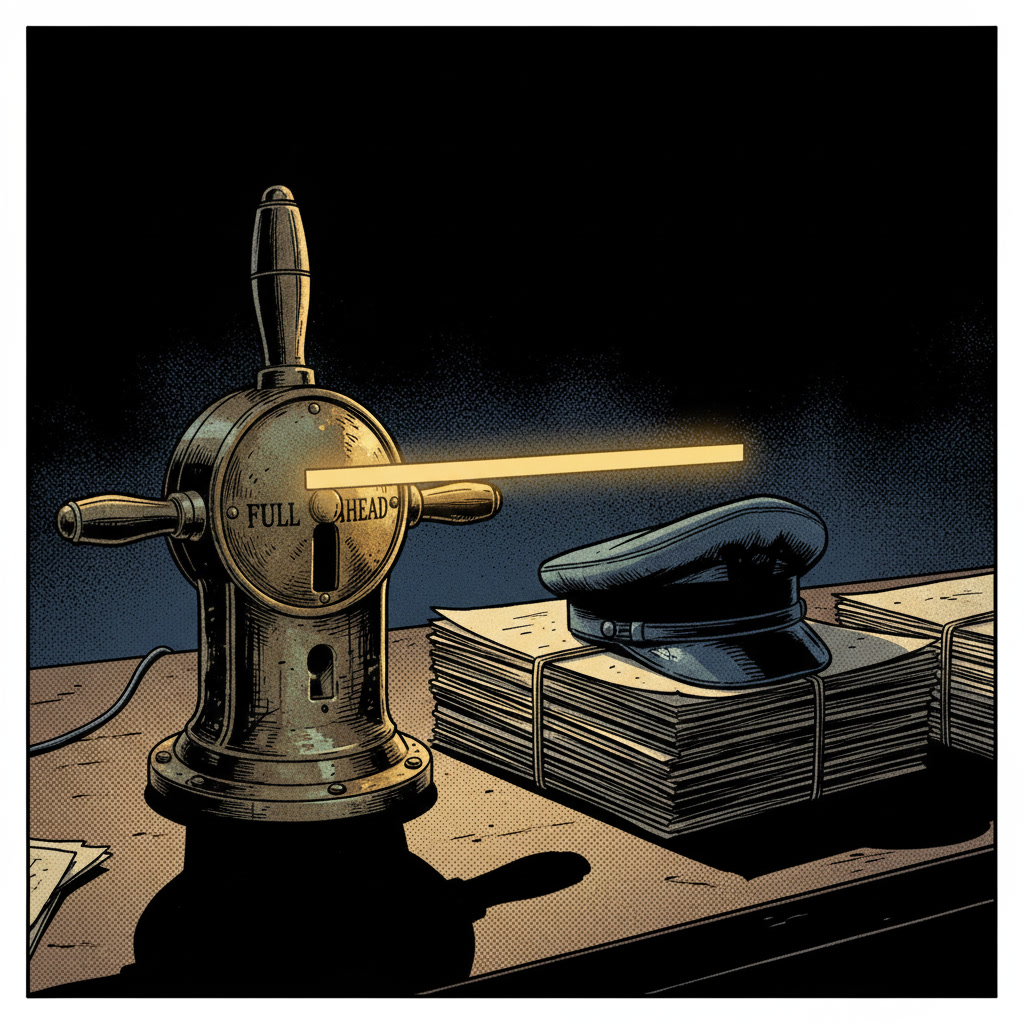
"No letup." That is Secretary of State Marco Rubio's phrase for American airstrikes against Iran, confirmed by the New York Times live wire this morning — and the oil market has taken it literally. Brent crude crossed $95 a barrel overnight, its highest level since the conflict resumed, as traders priced the distance between Rubio's posture and any near-term diplomatic resolution.
The same morning produced a command decision that yesterday this brief said remained "open." It is open no longer. President Zelenskyy has removed General Valery Syrskyi as Ukraine's commander-in-chief, the Financial Times and the New York Times both confirmed — a resolution to weeks of mass protests this brief has been tracking. Two active conflicts, one morning: in Washington, the posture is locked. In Kyiv, the keys just changed hands.
Neither war cares which you're watching.
Kyiv Changed Its General. Rubio Changed Nothing.
Oil crossed $95 a barrel early Wednesday after the Financial Times reported that President Trump threatened further Iran escalation, with Rubio publicly confirming the "no letup" posture on U.S. strikes. The New York Times simultaneously published a piece drawing on interviews with officials across Iran's immediate neighborhood — Pakistan, Turkey, Oman, the Gulf states — describing regional leaders seeking, in the Times's framing, "any deal, any deal" to end the war. That language does not sound like a conflict approaching settlement. It sounds like a conflict that has outlasted the crisis management assumptions of every government in the region.
The read here is this. The historical parallel that fits is not the 1973 oil shock — that was an OPEC embargo, a deliberate supply decision by producers. The closer analog is the second and third years of the Iran-Iraq War, 1981 through 1983, when oil remained elevated not because of a single disruption but because no party had an exit mechanism and every regional actor was quietly extracting leverage before the conflict terminated. The mechanism running today is similar: the "no letup" posture forecloses near-term negotiation, which keeps the risk premium in oil, which incidentally helps finance Iran's war economy through intermediary sales — even as it finances the U.S. military posture against them. At $95, this conflict has found something like its equilibrium price. Neither side is currently paying a cost that exceeds what it has decided to absorb.
What I'd watch for next is specific. If Brent breaks $110, the domestic political calculus in the United States shifts — gasoline becomes a congressional issue, not just a commodity story, and "no letup" faces its first real internal constraint. On the diplomatic side: Oman has historically served as the back-channel for U.S.-Iran communication. If Oman's foreign minister begins traveling visibly to Washington or Tehran, that signal is more reliable than any official statement. If instead the Houthis formalize entry into the conflict — yesterday's brief tracked them as "edging closer," and no wire today has walked that assessment back — the equilibrium read is wrong. That is escalation, not stasis.
Three other things worth knowing
Syrskyi's departure carries more strategic weight than the headlines suggest. General Valery Syrskyi, who commanded Ukraine through the Kharkiv counteroffensive and subsequent operations, has been removed under pressure from mass street protests — a rare instance of democratic accountability operating, messily, inside an active war. The incoming commander, identified in New York Times coverage as Drapatyi, faces an immediate battlefield test with no operational pause while Russian forces reorganize around the transition. The risk in every mid-war command change is a momentum gap: the window between when the old posture stopped working and when the new one proves itself. The read here is that Zelenskyy has demonstrated something significant — civilian protest can move him on command decisions during an active war — and both Moscow and Kyiv's Western allies will have taken note of that.
Tokyo broke its silence on the yen this morning. Japanese authorities vowed to take "bold" action as the yen continued sliding, the Financial Times reported. Japan has deployed this precise language before and followed through: in September 2022, the Ministry of Finance intervened to buy yen for the first time in 24 years after using nearly identical phrasing. Anyone with dollar-yen exposure or Japanese equity exposure should treat this morning's statement as a warning shot, not background noise. The 2022 playbook ran: warn publicly, warn again, then intervene without advance notice. We are currently at step two.
The tropical storm this brief flagged in yesterday's "quiet things" section is now a formal operational emergency. As of this morning, tropical storm warnings are active across Lake Pontchartrain, the Mississippi Sound, Mobile Bay, Breton Sound, Chandeleur Sound, Barataria Bay, and extensive coastal stretches from Louisiana through Mississippi and Alabama. A coastal flood warning covers Lower Plaquemines Parish and parts of southeastern Louisiana. What the National Weather Service listed as a watch yesterday is a warning today. Flash flood warnings are simultaneously active in West Virginia, Arizona, and Utah. The read here is that the storm is not receiving national coverage commensurate with its footprint because the Iran wire is consuming all available editorial bandwidth.
Echoes
The most instructive parallel for Zelenskyy's command decision is the British relief of General Claude Auchinleck in August 1942 and his replacement by Harold Alexander and Bernard Montgomery in North Africa. The mechanism was nearly identical: a political leader under domestic pressure replaced a competent general with an untested one in the middle of an active campaign. Churchill was arguably wrong about Auchinleck's battlefield performance — Auchinleck had stopped Rommel at the First Battle of El Alamein — but correct about the political necessity of the change. Montgomery then won decisively at El Alamein, but it required three additional months, a substantial resupply of material from the United States, and a series of preliminary engagements that nearly unraveled the broader operation. The lesson is not that mid-war command changes fail — sometimes they work. The lesson is that they require a resource buffer and a time buffer that the predecessor didn't have. The question for Drapatyi is whether Ukraine possesses either.
The quiet things
OSHA (Occupational Safety and Health Administration) published twelve separate information-collection notices Tuesday covering formaldehyde, inorganic arsenic, asbestos, ethylene oxide, cadmium, lead, 1,3-butadiene, vinyl chloride, and several other industrial carcinogens. These are collection-activity renewals, not new rules — but the read here is that simultaneous batch publication at this scale typically signals a systematic regulatory review underway. The directional intent won't be visible until comment periods close, but workers in affected industries should know the review is active.
The Financial Times also ran a piece this morning that is being largely ignored: the European Union cannot simultaneously tighten sanctions on Russian oil and maintain its Russian liquefied natural gas imports for winter energy security, and it is currently doing neither cleanly. The EU's Russian energy bind is a story that keeps getting deferred because Iran is dominating the energy policy conversation, but the structural problem doesn't defer with it.
How I'd act on this
If you trade energy or watch the Fed's rate path, $95 Brent is the new floor to monitor. The read here is that the level at which U.S. domestic politics forces a posture rethink sits around $110 — below that, "no letup" is credible and the risk premium holds. Above it, the political economy of the war changes shape.
If you follow Ukraine policy, read the command change less as a personnel story and more as a civil-military dynamics story. A wartime president demonstrated that mass civilian protest can move him on command decisions. That is a significant political fact — and it cuts in multiple directions depending on who's reading it.
If you hold dollar-yen exposure or Japanese equities, Tokyo's "bold" language this morning is the warning shot that precedes the actual shot. Watch the daily Ministry of Finance statements. The escalation sequence is well-established and we are inside it.
If you are anywhere from New Orleans to Mobile Bay this morning, the tropical storm governs your day. Warnings are active. Coastal flooding is expected in parts of Louisiana. The national wire is covering Iran. The Gulf is not reading the national wire.
Rubio said "no letup" and Brent answered at $95; Zelenskyy fired Syrskyi and the front line did not pause to acknowledge it; and tropical storm warnings now stretch from Lake Pontchartrain to Mobile Bay while the cameras face east.
— *The Plumb Line*. Daily world brief.
Sources
Newswire — Iran War / Oil / Escalation
- newswire/nyt (iran-war-strikes-trump-hormuz, live) — "Rubio Signals No Letup in U.S. Strikes," NYT live wire, July 22
- newswire/ft (90facd68-4df7) — "Oil rises past $95 after Trump threatens further Iran escalation," FT, July 22
- newswire/nyt (iran-pakistan-karachi-trade-oil) — "Iran's Neighbors Long for a Deal, Any Deal, to End the War," NYT, July 22
Newswire — Ukraine / Command Change
- newswire/ft (500286b4) — "Zelenskyy replaces top Ukraine general after mass protests," FT, July 22
- newswire/nyt (ukraine-syrskyi-general-russia-war) — "Firing of Ukraine's Top General Signals the End of an Era," NYT, July 22
- newswire/nyt (ukraine-military-chief-drapatyi) — "Ukraine's New Military Chief Faces a Monumental Test," NYT, July 22
- newswire/nyt (2026-07-21, ukraine-general-fired-india-protests) — "A Wartime Rift in Ukraine," NYT, July 21 *(prior-day continuity)*
Newswire — Japan / Yen
- newswire/ft (62d340a5) — "Tokyo vows to take 'bold' action as yen keeps sliding," FT, July 22
Newswire — EU / Russia / Energy
- newswire/ft (05f08fff) — "Why the EU faces a Russian oil vs LNG sanctions stand-off," FT, July 22
NOAA Alerts — Gulf Coast Tropical Storm
- noaa_alerts (e334cb09, NWS New Orleans) — Tropical Storm Warning: Lake Pontchartrain, Mississippi Sound, Lake Borgne, Breton Sound, Chandeleur Sound, Barataria Bay, July 22
- noaa_alerts (e8aa9279, NWS Mobile AL) — Tropical Storm Warning: Mobile Bay, Mississippi Sound, Perdido Bay, Pensacola-area coastal waters, July 22
- noaa_alerts (6fe4cb5a, NWS New Orleans) — Coastal Flood Warning: Lower Plaquemines, Eastern Orleans, Lower St. Bernard, Southeast St. Tammany, July 22
- noaa_alerts (multiple, NWS Flagstaff / Charleston / Pittsburgh) — Flash Flood Warnings: Coconino AZ, Yavapai AZ, Piute UT, West Virginia (Barbour, Randolph, Upshur, Ritchie et al.), Ohio (Monroe, Noble, Guernsey, Muskingum), July 22
Federal Register — OSHA Carcinogen Collection Review
- federal_register/2026-14849 — Formaldehyde (OSHA); /2026-14850 — Inorganic Arsenic; /2026-14840 — Asbestos; /2026-14843 — Ethylene Oxide; /2026-14842 — Cadmium; /2026-14851 — Lead; /2026-14839 — 1,3-Butadiene; /2026-14853 — Vinyl Chloride; /2026-14844 — 13 Carcinogens (4-Nitrobiphenyl et al.) — OSHA information-collection renewals, July 22
NVD — Oracle Quarterly Patch Cycle
- nvd_cve/CVE-2026-60358, CVE-2026-60217, CVE-2026-60644 et al. — Oracle Fusion Middleware, Database Server, PeopleSoft, Siebel CRM critical patches, July 21–22