The Truce Broke. Trump Wants a Toll.
The Plumb Line
Tuesday, July 14
$87.
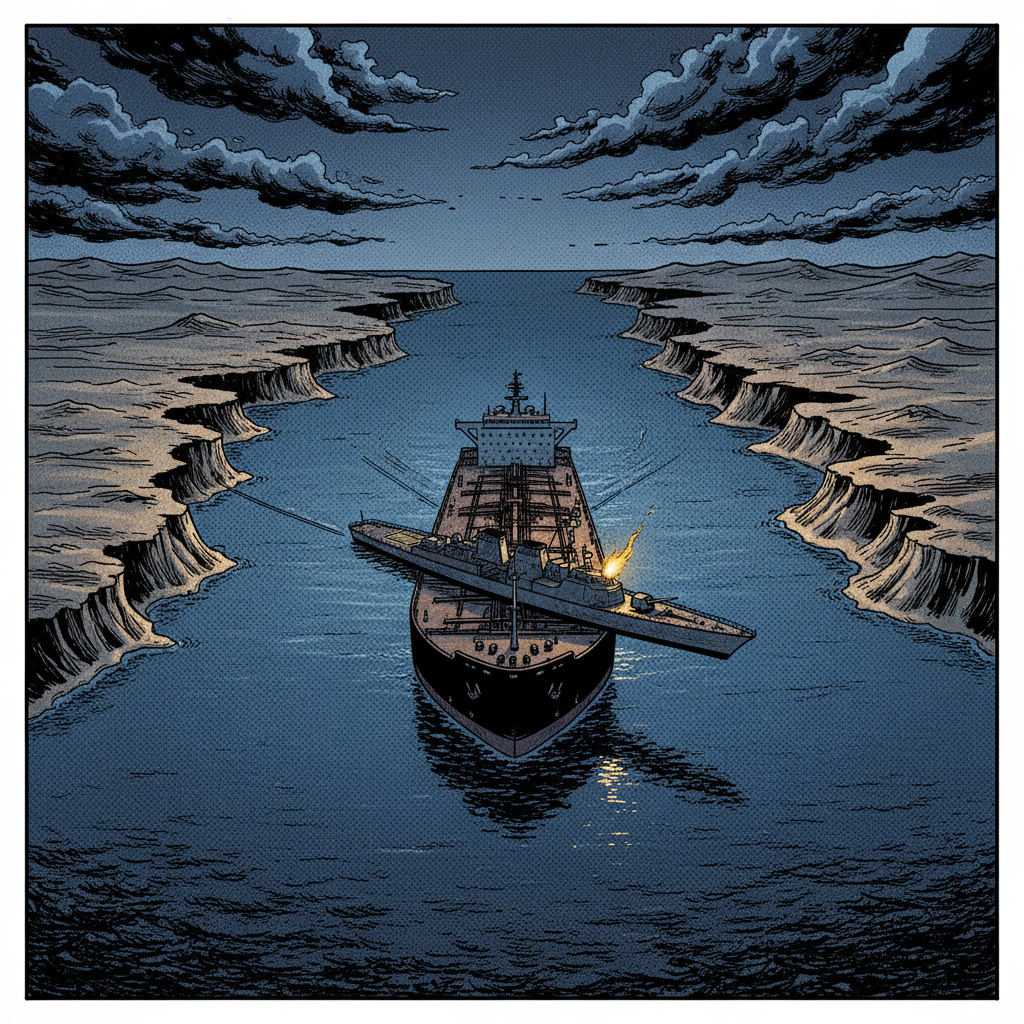
That's where crude oil traded this morning as the United States launched airstrikes on Iran for the third consecutive night, the truce framework the wires were calling a ceasefire yesterday officially collapsed, and the White House announced it was contemplating a transit toll on the Strait of Hormuz — the chokepoint through which roughly 20 percent of the world's oil supply passes each day.
Yesterday's brief concluded that a ceasefire without an enforcer is a pause between strikes, not a peace. Bloomberg this morning confirmed it — the truce is gone, with attacks on Gulf shipping worsening overnight and the blockade returning. India summoned Tehran's ambassador in New Delhi after an Indian seafarer was killed when Iranian-backed forces struck a vessel in the Gulf. UK government borrowing costs hit their highest level since May, not because of anything happening in London, but because a war in the Persian Gulf reprices risk everywhere it touches.
The toll proposal is the genuinely new element, and the read here is that it deserves closer attention than the energy desks will give it. The Strait of Hormuz is international waters under the UN Convention on the Law of the Sea. No single government has legal authority to charge transit fees there. What the Trump administration is describing is either the military enforcement of a fee schedule — which would require naval presence sufficient to stop and tax some 17 million barrels of oil per day — or it is a pressure instrument designed to bring Iran and the Gulf states to the table on American terms. The price of crude reflects the market's honest uncertainty about which one this is.
The Truce Broke. Trump Wants a Toll.
The US launched airstrikes on Iranian targets for a third night, confirmed by Bloomberg and the New York Times, which characterized the exchange as a "return to open conflict." Separately, Bloomberg's morning reporting confirmed the US-Iran truce has collapsed entirely as attacks on Gulf shipping intensified and the blockade resumed. Oil hit $87 per barrel. India summoned the Iranian ambassador after an Indian national died in an attack on a vessel in the Gulf. UK gilt yields — the market's read on British government borrowing costs — hit their May peak, driven by the oil surge passing through European inflation expectations. Bloomberg and the NYT both published detailed accounts of Trump's proposal to charge a transit toll on Hormuz, without yet specifying a price.
Here's the read. The toll proposal changes the politics of this crisis in ways that won't be visible immediately. The historical parallel worth reaching for is not 1973 but 1956 — the Suez Crisis. Egyptian President Gamal Abdel Nasser nationalized the Suez Canal in July of that year, announced transit fees, and triggered a military response from Britain, France, and Israel. What stopped them was not battlefield failure but American pressure: Eisenhower forced the allies to stand down, on the principle that no power — including American allies — could use a global chokepoint as a revenue instrument. The irony today is that the United States is making the move Eisenhower spent political capital to prevent. If Trump is serious, he is asserting that the US Navy has the right to toll international waters through military enforcement — a categorical departure from the freedom-of-navigation order that American power spent eight decades constructing. If he is not serious, the toll is a bargaining chip designed to force a negotiation Iran won't attend voluntarily. The price of crude is what $87-per-barrel skepticism looks like.
What I'd watch for next: if the toll proposal acquires a specific price — a dollar amount per barrel or per vessel — before the end of this week, it has moved from leverage theater to implementation planning, and $87 will look cheap in retrospect. If no number appears and the language softens within 72 hours, the read shifts to maximum-pressure bluff. The falsifier is the price tag.
Three other things worth knowing
JPMorgan Chase reported record profits on a "blockbuster trading haul" this morning, with Bank of America and Wells Fargo filing earnings disclosures the same morning. The read here is legible without much analysis: the firms whose trading desks profit most from volatility are announcing records on the same morning oil hits $87 and Gulf shipping is under fire. The earnings tell you Wall Street is fine; they tell you nothing about whether crude at this level can be absorbed by the consumers and manufacturers who can't hedge their exposure at a trading desk.
China's Communist Party expelled a senior Politburo official on corruption and sex charges, according to the New York Times. Politburo-level purges are rare — the body has 24 members — and the read here is that they almost always signal consolidation by Xi Jinping rather than spontaneous accountability. The timing is worth noting: a domestic political drama of this scale lands precisely when Beijing's silence on the Gulf crisis is becoming a subject of open international commentary. Whether the purge frees political bandwidth for a Chinese initiative on the conflict, or simply reflects Xi managing internal pressures, is not knowable from the outside today.
The Fish and Wildlife Service rescinded the regulatory definition of "harm" under the Endangered Species Act, published today in the Federal Register as a significant rule. Since a 1995 Supreme Court ruling, "harm" had included habitat modification — meaning land use that degraded a protected species' environment could constitute illegal harm under federal law even without directly killing an animal. Eliminating that definition narrows the law's reach considerably and opens terrain that has been legally constrained for three decades. Environmental attorneys anticipate a challenge; the question is how quickly activity begins on the ground before litigation concludes — and how much of it will be irreversible.
Echoes
The 1956 Suez Crisis is the sharpest parallel to a government proposing to toll a major international waterway. Nasser's nationalization of the Suez Canal and his announcement of transit fees produced a military coalition — Britain, France, and Israel — that attempted to retake it by force. Eisenhower's intervention stopped them, and the core of his argument was that freedom of navigation was an American strategic interest, not merely a maritime principle, and that any transit-fee regime in chokepoint waters set a precedent dangerous to American commerce globally. What Trump is now proposing is precisely the logic Eisenhower deployed American prestige to defeat — applied this time by Washington itself. The read here is that the mechanism has been turned inside out: the guarantor of the old order is now its most prominent challenger.
The quiet things
China has been publicly silent on the Iran crisis for roughly 96 hours — through the ceasefire's emergence, its collapse, three nights of American airstrikes, and now the announcement of a Hormuz toll. Yesterday's brief noted that the silence was gaining weight each day it held. The read here is that it is now impossible to describe as anything other than a considered policy choice. Beijing may be calculating that the United States will impose its terms without Chinese involvement. It may have communicated preferences through private channels and be watching for results. Or its actual leverage over Iranian decision-making is more constrained than the depth of their energy relationship implies. A Chinese foreign ministry statement calling for Iranian compliance with any negotiated framework would, at this point, be the single most consequential de-escalation signal available from any government. Every additional hour of quiet makes that signal more valuable if it ever comes — and more revealing if it does not.
How I'd act on this
If you trade energy or manage commodity exposure — $87 is where the market is today, but the more actionable number is war-risk insurance premiums in the Persian Gulf. If Lloyd's and the marine war-risk market hold transit rates elevated, physical oil cannot move at normal cost regardless of what any government announces. The toll proposal adds a second layer of uncertainty: no shipping operator yet knows whether US naval enforcement of a transit fee is theoretical or imminent.
If you hold UK gilts or track European sovereign debt — the oil-inflation transmission is already showing up in yield moves, with gilt rates at their May peak this morning. If crude stays at or above $87 for 30 days, European central banks face the same inflation-versus-growth dilemma they misjudged badly in 2022. The Bank of England's next rate decision becomes materially harder than it was last week.
If you follow environmental law or land-use policy — the Endangered Species Act "harm" definition rescission published today is worth reading in full. It is the kind of regulatory change that moves slowly in courts but quickly on the ground: developers, timber operators, and agricultural interests can begin relying on the new interpretation before any injunction, and some of the activity that follows will be difficult to reverse.
If you cover China's Gulf posture — the next 48 hours are a genuine inflection point. Each day Beijing stays silent while the situation deteriorates makes its eventual statement either more significant or more irrelevant, depending on what the conflict looks like when it finally arrives.
The ceasefire that yesterday's brief said wasn't holding has been confirmed collapsed; the blockade is back, the strikes have entered their third night, oil is at $87, and the United States is now proposing to charge passage through international waters.
If the toll gets a price this week, $87 was the cheap print.
— *The Plumb Line*. Daily world brief.
Sources
Iran / Hormuz / US Strikes / Oil
- newswire/bloomberg — "US-Iran Truce Collapses as Attacks Worsen and Blockade Returns" (July 14)
- newswire/bloomberg — "Trump Plans Hormuz Toll as US-Iran Truce Collapses" video (July 14)
- newswire/nyt — "Trump's Plan to Charge a Toll in the Strait of Hormuz: What to Know" (July 14)
- newswire/nyt — live coverage: "Here's the latest" Iran/war/Trump/Hormuz (July 14)
- newswire/nyt — "U.S. Strikes Iran for 3rd Night, in Return to Open Conflict" (July 13–14)
- newswire/ft — "Oil hits $87 as battle for Strait of Hormuz alarms energy markets" (July 14)
- newswire/ft — "UK borrowing costs hit highest level since May as oil surges" (July 14)
- newswire/bloomberg — "India Summons Iran Envoy After Seafarer Dies in Ship Attacks" (July 14)
- newswire/bloomberg — "How the Middle East Has Been Changed Forever" (July 14)
US Bank Earnings
- sec_edgar/0001628280-26-048078 — JPMorgan Chase 8-K (items 2.02, July 14)
- sec_edgar/0000070858-26-000353 — Bank of America 8-K (items 2.02, July 14)
- sec_edgar/0000072971-26-000288 — Wells Fargo 8-K (items 2.02, July 14)
- newswire/ft — "JPMorgan reports record profits on blockbuster trading haul" (July 14)
China
- newswire/nyt — "China Purges Top Official Over Corruption and Sex Charges" (July 14)
Endangered Species Act
- federal_register/2026-14195 — "Rescinding the Definition of 'Harm' Under the Endangered Species Act" (SIGNIFICANT; Interior Dept., Fish and Wildlife Service; July 14)
Europe / NATO
- newswire/ft — "We are not on course for a Nato divorce — yet" (July 14)
- newswire/bloomberg — "Bulgaria Quits Pro-Ukrainian Coalition of the Willing" (July 14)
Weather
- noaa_alerts — Extreme Heat Warning, NWS Billings MT (south-central and southeastern Montana, through July 16)
- noaa_alerts — Extreme Heat Warning, NWS Glasgow MT (central/eastern Montana, through July 16)
- noaa_alerts — Extreme Heat Warning, NWS Twin Cities/Chanhassen MN (Minneapolis metro and surrounding region, through July 16)
- noaa_alerts — Flash Flood Warnings, NWS Austin/San Antonio TX and NWS San Angelo TX (Medina, Uvalde, Bexar, Comal, Crockett, Schleicher, Sutton counties; July 14)