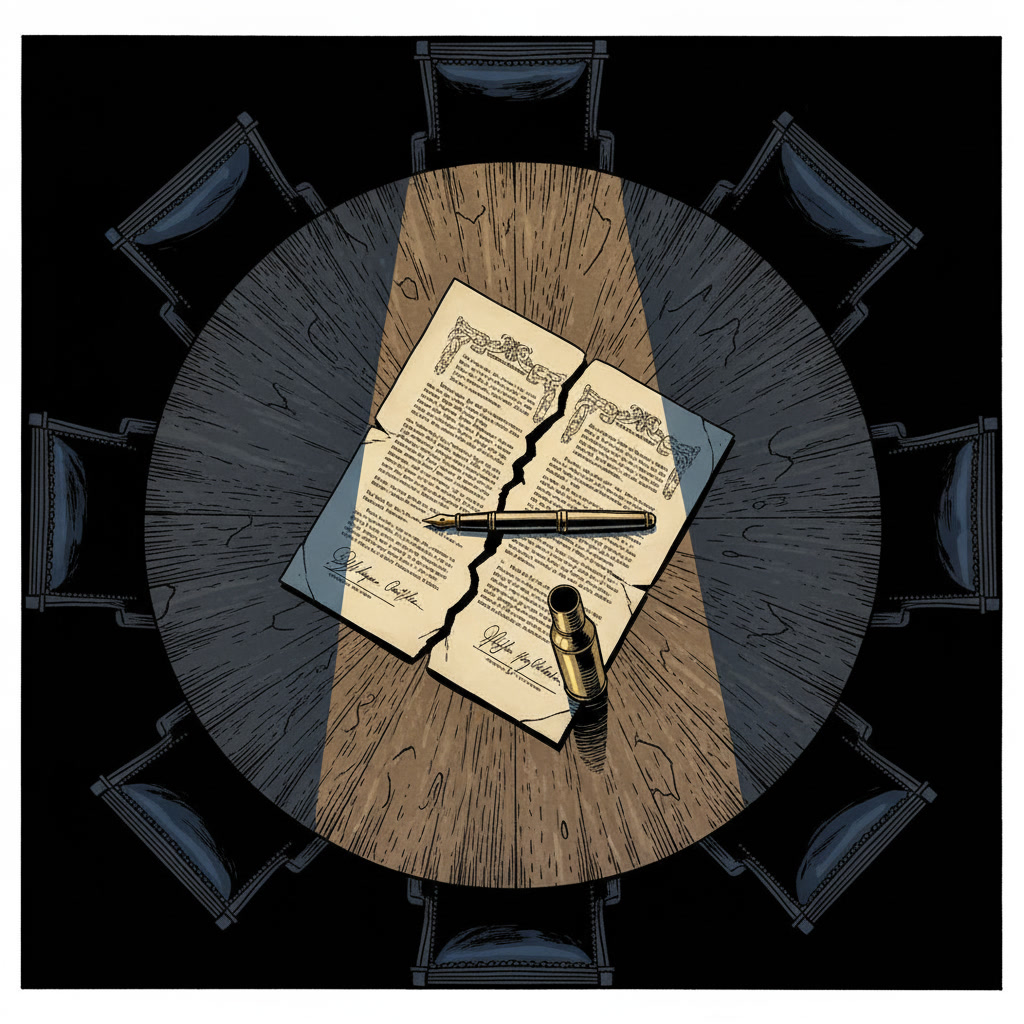
The Ceasefire Is Teetering. Tehran Is Not.
The Plumb Line
Monday, July 13
Three things happened overnight that together define what kind of week this is becoming. The United States and Iran traded fresh strikes while a ceasefire framework that materialized overnight is already teetering — Tehran retaliated against American military action and its leadership is publicly ramping up threats rather than reaching for an exit. Simultaneously, Ukrainian President Volodymyr Zelenskyy dismissed his Prime Minister while European heads of government convened in Paris to sketch a security architecture that no longer assumes Washington at its center. And the extreme heat emergency that yesterday's brief called a weather regime has expanded north and east into major population centers: Extreme Heat Warnings now cover the entire Twin Cities metropolitan area — Hennepin, Anoka, Ramsey, Washington, and surrounding counties — through July 16.
Three simultaneous crises. Each would dominate a quieter week. None of them got one.
The connective thread worth naming — and this is analysis, not fact — is that all three are running in the space created by American strategic ambiguity. The Iran strikes continue without a formal war-authorization vote. Zelenskyy's reshuffle comes partly because Kyiv's position in Washington has weakened — yesterday's brief reported Senator Lindsey Graham's death; the Times followed up this morning noting Ukraine has now lost its most effective advocate in Trump's immediate circle. And the Paris conversations exist because NATO's traditional architecture cannot be assumed intact.
The Ceasefire Is Teetering. Tehran Is Not.
The Financial Times reported overnight that the United States launched additional airstrikes on Iranian targets and Iran retaliated in kind. Bloomberg's morning brief confirmed the exchange under the headline "Fresh US-Iran Strikes Threaten Ceasefire," indicating that some form of ceasefire framework is on the table — a development not visible in Sunday's coverage — but that neither side is observing it. The New York Times ran live updates headlined "Iran Ramps Up Threats as It Retaliates Against U.S. Strikes," meaning Tehran's response is not limited to the military exchange but includes an explicitly escalatory political posture. As of this morning, no formal ceasefire has been accepted by both parties. Separately, the Times published a significant intelligence report: Israel conducted a covert operation to cultivate Mahmoud Ahmadinejad, the former Iranian president. The full scope and current status of that operation have not been disclosed.
The read here: a ceasefire on paper with no party willing to enforce it is not a diplomatic off-ramp — it is a pause that allows both sides to reload while the language of de-escalation provides cover. The historical parallel is the first ceasefire of the 1973 Yom Kippur War. UN Security Council Resolution 338 was passed on October 22 with both superpowers as co-sponsors. Egyptian and Israeli forces kept fighting for three more days. What finally made it stick was not the text but a threat: on October 25, the United States moved to a heightened nuclear readiness posture, a direct signal to Moscow that Washington would impose real costs if Soviet forces entered the theater. The mechanism was an enforcer willing to name consequences. Today's framework has no equivalent. China, which has more economic leverage over Tehran than any other government and more at stake in open Gulf transit than any other country, has issued no public statement calling for Iranian compliance. Russia is silent. The Western coalition cannot enforce a ceasefire while simultaneously conducting strikes against one of the parties. The Ahmadinejad intelligence story adds a dimension worth carrying: Israeli intelligence apparently believed there were exploitable fractures inside Iranian politics deep enough to justify cultivating its former president. Whether that assessment was correct, or whether the operation contributed to the current configuration in Tehran rather than containing it, is a question the coming weeks will begin to answer.
What I'd watch for next, in the next 48 hours: whether either the United States or Iran announces a unilateral operational pause, and whether any government — China above all — publicly links its relationship with Tehran to compliance with the ceasefire terms. If no pause occurs and no enforcer steps forward by Tuesday, the framework is decoration. The falsifier worth tracking precisely: a Chinese foreign ministry statement calling for Iranian compliance would be the single largest de-escalation signal available right now, because it would mean Beijing has calculated that the cost of continued hostilities exceeds the benefit of strategic silence. Every additional day Beijing says nothing makes the third interpretation more probable — that China's leverage in Tehran is more limited than the scale of their bilateral relationship implies.
Three other things worth knowing
Zelenskyy's Prime Minister dismissal comes at Kyiv's weakest diplomatic moment in months. Bloomberg reported that the Ukrainian president removed his Prime Minister while European leaders were assembled in Paris. The Graham vacancy, confirmed this morning by the Times, removes Ukraine's most reliable congressional advocate in Trump's immediate circle at the precise moment a wartime leadership reshuffle raises questions about strategic direction. The read here: Zelenskyy's personnel changes have historically preceded rather than followed strategic pivots. The identity of the replacement will be the first concrete signal of which direction he is pivoting toward.
France is formally summoning Russia's ambassador over cyberattacks on French government systems. Bloomberg reported the diplomatic demarche — a step beyond prior French attributions of Russian interference, which typically stopped short of a formal ambassador-level summons. Taken alongside the Paris security summit convened the same day, the read here is a French government that has decided the era of managed coexistence with Russian hybrid operations is over. That is a meaningful shift in posture, and it has implications for how Europe's new security architecture will treat the boundary between military and non-military threats.
Global equities fell this morning, with Asian memory chipmakers leading the decline. The Financial Times and Bloomberg both reported the sell-off, framing it as two concurrent fears: the Gulf crisis pressing on energy and shipping costs, and uncertainty about whether the AI capital-expenditure cycle that has driven semiconductor valuations is approaching its peak. Two distinct risks, one market move — and the analytical challenge is knowing which one is actually in the price. The read here: the next sharp market move is disproportionately large whichever trigger fires first.
Echoes
The 1973 Yom Kippur War ceasefire is the right place to look. Resolution 338 passed the Security Council on October 22 with both superpowers co-sponsoring it. It did not hold. Three days later, with Soviet forces reportedly moving toward the theater, the Nixon administration issued a DefCon 3 (Defense Readiness Condition 3) alert — the sharpest American nuclear-readiness signal in decades — to make the enforcement cost explicit. The ceasefire held from that moment. The lesson is not that ceasefires are impossible in the Middle East; it is that they require an actor willing to name consequences for non-compliance and to be believed when it does. In 1973 that actor was the United States, and it worked because the Soviets believed the signal. Today, the actor with the most credible leverage over Tehran is China, and China is silent. The parallel does not guarantee failure — but it names the mechanism that is missing.
The quiet things
China's foreign ministry has now been silent on the Iran conflict for more than 72 hours — through the Hormuz closure, through the fresh strikes, and through the emergence and early deterioration of a ceasefire framework. Yesterday's brief called that silence a data point. Today it is a policy in all but name. The read remains the same, but the weight on each interpretation has shifted. Beijing may believe the situation will resolve without its intervention. It may have communicated preferences privately and be watching for Iranian compliance. Or — and this interpretation gains force with each passing day — its leverage in Tehran is more constrained than the depth of their energy relationship implies. If the ceasefire deteriorates further through Tuesday with no statement from Beijing, the third interpretation deserves serious weight. A Chinese foreign ministry statement urging Iranian compliance would, at that point, be more significant than anything the Western coalition could say.
How I'd act on this
If you trade energy or manage supply-chain exposure — the "ceasefire teetering" designation is the variable that determines whether last week's oil price move is a ceiling or a floor. Watch Lloyd's of London and the major maritime war-risk insurers before today's close. If war-risk ratings on Persian Gulf transit hold elevated, tanker operators cannot insure passage regardless of what either government announces, and the physical market cannot recover until they can.
If you follow Ukraine policy or track US Senate dynamics — the Zelenskyy Prime Minister dismissal and the Graham vacancy are the two variables that together define Kyiv's diplomatic position for the fall. The South Carolina governor controls the appointment timing; whoever fills that Senate seat gives you the first real read on whether the chamber's hawkish coalition holds or narrows. Whoever Zelenskyy names as Prime Minister tells you whether Kyiv is preparing for a settlement push or a military consolidation.
If you cover European defense or follow NATO's evolution — the Paris summit combined with France's ambassador summoning on the same day represents a French government publicly committing, in a single news cycle, to both European strategic autonomy and harder responses to Russian interference. That is a materially different posture than six months ago, and it has procurement and treaty implications that will take months to become visible.
If you are anywhere in the upper Midwest — the National Weather Service has Extreme Heat Warnings active through July 16 for large portions of Minnesota, North Dakota, Montana, and Wisconsin. The Twin Cities metro is now inside the warning area. These are warnings, not watches, and a four-day duration for a major urban population center is not routine language.
Today a ceasefire arrived on the wires and began unraveling before either side agreed to it, a Ukrainian wartime cabinet reshuffle signaled a strategic pivot no one has named yet, and an Extreme Heat Warning reached Minneapolis through Thursday.
A ceasefire without an enforcer is a pause between strikes, not a peace.
— *The Plumb Line*. Daily world brief.
Sources
Iran / US Strikes / Ceasefire
- newswire/ft — "US launches more strikes on Iran as ceasefire teeters" (July 13)
- newswire/ft — "FirstFT: Stocks tumble on Iran and AI fears" (July 13)
- newswire/bloomberg — "US and Iran Trade Fresh Strikes" video brief (July 13)
- newswire/bloomberg — "Fresh US-Iran Strikes Threaten Ceasefire; TMSC Sales Surge | Daybreak Europe 7/13/2026" (July 13)
- newswire/nyt — live coverage: "Iran Ramps Up Threats as It Retaliates Against U.S. Strikes" (July 13)
- newswire/nyt — live coverage: "Here's the latest" / "Here's a look at the heavy strikes in recent days" (July 12–13)
- newswire/nyt — "Inside Israel's Secret Operation to Cultivate Ahmadinejad" (July 13)
Ukraine / Zelenskyy / Graham
- newswire/bloomberg — "Zelenskyy Removes Prime Minister as Allies Meet in Paris" video (July 13)
- newswire/nyt — "With Lindsey Graham Gone, Ukraine Loses an Ally in Trump's Ear" (July 13)
- newswire/ft — "Ukraine's drone swarms test Moscow air defences" (July 13)
Europe / NATO / France / Russia
- newswire/bloomberg — "What a Europe-Led NATO Would Look Like" (July 13)
- newswire/bloomberg — "France to Summon Russia Ambassador Over Cyber Attacks" (July 13)
- newswire/bloomberg — "US-NATO Allies Prepare to Defend Themselves After Trump Threats" (July 13)
Global Markets
- newswire/ft — "Global stocks fall as Asian memory chipmakers hammered" (July 13)
US Extreme Heat / Flood Emergency
- noaa_alerts — Extreme Heat Warning, NWS Twin Cities/Chanhassen MN (Hennepin, Anoka, Ramsey, Washington, Carver, Scott, Dakota; through July 16)
- noaa_alerts — Extreme Heat Warning, NWS Twin Cities/Chanhassen MN (Douglas, Stearns, Benton, Sherburne, Wright, and surrounding central/western Minnesota + western Wisconsin; through July 16)
- noaa_alerts — Extreme Heat Warning, NWS Duluth MN (northern Minnesota / northern Wisconsin; through July 13–14)
- noaa_alerts — Extreme Heat Warning, NWS Grand Forks ND (eastern North Dakota / northwestern Minnesota; through July 14)
- noaa_alerts — Extreme Heat Warning, NWS Bismarck ND (nearly all of North Dakota; through July 14)
- noaa_alerts — Extreme Heat Warning, NWS Aberdeen SD (north-central South Dakota; through July 16)
- noaa_alerts — Extreme Heat Warning, NWS Billings MT (south-central and southeastern Montana; through July 14–16)
- noaa_alerts — Extreme Heat Warning, NWS Glasgow MT (central and eastern Montana; through July 14)
- noaa_alerts — Extreme Heat Warning, NWS Riverton WY (western and central Wyoming; through July 14)
- noaa_alerts — Extreme Heat Warning, NWS Pocatello ID (southern Idaho; through July 13)
- noaa_alerts — Extreme Heat Warning, NWS Grand Junction CO (southeast Utah / western Colorado; through July 14)
- noaa_alerts — Red Flag Warning, NWS Cheyenne WY (eastern Wyoming / Nebraska panhandle; through July 15)
- noaa_alerts — Flash Flood Warning, NWS Blacksburg VA (Surry NC, Wilkes NC; July 13)
- noaa_alerts — Flash Flood Warning, NWS Fort Worth TX (Tarrant County TX; July 13)
- noaa_alerts — Flood Watch, NWS Blacksburg VA (30+ counties in Virginia and North Carolina; through July 13)
- noaa_alerts — Flood Watch, NWS Morristown TN (east Tennessee / southwest Virginia; through July 13)