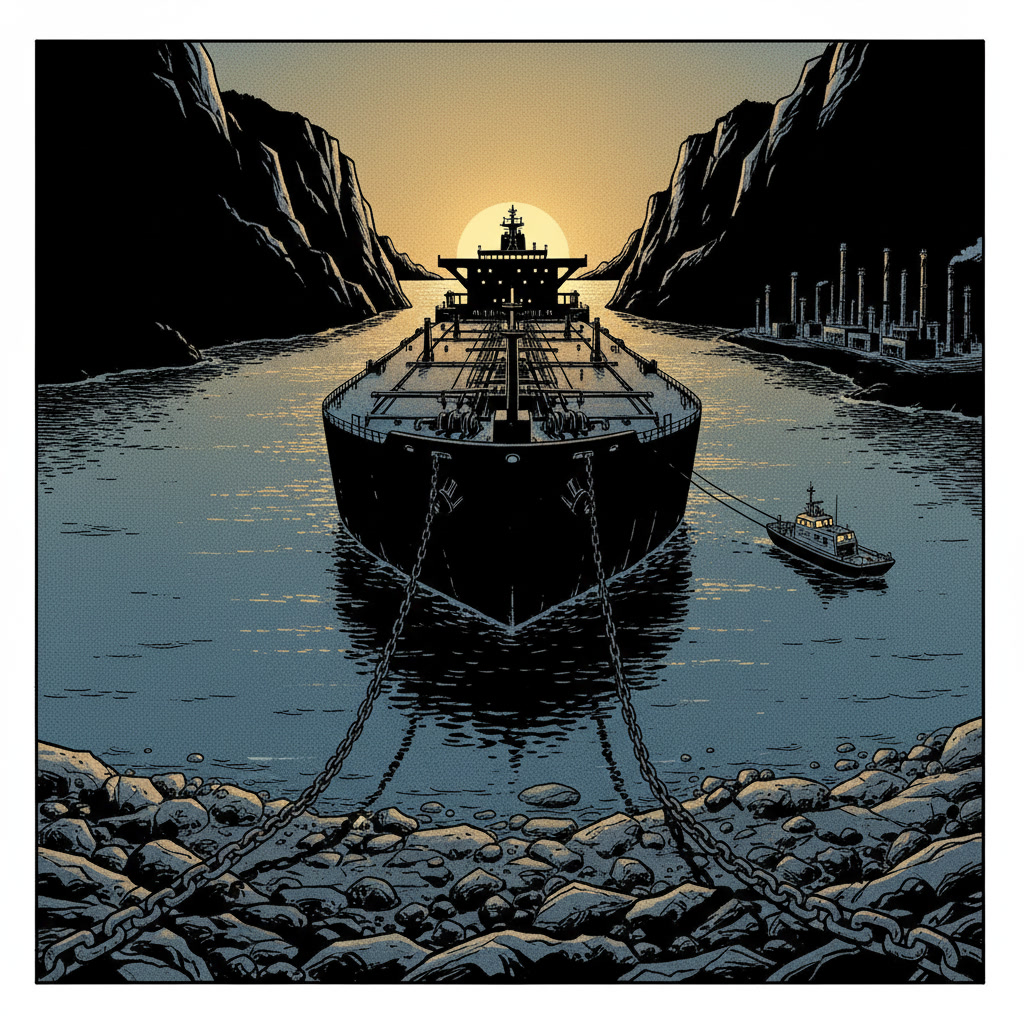
Iran Sealed the Gulf. America Struck Back.
The Plumb Line
Sunday, July 12
"Closed until further notice."
Iran's declaration about the Strait of Hormuz — issued after Iranian forces fired on a vessel attempting transit and carried by Bloomberg before midnight — is the kind of language that insurance underwriters, tanker captains, and energy traders cannot discount by morning. The Strait is not one choke point among many. It is the passage through which a significant fraction of the world's seaborne oil and nearly all of the Persian Gulf's liquefied natural gas exports move. A closure, even a declared one, reprices global energy markets before anyone can determine whether it will actually be enforced.
Yesterday's issue was built on a specific observation: Foreign Minister Araghchi's flight to Muscat meant the diplomatic channel was open. It named a falsifier: "If the United States issues any new military posture announcement in the Gulf within 72 hours, treat today's Muscat meeting as noise and the confrontation as moving into a harder phase." That falsifier has triggered. The US launched fresh airstrikes on Iran overnight in direct response to the Hormuz incident. The read here: the Muscat channel either failed, was overtaken by events, or was never fully authorized by the faction that matters in Tehran. The confrontation is now in its harder phase.
That faction is visible today. The New York Times is running a piece headlined "Hard-Liners in Iran Want to Keep Fighting America" — the read here is that the political argument inside Tehran over the last day appears to have been won by the side least interested in an Omani-brokered exit.
Iran Sealed the Gulf. America Struck Back.
Iranian forces fired on a vessel in the Strait of Hormuz, prompting Tehran to formally declare the waterway "closed until further notice." The United States responded with fresh airstrikes on Iranian targets, per the Financial Times and Bloomberg. The New York Times documented oil prices moving sharply on the news, with continued volatility expected as markets price the risk that tanker operators will treat the closure as enforceable. Separately, the Times reported that Iranian hard-liners are now publicly pressing for sustained combat with the United States — an internal posture that substantially constrains whatever diplomatic space was being probed through Oman.
The historical parallel is Operation Praying Mantis, April 18, 1988 — the single day of concentrated US naval action during the Tanker War in which the Reagan administration destroyed two Iranian oil platforms and sank or disabled several Iranian vessels in direct response to Iranian mine warfare against tankers. Iran did not escalate further. The mechanism that made it work: Iran was simultaneously fighting a grinding land war against Iraq, was economically exhausted, and had already concluded that continued conflict with the United States was unwinnable. The read here on why 2026 is different: Iran is not fighting a simultaneous land war elsewhere, its hardline faction has just won an internal argument about whether to keep fighting rather than losing one, and the domestic US political environment is considerably more skeptical of open-ended Gulf engagement than Reagan's was. The 1988 playbook is the one being reached for. Whether the conditions for its success still obtain is the central question this week will begin to answer.
What I'd watch for next: whether Iranian forces actively interdict vessels in the coming 48 hours, or whether the closure is a declaration rather than an enforcement action. If Iranian forces board or fire on additional ships, this is a blockade — with legal and military implications that move significantly beyond what has happened so far. If no new interdiction occurs and tanker operators resume transit within 72 hours, treat the closure as a pressure move, serious but not yet a blockade. The falsifier worth tracking carefully: does China — the world's largest importer of Persian Gulf oil — make any public statement urging Iranian restraint? Beijing has said nothing so far. The read here: that silence, extended through the weekend, is its own data point.
Three other things worth knowing
Senator Lindsey Graham of South Carolina died Saturday at age 71. The Financial Times and Bloomberg both reported his death, citing a sudden illness. Graham had been the Senate's most persistent hawk on Iran — a consistent voice for military pressure on Tehran and for continued American arms supply to Ukraine. The read here: his death removes a reliable institutional voice for sustained Gulf engagement at the precise moment the Senate will eventually be asked whether to formally authorize what the executive branch is currently doing there. South Carolina's governor controls the appointment; whoever fills that seat in the coming weeks matters for the war-authorization arithmetic in the chamber.
Ukraine struck Russia's Syzran refinery and tankers operating in the Azov Sea overnight. Bloomberg reported the strikes, which represent Kyiv's continued assault on Russian energy infrastructure and Black Sea logistics. The New York Times ran a piece this morning framing the parallel precisely: Trump sought an exit from the Iran confrontation while Putin pressed forward in Ukraine — "now both are stuck" is the Times's summation of the dual-theater bind Washington currently occupies. The read here: the Syzran strike is Kyiv signaling that even while global attention has shifted to the Gulf, Ukraine is not standing still on its own front.
The compound weather emergency across the American interior has entered its fourth consecutive day without breaking. The National Weather Service in Bismarck issued Extreme Heat Warnings covering nearly all of North Dakota through July 14, spanning dozens of counties from Williams and McKenzie in the west to Dickey and McIntosh in the south. Parallel warnings are active across Montana, Wyoming, Utah, and Idaho. Simultaneously, Flood Watches covering eastern Kentucky run through July 13, with additional watches and active warnings across West Virginia, Tennessee, and Virginia. Yesterday's issue identified this as a weather regime. The read here: the regime has not retreated.
Echoes
Operation Praying Mantis is where the American military's institutional memory of managing Iran in the Gulf is anchored. One day of concentrated naval action in April 1988, after Iranian mines crippled the USS Samuel B. Roberts, ended the Tanker War's most dangerous phase without wider escalation. That outcome became the template: overwhelming tactical superiority plus Iranian exhaustion equals a manageable ceiling on conflict. The read here: what that template does not account for is an Iran that is not exhausted — one whose hard-liners have just won an internal argument about whether to keep fighting rather than losing it. The lesson from 1988 is real. Whether the conditions that made it work transfer to 2026 is precisely what the next several days will test.
The quiet things
China has said nothing publicly about the Hormuz closure. That silence is significant because Beijing is the world's largest importer of Persian Gulf oil and has more at stake in open Strait transit than almost any other government. The read here: the silence could mean several things — Beijing expects the closure to be short and is waiting, Beijing has already communicated privately to Tehran and is observing the result, or Beijing's leverage in Tehran is more limited than it appears. If the closure holds past 72 hours with no Chinese statement, the third interpretation becomes more probable — and that tells you something important about how much weight Beijing's preferences actually carry in the current configuration in Tehran. A Chinese foreign ministry statement urging restraint, by contrast, would be the most significant diplomatic signal of the week.
How I'd act on this
If you trade energy or manage supply-chain exposure in transportation or manufacturing — the Hormuz declaration is the dominant fact of the week. Watch for Lloyd's of London and the major Protection and Indemnity clubs to update war-risk ratings by Monday morning; those ratings determine whether tanker operators can secure insurance for transit, and without insurance, no transit occurs regardless of what either government says. The read here: the spread between what insurance markets price and what official statements claim will be more informative than either alone.
If you follow US Senate dynamics or defense appropriations — the Graham vacancy matters for war-authorization politics more than almost any other individual Senate appointment available right now. South Carolina's governor has not announced a timeline; whoever is named gives you the first real read on whether the Senate's hawk coalition narrows or holds through the fall.
If you cover Ukraine or track Russian energy and military logistics — the Syzran strike deserves focused attention. Syzran sits in Samara Oblast in central Russia and produces refined petroleum products that feed military as well as civilian supply chains. The read here: a damaged or offline Syzran refinery is a logistics problem for the Russian front, not a symbolic gesture.
If you are a citizen in North Dakota, Wyoming, Montana, Utah, or Idaho — the National Weather Service Heat Warnings run through Monday in most areas. The guidance to limit outdoor exposure during afternoon peak hours is not precautionary language; it is active, and the coverage area is enormous.
The Muscat meeting was the off-ramp. Iran closed the Strait before anyone could take it.
— *The Plumb Line*. Daily world brief.
Sources
Iran / Hormuz / US Strikes
- newswire/bloomberg — "US Launches Fresh Iran Strikes as Tehran Declares Hormuz Closed" (July 11)
- newswire/ft — "US launches fresh strikes after Tehran declares Strait of Hormuz closed" (July 12)
- newswire/nyt — "U.S. Strikes Iran After Iran Fires on Ship in Strait of Hormuz" (July 11)
- newswire/nyt — "Hard-Liners in Iran Want to Keep Fighting America" (July 12)
- newswire/nyt — "Oil Prices Set for More Volatility After Latest Iranian Attack in Strait of Hormuz" (July 12)
- newswire/nyt — "Trump Sought an Iran War Exit. Putin Pushed On in Ukraine. Now Both Are Stuck." (July 12)
- newswire/nyt — live coverage: "Here's the latest" / "Here's a look at the heavy strikes in recent days" (July 11–12)
Lindsey Graham
- newswire/ft — "US senator Lindsey Graham dies aged 71" (July 12)
- newswire/bloomberg — "Lindsey Graham, Senate Hawk Turned Trump Ally, Dies at 71" (July 12)
Ukraine / Russia
- newswire/bloomberg — "Ukraine Says It Hit Russia's Syzran Refinery, Azov Sea Tankers" (July 12)
- newswire/ft — "Russia closes in on city that made the Kremlin glitter" (July 12)
US Weather Emergency
- noaa_alerts — Extreme Heat Warning, NWS Bismarck ND (nearly all of North Dakota; through July 14)
- noaa_alerts — Extreme Heat Warning, NWS Glasgow MT (central and eastern Montana; through July 13)
- noaa_alerts — Extreme Heat Warning, NWS Billings MT (south-central Montana; through July 14)
- noaa_alerts — Extreme Heat Warning, NWS Riverton WY (western and central Wyoming; through July 13)
- noaa_alerts — Extreme Heat Warning, NWS Salt Lake City UT (northern Utah / southwest Wyoming; through July 14)
- noaa_alerts — Extreme Heat Warning, NWS Pocatello ID (southern Idaho; through July 13)
- noaa_alerts — Extreme Heat Warning, NWS Grand Junction CO (southeast Utah / western Colorado; through July 14)
- noaa_alerts — Extreme Heat Warning, NWS Aberdeen SD (north-central South Dakota; through July 14)
- noaa_alerts — Flood Watch, NWS Jackson KY (eastern Kentucky; through July 13)
- noaa_alerts — Flood Watch, NWS Louisville KY (central Kentucky; through July 12)
- noaa_alerts — Flood Watch, NWS Charleston WV (West Virginia / eastern Kentucky / western Virginia; through July 12)
- noaa_alerts — Flood Watch, NWS Morristown TN (east Tennessee / southwest Virginia; through July 13)
- noaa_alerts — Flash Flood Warning, NWS Morristown TN (Hancock County TN, Lee County VA; July 12)