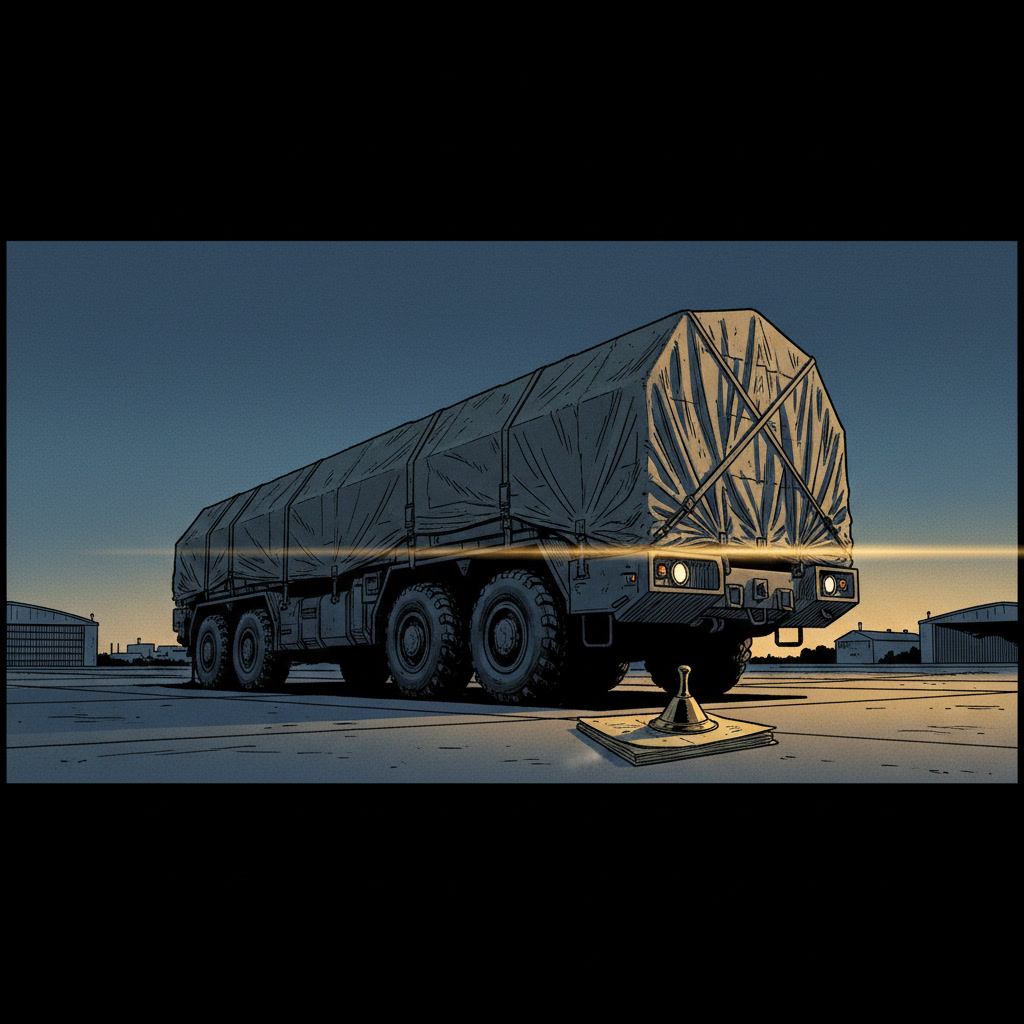
Turkey Put the S-400 Up for Sale
The Plumb Line
Friday, July 10
What has the NATO summit in Antalya produced, 48 hours after the handshakes ended? The wire services spent Wednesday night summarizing the spending-target communiqué. The real answer arrived today in the language that actually moves alliance policy: hardware.
Turkey has approached Washington about surrendering its Russian-made S-400 air defense system — the purchase that got Ankara expelled from the F-35 program in 2019 — in exchange for re-entry into that program, Bloomberg reported this morning. The European Union confirmed separately that it will allow Ukraine to spend its €60 billion security loan on British-manufactured weapons, not just arms from EU member states. Yesterday this brief identified Germany's Tomahawk contract as the summit's real deliverable. Today, two more pieces landed.
The read here: these three decisions — German Tomahawks, Turkish S-400 exit offer, EU-to-UK weapons bridge for Ukraine — are not coincidental. They are what the summit's participants actually concluded, expressed in procurement rather than in press releases. The communiqué will be forgotten by autumn. These contracts will still be in force in 2035.
Turkey Put the S-400 Up for Sale
Turkey purchased its S-400 air defense system from Russia in 2019 despite explicit NATO warnings, and the United States expelled it from the F-35 Joint Strike Fighter program immediately thereafter. The cost has compounded since: Turkey's air force has been flying upgraded F-16s with no path to the next-generation American fighter while European NATO partners take F-35 delivery. Bloomberg reported this morning that Ankara is now seeking Russian consent — the system cannot legally be transferred without Moscow's approval — to offload the S-400, with American F-35 access as the explicit ask in return.
Here's the read. The transaction is not imminent and faces at least two genuine veto points: Russian refusal and a US congressional approval process that would be contested. But Turkey is now publicly making the offer, and that is itself the strategic signal. A country that was still hedging between its NATO commitments and its Russian supplier relationship as recently as 2022 has put the Russian asset on the table. The read here is strategic recalibration under pressure: the US-Iran confrontation this week, the momentum of the Antalya summit, and a widening F-35 capability gap all shifted Turkey's cost-benefit calculation on the Russian hedge. The historical parallel is France's 2009 decision to rejoin NATO's integrated military command, 43 years after de Gaulle pulled France out in 1966. Sarkozy's reasoning was almost structurally identical to Erdoğan's apparent calculation now: sitting outside the alliance's hardware architecture was costing more — in operational relevance, procurement access, and influence over planning — than the symbolic independence was worth. The timing of France's reintegration, like Turkey's S-400 offer, arrived not in a moment of weakness but in a moment when the price had finally been priced correctly.
What I'd watch for next: if the State Department or Pentagon issues any statement welcoming dialogue with Turkey on the S-400 within the next ten days, treat that as confirmation the offer is serious — a real opening, not a gambit. If no official American response emerges, discount the timeline accordingly. The hard falsifier is a Kremlin statement. Russian refusal ends the transaction before it begins, and Moscow has every incentive to refuse; if Russian consent were somehow forthcoming, it would signal something unusual about what Turkey had privately offered in return.
Three other things worth knowing
Iran's Supreme Leader is still absent — and today the New York Times made it a standalone story. Yesterday this brief called the Iranian succession void "the most important structural fact about this confrontation, receiving a fraction of the coverage it deserves." Overnight the Times published a full piece on the continued absence at the top of the Iranian government. What is new today is not the underlying fact but its visibility: it has finally broken through as a headline in its own right. The Assembly of Experts has still not announced a convening date or named candidates. Iran is absorbing military pressure without a named central authority. The void persists.
At least twelve people have died in a southern Spain wildfire as a European heatwave deepens. The Financial Times put the toll at twelve; the New York Times reported at least eleven. The fire is burning through a period both outlets describe as an active European heatwave. Extreme heat warnings are simultaneously in effect across California's Coachella Valley, the San Diego County desert areas, and the San Gorgonio Pass near Banning. Simultaneously — and separately — dozens of counties across Kentucky, Missouri, Illinois, Indiana, and Iowa are under flood watches or flash flood warnings running through Saturday morning. The read here: the compound pattern of extreme heat in one region and catastrophic flooding in another is precisely the scenario that climate researchers have modeled as increasingly common; a research paper published this week in the OpenAlex preprint repository modeled exactly this kind of compound flood-heatwave risk for coastal development zones.
The Department of Housing and Urban Development rescinded its federal floodplain management rules today. The Federal Register entry was flagged as SIGNIFICANT — the administration's own designation for rules it judges consequential enough to require heightened review. The rescission removes minimum property standards that had required federally financed housing to be built above Federal Flood Risk Management Standard elevations in flood-prone zones. The timing is conspicuous: the rescission published the same morning that the National Weather Service issued flood watches covering 34 eastern Kentucky counties through Saturday, alongside flash flood warnings across Missouri and southern Illinois. Whether the timing matters legally is a question for whoever sues first. The calendar has already answered the symbolic question.
Echoes
Turkey's position rhymes with France's in 2008. De Gaulle pulled France from NATO's integrated military command in 1966, insisting French sovereignty required independence from the American-dominated alliance structure. For 43 years that position held — not because France was weak, but because the cost of independence hadn't been totaled honestly. Sarkozy totaled it in 2008 and reversed the decision the following year: France had no voice in the planning decisions shaping European security for the next generation, and no amount of Gaullist prestige compensated for that absence. The read here: Turkey's S-400 situation is structurally identical — a sovereignty statement made under different conditions, now costing more than it buys. The lesson from France's reintegration is instructive on timeline: Sarkozy announced the intent in 2008, the formal reintegration completed in 2009, and the downstream procurement effects took years to fully materialize. Expect Turkey's F-35 conversation to outlast the S-400 transaction by a similar margin.
The quiet things
The Gulf has nearly disappeared from the wire. Yesterday this brief was almost entirely consumed by the US-Iran confrontation, the commercial shipping exit, and Oman's diplomatic role as back channel. Today there is one New York Times piece on the Iranian leadership void — and that is essentially all. No new strike reporting, no Hormuz update, no Omani Foreign Ministry statement. The read here: this absence is not nothing. Either the confrontation is in a genuine tactical pause, or the news cycle rotated, or something is moving in channels this brief cannot see. The falsifier offered yesterday still holds: Omani silence is itself a signal about the back channel's status. I cannot speak to that from what the wires say today — but a story this dominant on Wednesday does not evaporate by Friday without reason.
The International Energy Agency warned this morning of an approaching petrol and diesel supply crunch, according to the Financial Times. On a day when the Gulf story was running hot, that warning would have commanded a different kind of attention. Today it ran quietly, separated from the context that would amplify it.
How I'd act on this
If you follow European defense procurement or hold exposure to defense contractors with F-35 supply chains — the Turkey story is the read. Re-entry into the F-35 program would reopen billions of dollars in Turkish industrial participation that was suspended in 2019. Don't price it in yet, but put it on the list.
If you cover Ukraine financing or EU fiscal architecture — the UK weapons approval means British defense firms are now directly in the €60 billion financing loop. That expands Ukraine's procurement options and changes who competes for European defense contracts in ways the EU-only framework never allowed.
If you hold US housing or real estate exposure in flood-prone regions — the HUD floodplain rescission is the regulatory development to track. Federally financed construction in flood zones will face lower minimum standards going forward. Insurance markets will reprice before builders do.
If you cover energy markets — pair the IEA supply crunch warning with what you know about Gulf shipping posture. The two stories belong together; today they ran separately, without the connective tissue the wire would normally provide.
Germany signed for Tomahawks Wednesday, Turkey offered the S-400 Thursday, and the EU unlocked British weapons for Ukraine today. The summit that mattered was not the one that ended in Antalya.
— *The Plumb Line*. Daily world brief.
Sources
Turkey / NATO / S-400 / F-35
- newswire/bloomberg — "Turkey Seeks to Offload Russian Weapon to Secure F-35 Access"
EU / Ukraine / UK Weapons
- newswire/bloomberg — "EU to Allow Ukraine to Buy UK Weapons With its €60 Billion Loan"
Iran Succession
- newswire/nyt — "Iran's Supreme Leader Remains Absent, a Void at the Top of the Regime"
Spain Wildfire / European Heatwave
- newswire/ft — "At least 12 people die in Spanish wildfire as heatwave grips Europe"
- newswire/nyt — "At Least 11 People Die in Southern Spain Wildfire"
- newswire/nyt — "Fighting Fires With Figures, These Experts Are Trying to Stop Europe from Burning"
US Flooding / Weather
- noaa_alerts — Flood Watch, NWS Jackson KY, July 10–12 (34 eastern Kentucky counties)
- noaa_alerts — Flood Watch, NWS Paducah KY, July 10–12 (multi-state: KY, IL, MO)
- noaa_alerts — Flood Watch, NWS Louisville KY and NWS Wilmington OH (additional Ohio Valley counties)
- noaa_alerts — Multiple Flash Flood Warnings, NWS St. Louis MO and NWS Paducah KY
- noaa_alerts — Extreme Heat Warning, Coachella Valley / San Diego County Deserts / San Gorgonio Pass, July 10
HUD Floodplain Rescission
- federal_register/2026-13939 — Rescission of Floodplain Management and Protection of Wetlands; Minimum Property Standards for Flood Hazard Exposure (HUD, designated SIGNIFICANT)
IEA Fuel Supply
- newswire/ft — "IEA warns of petrol and diesel supply crunch"
China Space / Long March 10B
- launch_library/1e79a5e9 — Long March 10B Demo Flight, launch successful, Low Earth Orbit, Wenchang Space Launch Site
- celestrak/69674 — TJS-26A cataloged (Chinese satellite, launch year 2026)