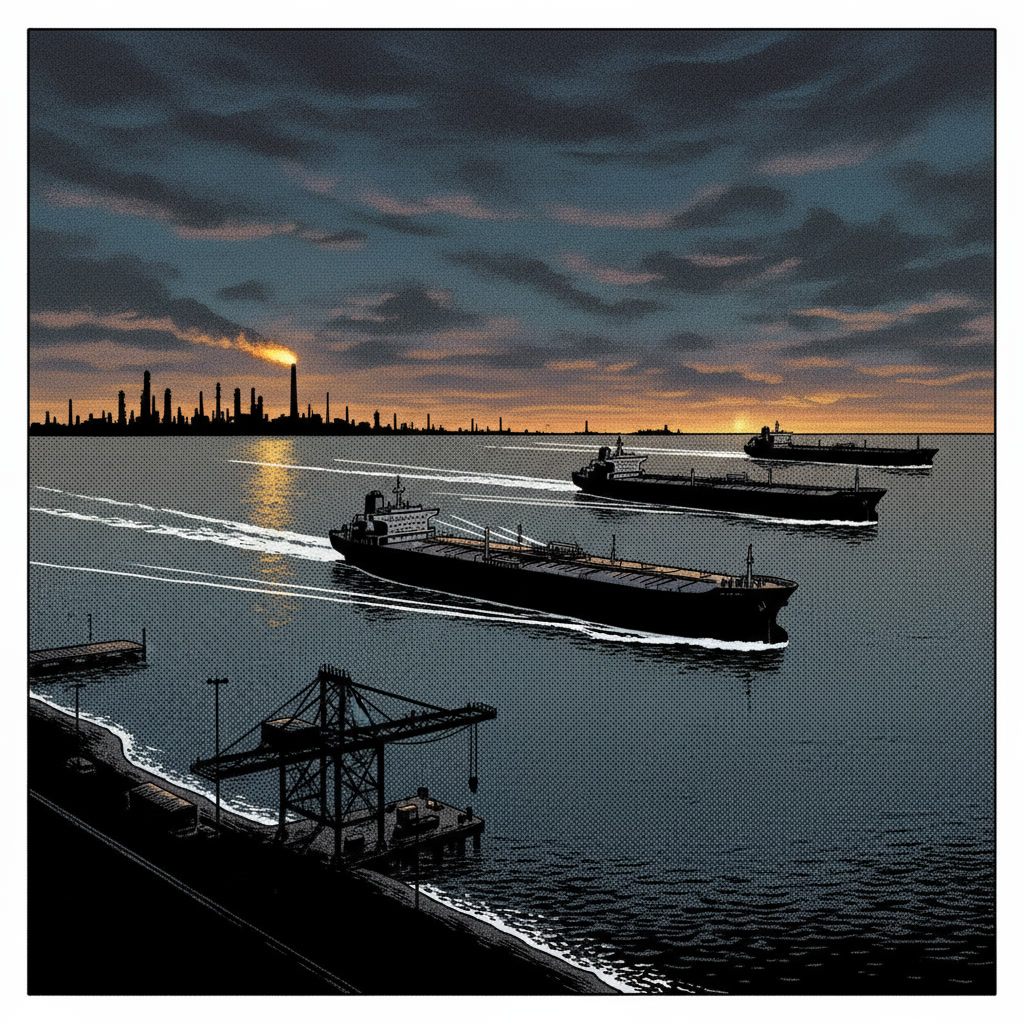
Count the Ships That Left
The Plumb Line
Thursday, July 9
The story dominating every wire this morning is the exchange of strikes between the United States and Iran — what the New York Times is calling a "violent cycle." That framing is accurate. Here's what it obscures when you read it as a single story.
Three things happened yesterday that aren't on the Iran page: Germany signed a contract to buy American Tomahawk cruise missiles at the NATO summit in Antalya; Chinese officials held what Bloomberg described as quiet, low-key meetings to assess where the US-Iran confrontation lands and whether the American midterms change the calculation; and ship operators — the people who own the actual vessels threading Gulf corridors — started moving their assets out voluntarily, before any Hormuz closure. These facts belong together. The read here: a NATO ally purchasing American strike weapons tells you how European capitals are reading American credibility right now. Beijing calculating quietly tells you how long China expects this to run. And the ships leaving tell you what the people with the most to lose — the ones who can't afford to be wrong — have already decided.
One more detail, easy to miss. The weeklong funeral of Ayatollah Ali Khamenei — which was expected to conclude this week — has been delayed. An Iranian government under active military pressure, without a named successor to its Supreme Leader, is now also unable to complete the burial rites that would formally close the transition moment. The organizational state of the Iranian government is visible in that fact, if you look at it straight.
Count the Ships That Left
The New York Times live blog on the Iran confrontation has been running continuously since yesterday, and the picture it presents as of this morning is of both sides trading attacks — not a one-off exchange but a back-and-forth that has settled into a rhythm. Bloomberg reported separately that stranded oil tankers are now clearing out of the Gulf as owners "get wary again." That phrase — "wary again" — carries the institutional memory of commercial shipping operators who have spent a generation learning what Gulf risk looks like before it materializes into physical interdiction. The delayed Khamenei funeral, meanwhile, is not a logistical footnote. The read here is that it's a signal about the operational coherence of an Iranian government that is simultaneously absorbing military strikes and preparing to name a new supreme leader.
Here's the read. Yesterday this brief identified two trajectories and a falsifier: Hormuz open means negotiation is still live; Hormuz threatened means something harder has begun. The voluntary exodus of commercial shipping is not a Hormuz closure — but it is the market's verdict on which trajectory is more probable. The historical parallel is early 1988, when Lloyd's of London war-risk premiums effectively priced many operators out of Gulf transit before the military situation fully escalated. The mechanism is the same now: commercial withdrawal precedes the event and deepens it, because it removes the commercial arguments for restraint that both sides had been quietly relying on.
What I'd watch for next: if Iran signals through Oman — Muscat's traditional role as back channel when Tehran wants to talk without being seen talking — a reversal of the commercial exit will follow within days. Speed of reversal is the falsifier. A fast reversal means the evacuation was precautionary; no reversal by this weekend means the operators know something that diplomatic channels haven't said publicly yet. If instead Iranian naval assets move toward the lower Gulf, or any indication of mining activity emerges, this crosses from commercial anxiety to physical interdiction — a different category of crisis, with a different price response.
Three other things worth knowing
Germany's Tomahawk purchase is the most concrete deliverable from the NATO summit. Chancellor Friedrich Merz confirmed the deal at Antalya, according to the Financial Times. Berlin had spent decades avoiding this category of American strike weapon, for reasons rooted in Germany's postwar strategic culture. The read here: that it has now signed the contract tells you something the summit's spending-target debates don't — European capitals are drawing hardware conclusions from what they're watching in the Gulf, independent of whatever the communiqué says about burden-sharing percentages. What I'd watch for next is whether Poland, Romania, or the Netherlands follow within the next 60 days. That is how alliance rearmament actually propagates — one country breaks the psychological barrier, and the rest have cover.
China is calculating, not intervening. Bloomberg reported that Beijing's officials are holding quiet meetings focused on two questions: the status of the US-Iran confrontation, and how American electoral dynamics might shift it. China is Iran's largest oil customer and among the most Hormuz-dependent economies on earth. The read here: that Beijing is framing its assessment around the American midterms — a two-year horizon — tells you Chinese officials are waiting for a different American administration rather than engaging the current one. The absence of any Chinese public statement on Gulf shipping security is not diplomatic modesty. It is a posture.
Oman is caught in the vice. Bloomberg published an extended piece on how Muscat is being squeezed by both Washington and Tehran as the confrontation deepens. Oman has historically served as the quiet intermediary when the two sides want to communicate without being seen communicating — the early Obama-era nuclear conversations ran through the Omani government before Geneva ever happened. Today that role is under documented stress. What I'd watch for next: if the Omani foreign ministry goes quiet — no statements, no ministerial travel — the most reliable back channel between the combatants has been suspended, and you should update your estimate of talks resuming soon accordingly.
Echoes
The commercial evacuation of the Persian Gulf has happened before, in almost exactly this sequence. In 1987, Iran mined Kuwaiti shipping lanes, Lloyd's war-risk premiums priced many operators out of the corridor, and the United States responded by reflagging Kuwaiti tankers and providing naval escorts. The Gulf reopened to commercial traffic — but only after American warships were physically present and prepared to absorb fire. USS Stark was struck by Iraqi missiles in May 1987, killing 37 sailors; USS Vincennes shot down Iran Air 655 in July 1988, killing 290 civilians. The confrontation ended not through diplomacy but through exhaustion and accident. The lesson from that sequence, as I read it, is not that escalation was contained — it wasn't — but that Iran's threshold for physically closing the Strait is higher than its rhetoric suggests, because closing Hormuz hurts Iran's remaining customers as much as its adversaries. The question in July 2026 is whether the unidentified officials who now hold Iranian decision-making authority have inherited that particular institutional memory.
The quiet things
The loudest silence continues to be Iran's succession. We flagged it yesterday; it remains unresolved today. The Assembly of Experts — the clerical body empowered to designate a new Supreme Leader — has not publicly announced a convening date or candidates. Khamenei's funeral is now delayed, which means the ritual that would formally close the previous era has not yet occurred. Iran is receiving American military strikes, conducting retaliatory strikes, and managing the final rites of a forty-year leadership — simultaneously, without a named central authority. The read here is that this is the most important structural fact about this confrontation, and it is receiving a fraction of the coverage it deserves.
How I'd act on this
If you hold energy positions or any commodity tied to Gulf supply — the indicator to watch is not Brent crude in isolation but the spread between spot and forward prices. The commercial evacuation of the Gulf is a leading indicator of a supply disruption, not a lagging one. The risk premium accumulates in that spread before it shows up as a spot-price event.
If you cover European defense procurement — the German Tomahawk purchase is the datum to anchor, not as a story about Germany but as a signal about sequencing. What happens at a NATO summit when the agenda was supposed to be spending percentages but the Gulf is on fire: the hardware purchases are the real deliverable. Watch Poland and Romania over the next 60 days.
If you follow Chinese foreign policy — the low-key meetings Bloomberg reports are more informative than any Beijing press release. The read here: China is not planning to intervene; it is planning to inherit whatever comes after. The two-year electoral horizon those officials are reportedly discussing is China's actual timeline for this situation, not ours.
If you track Middle East diplomacy — watch Oman, specifically. No statement from Muscat is itself a statement. If the Omani foreign ministry goes quiet, the back channel is suspended. If it speaks, something is moving.
Yesterday's brief said the falsifier was simple: Hormuz open means talks live, Hormuz threatened means something harder. Today, ship operators gave their verdict before the diplomats did — and they voted with their hulls.
— *The Plumb Line*. Daily world brief.
Sources
Iran / US Conflict / Gulf / Hormuz
- newswire/nyt — "Live Updates: U.S. and Iran Sink Into Violent Cycle After Latest Strikes"
- newswire/nyt — "Here's the latest" (NYT Iran live blog update)
- newswire/nyt — "Final Stage of Ayatollah Ali Khamenei's Weeklong Funeral Is Delayed"
- newswire/bloomberg — "Stranded Oil Ships Clear Out of Gulf as Owners Get Wary Again"
- newswire/bloomberg — "US, Iran Trade Attacks, Casting Doubt on Talks"
- newswire/bloomberg — "How the Future of Hormuz Is Testing Oman's Balancing Act"
NATO Summit / European Defense
- newswire/nyt — "At NATO Summit, Trump Puts on a Show While Europe Gets Down to Business"
- newswire/bloomberg — "NATO Success Is Surviving a Summit With Trump"
- newswire/ft — "Germany strikes deal to buy US Tomahawk missiles, Merz says"
- newswire/bloomberg — "Germany Proposes Consumer Levy to Fund Emergency Gas Reserve"
China / Strategic Posture
- newswire/bloomberg — "Chinese Officials Gauge US Truce, Elections in Low-Key Meetings"
- newswire/ft — "China could be the US tech hedge"
Other
- newswire/bloomberg — "Starmer Exits World Stage Unsure His Foreign Policy Will Endure"
- newswire/bloomberg — "India Pushes Back Against US Forced-Labor Claims as Tariffs Loom"
- newswire/bloomberg — "Fujimori Legacy Shows Limits of Trump's Push Against China in Peru"
- newswire/bloomberg — "Narco Violence, Fiscal Risk Await Trump's New Colombian Ally"
- newswire/nyt — "In Israel, Rahm Emanuel Calls for End of Unconditional U.S. Support"