Deal Dead. The Strait Decides.
The Plumb Line
Wednesday, July 8
"'Over.'"
That is Donald Trump's word for the U.S.-Iran ceasefire, delivered from the NATO summit in Antalya, Turkey, this morning. Oil prices rose within the hour. India — whose economy runs on Gulf energy — quietly filed a request for safe passage for nine of its ships through the Strait of Hormuz. And in Mashhad, Iran's holiest city, workers were preparing the burial site for Ali Khamenei, Supreme Leader for nearly four decades and, as of this week, dead.
The full statement was more textured than the headline. Trump also said negotiations could continue, per NPR's reporting from the summit. The read here is that this is a recognizable posture: declare the existing framework finished, raise the temperature, and offer a new deal on new terms. Whether Iran's new and as-yet-unnamed leadership will respond to that playbook — or even has the institutional coherence to respond at all — is the open question that markets are now pricing in real time.
The NATO summit, which was designed as a bookkeeping exercise on European defense commitments and Trump's demand that allies spend 5 percent of their economies on defense, has been consumed by this. Denmark said it will defend "every inch" of NATO territory as Trump eyes Greenland again. Britain and Turkey signed a bilateral security pact on the sidelines. Russia struck Kyiv overnight, ahead of the summit. The alliance's secretary-general endorsed the U.S. strikes on Iran as "necessary." A meeting meant to settle procurement targets has become something considerably more consequential.
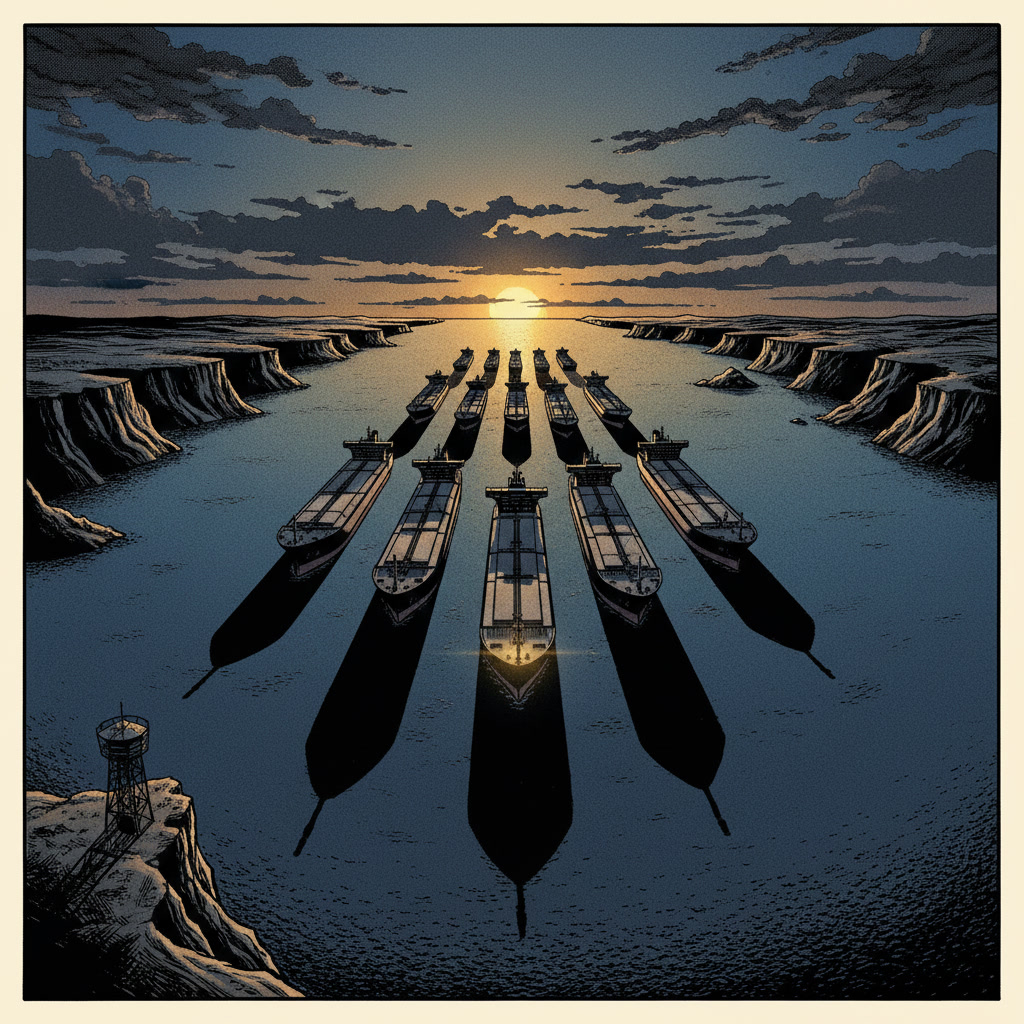
Deal Dead. The Strait Decides.
What happened: Trump declared the U.S.-Iran ceasefire "over" at the NATO summit in Antalya, citing what he described as fresh Iranian provocations after a new round of strikes — confirmed by the New York Times. Oil prices moved up on the news. Bloomberg reported that India formally requested safe-passage guarantees for nine ships in the Hormuz corridor, vessels already at sea, already exposed to whatever comes next.
Here's the read. The most dangerous phase of a military standoff is not the initial strike — it is the interval between a ceasefire and its collapse, when neither side has demobilized and each interprets the other's repositioning as fresh aggression. The historical parallel is the 1987-1988 tanker war in the Persian Gulf: Iran mined Kuwaiti shipping lanes, the United States reflagged Kuwaiti tankers under Operation Earnest Will, eleven ships were struck anyway, and the confrontation ground on until both sides were exhausted. The mechanism was incremental escalation, with each party claiming the other had violated some prior understanding. The mechanism now is identical. The key difference is that in 1987, Ayatollah Khomeini was alive and held centralized decision-making authority. Today, Iran is simultaneously burying its supreme leader, absorbing military strikes, and receiving word that the American president has torn up the peace. A leadership vacuum entering a moment that demands precise strategic calculation is among the more dangerous combinations in statecraft.
What I'd watch for next: If Iranian naval assets move toward the lower Gulf or Iran signals mining activity in the Strait in the next 48 hours, this is escalation in fact — and the oil price response will not be incremental. If instead Iran signals through Oman, its preferred back channel for quiet diplomacy, that talks can resume on new terms, today was a Trumpian reset gambit rather than a declaration of resumed war. The falsifier is straightforward: Hormuz open means negotiation is still live; Hormuz threatened means something harder has begun.
Three other things worth knowing
UniCredit has secured nearly half of Commerzbank. The Italian bank locked in a 48 percent stake in Germany's Commerzbank, the Financial Times reported this morning. Berlin had resisted for months, framing the acquisition as a question of sovereignty over a flagship lender. The read here is that its going through signals European banking integration is accelerating past the political resistance that had stalled it. For investors in eurozone financial stocks, the immediate question is whether regulators treat this as a template or an exception to contain.
Apple has committed $30 billion to Broadcom chips manufactured in the United States. The Financial Times reported the purchase agreement, which mirrors the TSMC Arizona commitments and represents the clearest evidence yet that the Trump administration's industrial-policy pressure on technology companies is producing binding contracts rather than press-release promises. The scale — $30 billion over the agreement's life — makes this one of the larger domestic semiconductor reshoring commitments from a private buyer on record.
Pakistan is searching for a missing cargo plane over the Arabian Sea. A cargo aircraft disappeared over the Arabian Sea, and Pakistan's military launched search-and-rescue operations, the New York Times reported. The number of crew aboard has not been publicly confirmed. The read here is that the timing — with Hormuz shipping already under scrutiny and Gulf air traffic a secondary concern — adds operational texture to a corridor already under pressure. This is a developing story; crew status is the next fact to track.
Echoes
The closest historical parallel for today is not the 2015 nuclear negotiations — those were diplomacy under sanctions pressure, not post-strike exhaustion — but the tanker war of 1987 and 1988. Then: the United States was escorting Gulf shipping under Iranian attack, Washington had struck Iranian naval platforms directly, and a ceasefire was declared and immediately contested. Iran's eventual calculation — that threatening the Strait cost it more diplomatically with China, Japan, and the non-aligned world than it gained militarily — held, narrowly. What ended the hot phase was not a peace agreement but exhaustion: the USS Vincennes shot down Iran Air 655 in July 1988, killing 290 civilians, and Iran accepted a ceasefire with Iraq six weeks later. The lesson from that sequence is that Iran has historically calibrated its Hormuz threats more carefully than its rhetoric suggests, because closing the Strait hurts its remaining customers as much as its adversaries. The question in July 2026 is whether Iran's transitional leadership — unidentified as of this morning — has inherited the institutional memory to make that calculation correctly under pressure.
The quiet things
The loudest silence today is the one around Iran's succession. Khamenei led Iran for nearly four decades; his death has left the office of Supreme Leader vacant at the worst possible moment. Who is convening the Assembly of Experts to name a successor? Are the Iranian hardliners demanding an attack on Trump at the Antalya summit speaking for the government or for a faction that has lost its central arbiter? The wires today cover the funeral's symbols and the foreign mourners but say nothing about who holds the supreme leadership right now. That answer is the most consequential fact missing from this morning's coverage.
Also quiet: Beijing. China is Iran's largest oil customer and among the most Hormuz-dependent economies on earth. The absence of any Chinese statement on Trump's ceasefire declaration — nothing on record as of this morning — is either deliberate strategic ambiguity or simple lag. The read here is that China's private communications with Tehran right now are more important than any public statement, and we have no visibility into them.
How I'd act on this
If you trade energy or hold oil-linked positions — Brent crude is your real-time indicator of Hormuz risk. The spread between current prices and a pre-escalation baseline is the market's implicit probability of a Strait disruption. Watch whether that premium widens after European markets close today.
If you cover Middle East diplomacy — the back channel to monitor is Oman. Muscat has historically served as the intermediary when Tehran and Washington want to talk without being seen talking; the early Obama-era nuclear discussions ran through the Omani government. If a revival signal emerges, it will appear first as an Omani foreign ministry statement about "continued dialogue." If Oman goes quiet instead, that is a data point in itself.
If you cover European politics or defense procurement — Friday's NATO summit communiqué is the next fixed data point. Which member states sign onto specific spending commitments and which hedge — Belgium has already signaled it may miss the 2035 target — will shape European defense procurement cycles for the next two years, independent of whatever happens in the Gulf.
If you follow Indian foreign policy — New Delhi's Hormuz request for nine ships is a leading indicator of how Indian officials privately assess the next 72 hours. Whether India escalates to a formal diplomatic protest or keeps the request quiet will tell you how South Block is reading the situation.
Today moved from a contested ceasefire to a declared collapse, with nine Indian ships seeking safe passage and a strait priced for risk that hasn't yet materialized into physical disruption. In every prior Hormuz crisis, Iran found it wiser to threaten than to close — the read here is that the question tonight is whether Tehran's unnamed new leadership has inherited the same instinct for self-preservation.
— *The Plumb Line*. Daily world brief.
Sources
Iran / Ceasefire / Hormuz
- newswire/nyt — "Trump Casts Doubt on Future of Cease-Fire After Latest Strikes" (NYT live)
- newswire/nyt — "Iran's holy city of Mashhad prepares for Khamenei's burial"
- newswire/nyt — "Iraqis Turn Out in Droves to Mourn Khamenei in Show of Solidarity"
- newswire/nyt — "Oil Prices Jump After Trump Says Deal With Iran Is 'Over'"
- newswire/bloomberg — "Trump: US Ceasefire With Iran Is 'Over'" (video)
- newswire/bloomberg — "India Seeks Safe Hormuz Passage for Nine Ships as Truce Falters"
- newswire/ft — "FirstFT: Trump declares US-Iran ceasefire 'over'"
- gdelt/ualrpublicradio — "At NATO summit in Turkey, Trump says he believes ceasefire with Iran is 'over'"
- gdelt/weau — "After launching strikes on Iran, Trump says ceasefire is 'over' but negotiations can continue"
- gdelt/kprcradio — "NATO Chief Backs U.S. Strikes On Iran As Necessary"
- gdelt/jpost — "Iranian hardliners demand attack on US president at NATO summit"
NATO Summit
- newswire/nyt — "Live Updates: Trump Lashes Out at Europe at NATO Summit"
- newswire/nyt — "Denmark Says It Will Defend 'Every Inch' of NATO as Trump Eyes Greenland Again"
- newswire/bloomberg — "UK and Turkey to Sign Security and Defense Pact at NATO Summit"
- newswire/bloomberg — "Belgium May Miss 2035 NATO Spending Target, Deputy PM Says"
- newswire/nyt — "Tensions Escalate Between Russia and NATO's European Members"
- gdelt/stardem — "The NATO summit was supposed to focus on defense spending. Trump's strikes on Iran changed that"
- gdelt/en.tempo.co — "Attacks on Kyiv Ahead of NATO Summit: What Is Putin's Goal?"
Other Stories
- newswire/ft — "UniCredit secures 48% stake in Commerzbank"
- newswire/ft — "Apple to buy $30bn of US-made chips from Broadcom"
- newswire/nyt — "Pakistan Launches Search After Cargo Plane Vanishes at Sea"