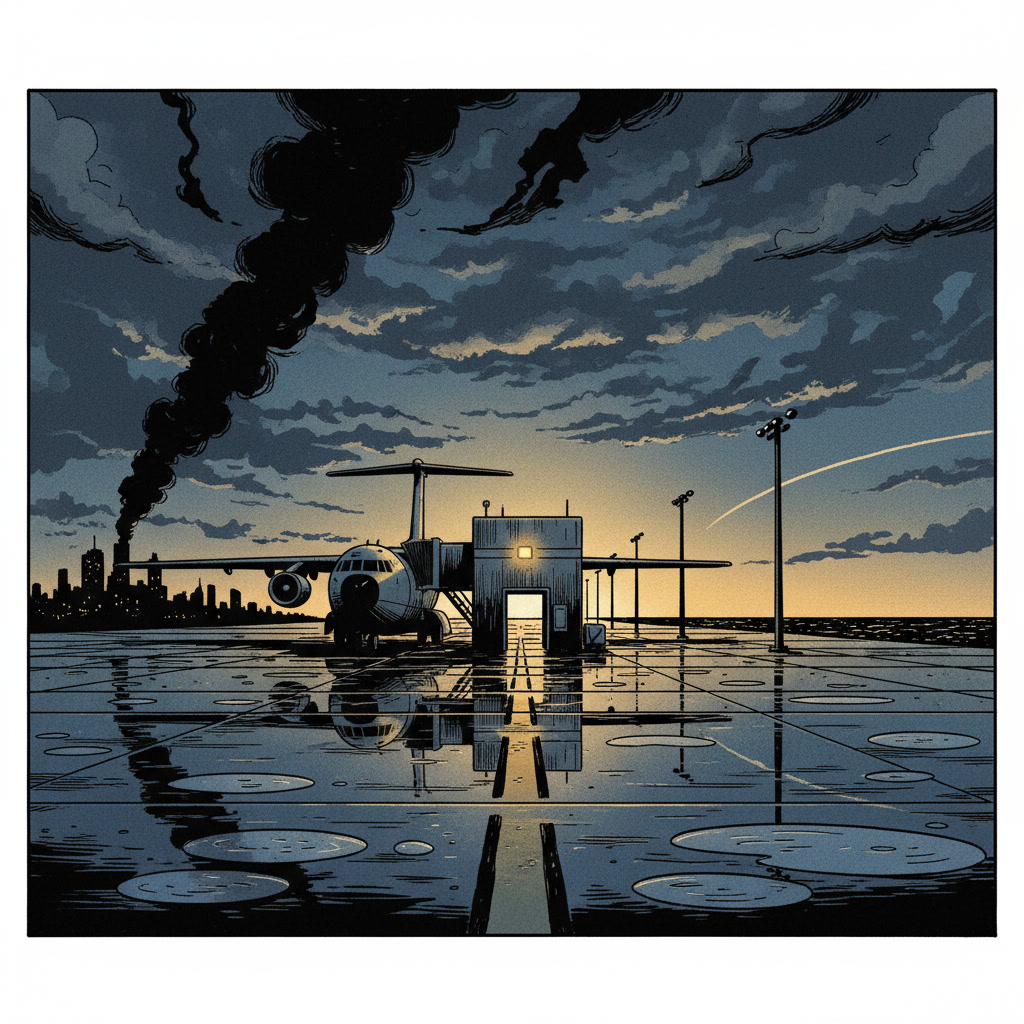
Ankara Opens. Moscow Fires. Beijing Tests.
The Plumb Line
Monday, July 6
Three things happened overnight that change how this week will be read. Russia launched a mass missile and drone attack on Kyiv as NATO leaders were landing in Ankara for the alliance summit — deadly, deliberate, timed for maximum diplomatic visibility. China test-fired a long-range ballistic missile into the South Pacific, targeting waters covered by a nuclear-free treaty that Beijing treats as advisory. And millions of Iranians lined the streets of Tehran for Ayatollah Khamenei's funeral procession, as a new Financial Times poll found that a majority of American voters believe the war that killed him wasn't worth the cost.
The read here: these are not three unrelated news events. They are three simultaneous demonstrations aimed at the same audience. Moscow is showing that the war runs through diplomacy, not around it. Beijing is showing that regional arms-control architecture constrains everyone except the power ignoring it. And Tehran's streets are broadcasting a demand — for a successor who can match Khamenei's posture — that will constrain whoever the clerical establishment chooses next. The collective audience for all three is Washington, and specifically the American president now in Ankara for a summit whose central question is how much of the post-Cold War order the United States still intends to maintain.
Yesterday's brief flagged the NATO summit communiqué as the most consequential document of this week. The overnight strikes on Kyiv have raised those stakes: the communiqué is no longer just a statement of alliance position. It is now the first public answer to a military action Russia timed specifically to frame the question.
Ankara Opens. Moscow Fires. Beijing Tests.
Russia struck Kyiv with missiles and drones the night before NATO leaders convened in Ankara, in attacks the New York Times described as "deadly." Ukrainian air defenses intercepted a significant portion of the barrage but could not stop it entirely — the Times noted in a parallel piece that Ukraine has "rewritten" its air defense tactics and that, still, it is not enough. Ukraine responded overnight with drone strikes on two Russian oil refineries, Bloomberg reported. The NATO summit has opened under an unusual host: Turkey's Recep Tayyip Erdoğan, who has maintained working relationships with both Moscow and Kyiv throughout the war, and whose government cracked down on press in the hours before allied leaders arrived, Bloomberg reported.
The read here. Russia's timing was deliberate — a signal embedded in the military action itself, designed so that every NATO head of government stepping off a plane in Ankara received a reminder of the war's ongoing cost. The historical parallel is not a battlefield precedent but a diplomatic one: Soviet behavior during the Strategic Arms Limitation Talks (SALT) of the early 1970s, when Moscow routinely timed military demonstrations to coincide with major diplomatic gatherings — not to derail the talks, but to shape them, reminding Western delegations that the hardware ran regardless of what the diplomats agreed. The lesson from SALT is a cautionary one: the demonstrations didn't prevent agreements, but they established the frame in Moscow's favor, producing treaties that formalized a parity the Soviets had already achieved. If today's NATO communiqué codifies the current level of alliance commitment to Ukraine rather than expanding it, Russia will have achieved the same effect — a diplomatic document that runs alongside the war without constraining it. Ukraine's refinery strikes, a continuation of the campaign yesterday's brief called "unprecedented," were the counter-demonstration: the economic attrition campaign has not paused for the diplomacy.
What I'd watch for next, and the falsification trigger: the communiqué's language on Ukrainian air defense and long-term weapons supply. Specific systems, specific timelines, a defined commitment horizon through 2027 — that falsifies Russia's calculation, demonstrating the Kyiv attack hardened allied resolve. Vague language, or Trump bilateral statements at the summit's margins that undercut whatever the formal text says, reads the other way. Watch also for what Turkey extracts from the host role. Erdoğan does not convene summits out of generosity. The read here is that the price of Ankara's hospitality is somewhere in a bilateral conversation with Trump that has not been disclosed.
Three other things worth knowing
China fired a ballistic missile into the nuclear-free Pacific. The New York Times and the Financial Times both reported that China test-fired a long-range ballistic missile into the South Pacific, deliberately targeting waters covered by the Treaty of Rarotonga — the 1985 agreement that established the South Pacific as a nuclear-weapons-free zone. China has not been bound by the treaty's protocols in the same binding way as the Western nuclear powers, but the choice of that zone as the test area is a signal Beijing was not required to send. The read here: Beijing is demonstrating publicly that regional arms-control architecture does not constrain its military program. The timing — with NATO convening and US attention concentrated on the European theater — is characteristic of how Beijing conducts consequential demonstrations while minimizing the response window.
Millions in Tehran, and a majority of Americans already want out. The Financial Times reported millions of Iranians lined the streets of Tehran for Ayatollah Khamenei's funeral procession — a display of mass mobilization the Islamic Republic deploys to project both domestic legitimacy and external resolve. On the same day, an FT poll found that a majority of US voters now believe the Iran war was not worth its cost. The succession remains unresolved, the factional clock is running, and the read here is that the gap between Iranian public expectation and American public tolerance is one of the structural facts any negotiated framework will have to navigate.
The EEOC (Equal Employment Opportunity Commission) quietly unwound decades of affirmative action guidance. The EEOC published in today's Federal Register the rescission of its longstanding guidelines on affirmative action permissible under Title VII of the Civil Rights Act — removing the regulatory guardrails that federal contractors, large employers, and universities have used to design race-conscious programs over decades. The formal notice is administrative; the litigation will be the real test of enforcement reach. On a day when every wire is running an Ankara dateline, this action will receive a fraction of the attention it warrants.
Echoes
The SALT analogy for Russia's summit-eve strike is worth holding seriously. Between 1969 and 1972, as US and Soviet negotiators worked toward the first strategic arms limitation agreement, the Soviet military conducted tests and exercises timed to coincide with high-visibility diplomatic moments — a consistent pattern of demonstrating that military capability ran on a track separate from political negotiation. The agreements produced were real, but they formalized a parity the Soviets had already achieved through sustained investment and demonstration. The read here: if the NATO summit produces a communiqué that mirrors the current level of alliance commitment to Ukraine rather than expanding it, the parallel closes. Russia will have used a military demonstration to codify a favorable status quo in a diplomatic document — the same operational logic, four decades later.
The quiet things
Turkey is hosting NATO while arresting and expelling journalists in the hours before allied leaders arrived, Bloomberg reported. No allied government has publicly commented. The read here: allied capitals have decided that the summit's diplomatic goals require not embarrassing the host. The trade-off between democratic values and practical alliance management has been made silently, in Ankara, by governments that routinely invoke democratic values.
The substance of Saturday's Putin-Trump call remains uncharacterized by Washington. The summit has now opened and allied leaders are setting collective policy — without any public account of what the American president discussed with the Russian president four days prior. As yesterday's brief noted, the absence of a readout is unusual. It has now become louder: the allies at the table in Ankara are negotiating a collective position on a war whose principal external actor held an undisclosed conversation with their host government's closest patron before the meeting began.
Also worth tracking before it disappears under the Ankara dateline: flood watches and warnings are active across a wide band of the eastern United States — Iowa, Illinois, Wisconsin, Pennsylvania, New Jersey, New York (including Manhattan, Brooklyn, and Staten Island), Connecticut, Massachusetts, and Rhode Island all have active alerts, with some Iowa river warnings running through July 12. No confirmed casualty figures yet, but the geographic footprint is substantial.
How I'd act on this
If you cover NATO or transatlantic defense: watch the communiqué language closely, but watch the bilaterals harder. What Erdoğan and Trump discuss privately, and whether anything surfaces about Saturday's Putin call, will carry more real information than the formal text. The communiqué will project unity. The bilaterals will reveal where it frays.
If you track European defense spending or hold positions in defense contractors: Germany calling the TKMS bid for Canadian submarines "unbeatable" is a leading indicator — European governments are moving from pledge-making to supply-chain preference, specifically toward non-American vendors, at a moment when the transatlantic relationship is under internal stress. Pair that with Bloomberg's $2 trillion defense-race projection and the read here is that the procurement decisions become the signal, not the pledge tallies.
If you hold energy positions tied to Russia's export capacity: Ukraine struck two more oil refineries overnight. The attrition campaign continues without pause. Russian state budget pressure compounds as heating-season demand approaches and the same infrastructure is being asked to serve both domestic consumers and export revenue.
If you follow China's Pacific posture: the ballistic missile test is not a routine military event. It is a deliberate demonstration in a treaty-protected zone, chosen specifically to signal that Beijing's program operates above the regional arms-control framework. Watch for official responses from New Zealand, Australia, and Pacific island governments — and watch whether Washington acknowledges the test directly or lets it pass without public comment.
Russia bombed Ukrainian cities on the morning NATO leaders landed in Ankara, and China fired a ballistic missile into the nuclear-free Pacific before the summit's first session — two governments running simultaneous demonstrations for an alliance that is simultaneously managing its own internal argument about the American president's intentions.
The communiqué NATO produces this week will be legible; whether it's consequential depends on what Trump told Putin on Saturday and has not yet told his allies.
— *The Plumb Line*. Daily world brief.
Sources
NATO Summit / Turkey
- newswire/bloomberg — "Turkey Cracks Down on Press as NATO Leaders Descend on Ankara," July 6
- newswire/bloomberg — "NATO's Biggest Mission Is Keeping Trump Happy," July 6
- newswire/nyt — "NATO Leaders Are Meeting This Week. Here's What to Know.," July 6
- newswire/nyt — "As Trump Cools on NATO, Turkey Hosts Summit Meeting," July 6
- newswire/nyt — "Erdogan-Trump Friendship Can Help NATO, Turkey's Foreign Minister Says," July 6
Russia strikes Kyiv / Ukraine air defense / refinery strikes
- newswire/nyt — "Deadly Russian Strikes Rock Kyiv on Eve of NATO Summit," July 6
- newswire/ft — "Russia hammers Kyiv with missiles and drones on eve of Nato summit," July 6
- newswire/nyt — "Ukraine Rewrote Air Defense Tactics. Against Russia, It's Still Not Enough.," July 6
- newswire/bloomberg — "Ukraine Says It Attacked Two Russia Oil Refineries Overnight," July 6
China ballistic missile test
- newswire/nyt — "China Test Fires Long-Range Ballistic Missile in the Pacific," July 6
- newswire/ft — "China fires ballistic missile into Pacific nuclear-free zone," July 6
Iran / Khamenei funeral / FT poll
- newswire/ft — "Millions attend funeral procession for Ayatollah Ali Khamenei," July 6
- newswire/nyt — "The Funeral of Iran's Supreme Leader Ayatollah Ali Khamenei," July 6
- newswire/ft — "FirstFT: US voters say Trump's Iran war not worth the cost — FT poll," July 6
EEOC / Affirmative action
- federal_register/2026-13637 — "Rescission of Guidelines on Affirmative Action Appropriate Under Title VII of the Civil Rights Act of 1964, as Amended," EEOC, July 6
European rearmament / Defense
- newswire/bloomberg — "Germany Calls TKMS Bid to Build Canadian Submarines 'Unbeatable'," July 6
- newswire/bloomberg — "Europe Pledged to Rearm. How's That Going?," July 6
- newswire/bloomberg — "$2 Trillion Race to Control Future Battlefields," July 6
US flooding
- noaa_alerts — Flood Warnings and Watches: Iowa (Poweshiek, Tama, Jasper, Marion, Polk), Illinois (Peoria, Tazewell, Woodford, Bureau, La Salle, Putnam), Wisconsin (Crawford), Pennsylvania (Elk, Clearfield, Centre, Blair, Dauphin, York, Lancaster, and others), New Jersey (statewide), New York (Manhattan, Brooklyn, Queens, Staten Island, Long Island, Westchester, Bergen, Essex, Union, Passaic), Connecticut, Massachusetts, Rhode Island, Ohio (Lucas, Wood, Sandusky, Erie, Huron), July 5–6