Watch the Pipeline, Not the Mourners
The Plumb Line
Sunday, July 5
"'Revenge.'"
That word rose from the crowds at Ayatollah Khamenei's funeral prayers in Tehran today — and it is, functionally, the job description for whoever the Assembly of Experts names as Iran's next Supreme Leader. The mourners are not just grieving; they are broadcasting an expectation. The read here: any successor who cannot speak to that demand inherits a legitimacy deficit on his first day in office.
But while every editor on earth is watching the funeral, the more consequential action is taking shape 1,500 miles north and west: Ukraine has been striking Russian energy infrastructure at what the Financial Times described today as an unprecedented rate in the conflict's history. And Vladimir Putin placed a call to Donald Trump ahead of the NATO summit — a conversation Washington has declined to publicly characterize.
These two things — an Iranian street chanting for revenge and a Ukrainian military methodically dismantling Russia's economic infrastructure — are not connected by any single actor, but the read here is that they share the same gravitational pull: both push toward escalation at precisely the moment when the diplomacy is supposed to be pulling toward settlement.
Watch the Pipeline, Not the Mourners
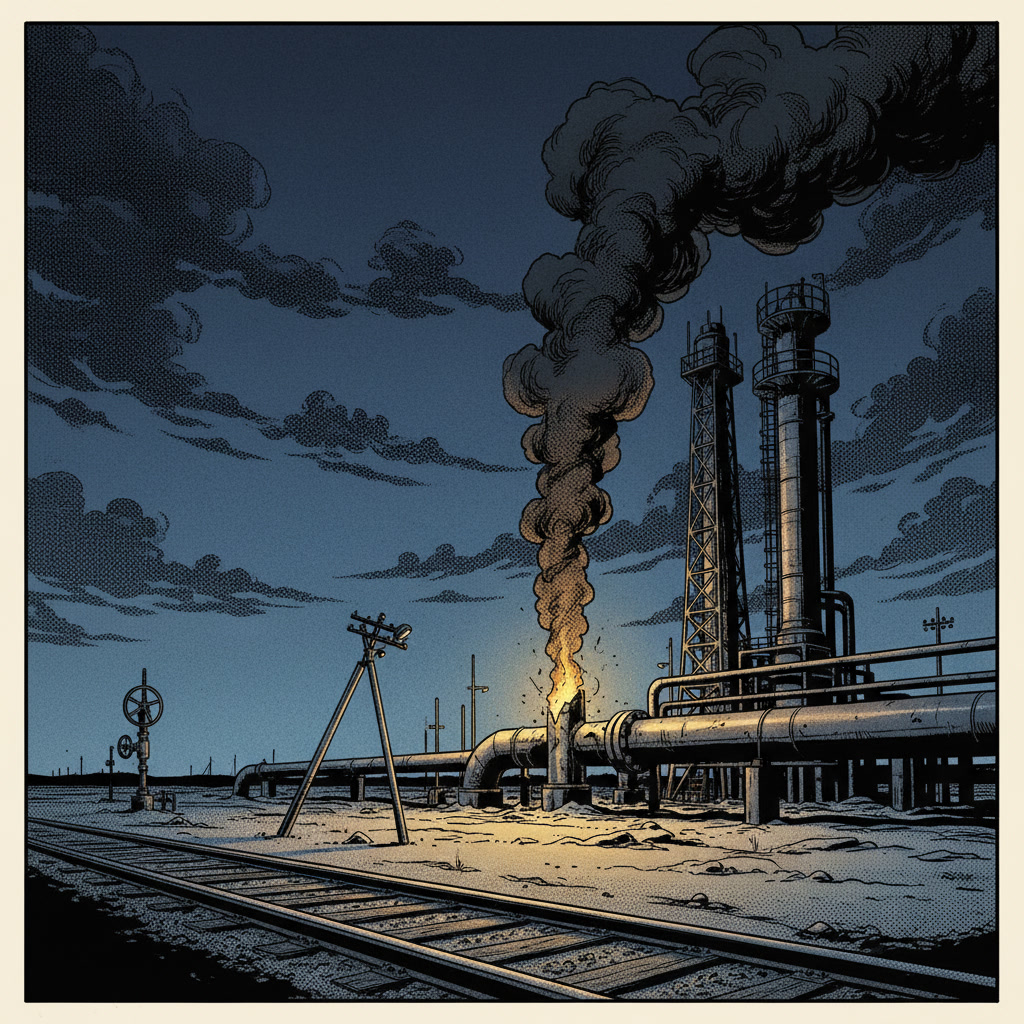
Ukraine has been hitting Russian energy infrastructure — power generation facilities, refineries, pipeline networks — at a pace the Financial Times reports is without precedent in four years of fighting. The read here: the timing is not accidental. The NATO summit is days away, and Kyiv appears to be maximizing the visible economic cost it can impose on Russia before alliance leaders convene. Separately, Putin called Trump yesterday to discuss Ukraine — and Iran — according to Bloomberg, a conversation that served as Moscow's attempt to shape the American president's frame before the alliance sets its collective position in a communiqué.
Here's the read. Ukraine is targeting the revenue base that funds Russia's war rather than purely its military capacity — the refineries and power infrastructure that translate oil and gas exports into government spending. The logic is attritional and deliberate: degrade Russia's economic ability to sustain the war before the diplomacy produces a ceasefire that freezes a disadvantageous front line. The Putin-Trump call is the countermove: if Moscow can shift Trump's orientation before NATO meets, it can soften whatever the communiqué says about long-term Ukrainian support. The historical parallel that fits is the Allied strategic bombing campaign of 1943–44, when British and American planners argued for targeting German oil infrastructure specifically because the economic incapacitation argument was understood to be more durable than destroying individual military targets. When the oil campaign won the internal debate in spring 1944, German aviation fuel production collapsed within months.
What I'd watch next, and the falsification trigger: the NATO summit joint statement language on Ukrainian support. If it commits to sustained weapons delivery with a defined timeline — through 2027 at minimum — Ukraine's energy campaign reads as successful pre-summit leverage, Kyiv demonstrating it can impose real costs while allies are deliberating. If instead the communiqué is vague on long-term commitments, or if Trump signals separately that he's pressing Kyiv toward a pause in strikes, the energy campaign was tactical noise against a diplomatic current running in Russia's favor. The Putin-Trump call's substance is the variable Washington hasn't disclosed — and that silence is itself worth tracking.
Three other things worth knowing
Iran's mourners are trying to write the brief. Yesterday this newsletter called the Assembly of Experts the most consequential institution in the world for the next 90 days, and noted the succession contest would unfold in deliberate silence. Today the crowds complicated that silence: the "Revenge" chant at funeral prayers — captured by the New York Times — is the public side of the factional negotiation, a demand from the streets that any successor must find a way to address, regardless of how the clerics choose him. The speed-versus-fracture falsifier from yesterday holds: fast, decisive selection signals institutional durability; public factional maneuvering signals exposure. Today adds a second trigger — what I'd watch for next is whether any IRGC (Islamic Revolutionary Guard Corps) commander publicly invokes the "Revenge" language before the Assembly of Experts has spoken. If the Guard starts using the crowd's vocabulary to frame the succession, the read is that the military is already trying to bind the religious choice before it's made.
China is pressuring Taiwan from both directions at once. The New York Times reported today that Beijing has expanded its coast guard patrols around Taiwan, extending coverage to areas of the coastline that have historically received less routine attention — a capability demonstration that Beijing can threaten Taiwan from multiple approaches simultaneously. On the same day, China freed a Christian pastor detained during Xi Jinping's crackdown on religion — after Trump personally urged his release, the Times reported. The read here: the dual signal is calculated — a small tactical concession to preserve the American president's political investment in the bilateral relationship, combined with a quiet expansion of maritime pressure in the theater that matters more. Beijing is managing two tracks simultaneously, and doing so with more discipline than most governments manage one.
Typhoon Bavi, a flooded Midwest, and a baking East Coast. The National Weather Service has issued a coastal flood warning for Guam, Rota, Tinian, and Saipan running through July 8 as Typhoon Bavi approaches the Northern Mariana Islands — all US territories, all on a stretch of Pacific real estate where Chinese maritime activity has been expanding steadily. On the continental side, flood warnings have covered a wide band from Bureau and La Salle counties in Illinois through Polk, Story, and Black Hawk counties in Iowa, while a heat dome is sending electricity prices soaring across the eastern seaboard, the Financial Times reported. The meteorological map of this July 4 weekend: flooded in the center, baking on the coast, bracing for a typhoon in the Pacific.
Echoes
The Allied strategic bombing debate of 1943–44 is the closest historical analog to Ukraine's current energy campaign, and worth taking seriously as a model rather than as decoration. The core argument — between the "transportation" school and the "oil" school — was whether to hit German logistics networks or German fuel production. When the oil argument won the internal debate in spring 1944, German aviation fuel production fell by roughly 90 percent over the following five months, grounding much of the Luftwaffe before the ground campaign needed it grounded. The lesson was that industrial targeting takes longer than military targeting to produce visible results, but when it lands, the effect is structural rather than tactical — it doesn't repair quickly. The read here: Ukraine faces the same calculation. Russian energy infrastructure is large and resilient, repairs are possible and ongoing, and the economic effect accumulates over quarters rather than weeks. The question is whether Ukraine has enough runway — in terms of Western supply, political will, and front-line stability — to reach the structural-effect threshold before the diplomacy locks in a ceasefire that the energy campaign was meant to prevent.
The quiet things
Washington has issued no public characterization of yesterday's Putin-Trump call. That is unusual: a conversation between the American president and the Russian president, held days before a NATO summit where Ukraine's war is the central agenda item, would normally produce at least a brief pro forma readout. The read here: the absence suggests either the call included something the administration doesn't want attributed before allied leaders convene, or Trump said something whose characterization would constrain his negotiating flexibility at the summit. Either explanation is worth tracking.
Also absent: Iran's Assembly of Experts has maintained complete silence on the succession — no timeline, no eligibility criteria, no procedural signal of any kind. The "Revenge" chants from today's funeral have not prompted any official Iranian response about what the state intends to actually do with that demand. The read here: the silence is deliberate, and it has a time limit. After the burial, pressure to name the process will become irresistible.
How I'd act on this
If you track energy markets or hold Russian-exposed positions: "unprecedented rate" is the operative phrase today. The read here: Ukraine's energy campaign, if sustained through the summer, will compound pressure on Russia's state budget heading into winter — when domestic heating demand competes directly with export capacity for the same infrastructure. This is not a single-event price spike; it is sustained revenue compression of the mechanism that funds the war.
If you cover NATO or transatlantic affairs: the summit communiqué's language on long-term Ukrainian support is the read. It will be the first public artifact of whatever Trump told Putin yesterday — the document that either reflects or quietly contradicts the substance of that call.
If you watch the China-Taiwan file: the expanded coast guard patrols are the story to file now and return to later. The pastor release will receive more coverage. The read here: the maritime expansion will matter more.
If you follow the Philippines: the Sara Duterte impeachment trial now beginning restructures the domestic political terrain of a country that sits at the center of the US Pacific alliance network — at the exact moment China is expanding maritime pressure and the alliance is under internal negotiation. It is not a sideshow.
Australia is reportedly finalizing both a Fiji security pact and a uranium export deal with India — Bloomberg sourced this to a newspaper report, not officials, so treat it as a leading indicator rather than confirmed fact. The read here: if it holds, it represents a meaningful expansion of the practical security architecture connecting the Pacific island chain to the Quad's nuclear supply relationship. Worth watching for official confirmation.
The pipeline strikes are accumulating, Tehran's mourners have named their terms, and Putin spent yesterday on the phone with the American president — all before the NATO summit has produced a word.
Three rooms are deciding the shape of the next decade simultaneously — a summit conference table in the days ahead, a clerical chamber in Qom, and a Ukrainian targeting cell — and only one of them has disclosed what it intends: the targeting cell, in the smoke rising from Russian refineries.
— *The Plumb Line*. Daily world brief.
Sources
Ukraine / Russia energy campaign
- newswire/ft — "Ukraine striking Russian energy infrastructure at unprecedented rate," July 5
Putin-Trump call / NATO
- newswire/bloomberg — "Putin, Trump Discuss Ukraine in Call Ahead of NATO Summit," July 4
Iran / Khamenei funeral
- newswire/nyt — "Mourners Chant 'Revenge' at Funeral Prayers for Iran's Slain Supreme Leader," July 5
- newswire/nyt — "Huge Crowds Mass in Tehran for Ayatollah's State Funeral," July 5
- newswire/nyt — "What to Know About Ayatollah Ali Khamenei as His Funeral Services Begin in Iran," July 5
China / Taiwan
- newswire/nyt — "China Raises Pressure on Taiwan With Expanded Coast Guard Patrols," July 5
- newswire/nyt — "China Frees Pastor Detained in Crackdown on Religion After Trump's Urging," July 5
Typhoon Bavi / US weather
- newswire/nyt — "Guam and Northern Mariana Islands Prepare for Typhoon Bavi," July 5
- newswire/ft — "'Heat dome' and storms over eastern US sends electricity prices soaring," July 5
- noaa_alerts — Coastal Flood Warning: Guam, Rota, Tinian, Saipan (NWS Tiyan GU), July 5–8
- noaa_alerts — Flood Warnings: Iowa (Polk, Story, Black Hawk, Jasper, Marion), Illinois (Cook, DuPage, Kane, Bureau, La Salle, Will, and others), Indiana (Lake, Porter), July 4–5
Philippines
- newswire/nyt — "Impeachment Trial of Philippine Vice President Set to Begin," July 5
Australia / Pacific security
- newswire/bloomberg — "Australia to Sign Fiji Security Pact, Finalize India Uranium Export Deal, Newspaper Says," July 5
Ukraine front / context
- newswire/nyt — "Far From Kyiv and Moscow, Soldiers Stalk Ruins and Evade Drones on the Front," July 5