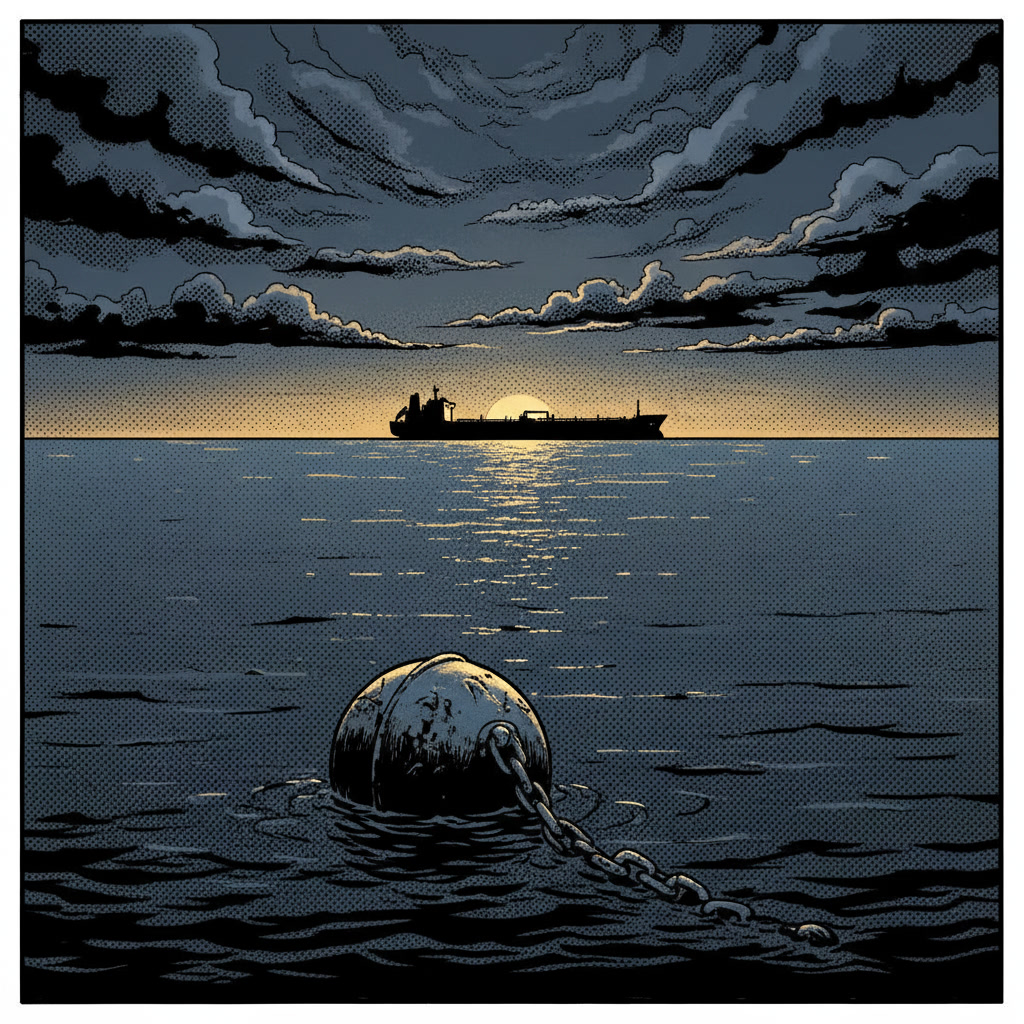
The Deal Is Done. The Waterway Isn't.
The Plumb Line
Monday, June 29
Three things happened overnight that would each anchor a slower week's coverage — and the coincidence of their arrival tells you something about the current tempo of global events.
The United States and Iran reached a deal to halt attacks and resume diplomatic talks, per the Financial Times and the New York Times. Pakistan launched airstrikes into Taliban-governed Afghanistan, killing more than 30 people — a nuclear-armed state bombing its neighbor, an event that on a slower day would lead every front page. And Samsung and SK Hynix announced $880 billion in combined chip and data-center investment, the largest coordinated semiconductor capital commitment in recorded history, per Bloomberg. In a quieter month, any one of these would define the week. Instead they all arrived this morning, and the ranking decision matters.
The Iran deal leads — not because diplomacy always trumps military action, but because it directly updates yesterday's read, and because the most important fact about the deal is what it does not include.
The Deal Is Done. The Waterway Isn't.
The United States and Iran have agreed to halt attacks and resume diplomatic talks, U.S. officials told the Financial Times and the New York Times this morning. The agreement ends the exchange of strikes that escalated through last week and marks the first formal diplomatic re-engagement after Iranian forces mined the Strait of Hormuz — a step yesterday's brief identified as categorically different from strike-and-counter-strike, because mines don't stand down when talks resume.
Here's the read. Yesterday's brief set a specific falsifier for genuine de-escalation: an Iranian commitment to mine clearance, or at minimum a verified statement demarcating existing mines so commercial shipping could route around them. That falsifier has not been met. A deal to halt attacks is not a deal to clear a waterway. Iran spent the past week using mine-laying as leverage — the New York Times reported yesterday that Tehran was explicitly risking peace talks to maintain control over the Strait — and leverage does not disappear because a deal was signed. The mechanism to watch is whether mine clearance language appears in the communiqués of resumed talks. If it does, the deal is substantive. If it doesn't, "guns down" has been achieved and the physical problem has been deferred to the next negotiating round.
What I'd watch next: any technical coordination between Iranian authorities and international maritime bodies within the next 72 hours would be genuine de-escalation. If the resumed talks produce only political commitments, expect tanker insurance rates and freight surcharges to remain structurally elevated regardless of the diplomatic headline. The falsifier for "this deal matters" is a mine clearance date. The falsifier for "this is atmospherics" is continued silence on mine disposition while both governments claim credit for peace.
Three other things worth knowing
Pakistan bombed Afghanistan. The New York Times confirmed that Pakistani airstrikes hit Afghanistan overnight, killing more than 30 people. Pakistan's stated justification — that the Taliban government in Kabul provides sanctuary to the Tehrik-i-Taliban Pakistan (TTP), the militant group responsible for cross-border attacks inside Pakistan — has been rehearsed for years and is not without basis in fact. The read here: air power that kills civilians in a country you cannot occupy solves the tactical problem and compounds the strategic one. Watch the Taliban's response in the next 48 hours: a diplomatic protest signals absorption; any cross-border retaliation signals the conflict is widening in ways neither side has planned for.
South Korea bets on AI's high end. Samsung and SK Hynix together announced $880 billion in combined chip and data-center investment, Bloomberg reported — with the Financial Times putting the chipmaking-specific figure at $600 billion. Either number is without precedent. The read: Seoul is treating AI-driven compute demand as a generational infrastructure build, not a business cycle. The implicit bet is that demand for AI chips grows faster than supply for the next five to seven years. If that read is right, South Korea locks in semiconductor dominance for a generation. If it's wrong — if the AI diffusion curve bends earlier than the models suggest — this becomes one of history's more expensive misreadings of a technology inflection.
Comcast breaks the bundle. Comcast announced it will spin off NBCUniversal — NBC, Universal Pictures, the Peacock streaming service — along with Sky, its European pay-TV operation, into a separate company, the Financial Times reported. The historical framing: this is the largest structural rejection of the content-and-distribution model since that model was assembled two decades ago. For investors, the separation creates two cleaner bets: a pure broadband infrastructure company and a pure media company, each now required to justify its capital structure independently in a market being remade by streaming and AI-generated content simultaneously.
Echoes
The closest historical parallel to today's Strait of Hormuz situation is Operation Earnest Will, the 1987–1988 U.S. naval operation in which the United States re-flagged Kuwaiti tankers and provided naval escorts through a Persian Gulf that Iranian forces had already mined. The operation kept oil flowing — but it required eleven months of sustained commitment, and it took an Iranian mine nearly sinking the frigate USS Samuel B. Roberts before Congress and the White House fully grasped the physical hazard still present while diplomacy ran in parallel. The Iran-Iraq War ended not because the political dispute resolved cleanly, but because Iran accepted a United Nations Security Council ceasefire after sustaining losses it could no longer absorb. What Earnest Will teaches is the distinction that matters today: mine clearance, not escort operations or ceasefire agreements, is what actually reopened the Persian Gulf. The same logic applies to the Strait now. A deal to stop shooting is necessary. It is not sufficient.
The quiet things
The U.S. corn and soybean belt is under a heat emergency that has received almost no coverage today. The National Weather Service has issued Extreme Heat Warnings — not watches, actual warnings — across Kansas, Missouri, Iowa, Nebraska, and parts of Illinois, most of them running through at least July 3. Both Kansas City and St. Louis are under active warnings. This is the heart of North American grain production during the late-June pollination window for corn, the period when heat stress causes yield damage that no amount of late-season rain can recover. The Agriculture Department's crop condition report releases Tuesday. Agricultural commodity markets have not priced this event. The read: if the report shows significant stress, the reaction will be compressed into a single session.
China's military released footage of what it described as a sixth-generation fighter jet, Bloomberg reported. No technical specifications accompanied the video — only the image, which is itself the message. Beijing is signaling that a successor to its J-20 stealth fighter is in development, and it has chosen a news cycle dominated by the Iran deal and the Pakistan-Afghanistan strikes to plant that flag quietly. Defense planning staffs will notice. Most wire desks today will not.
How I'd act on this
If you hold energy positions or trade tanker freight — the Iran deal does not resolve the mine-clearance question that drove last week's market signals. "Guns down" and "lanes clear" are different conditions that price differently. Watch whether Iranian authorities make any technical demarcation or clearance statement in the next 72 hours; the absence of one is itself information about how substantive this deal is.
If you follow South Asian security — Pakistan's airstrikes are the underreported story of the morning. The Taliban's response in the next 48 hours is the decisive indicator: silent absorption signals weakness, any retaliation signals the conflict is widening in ways neither Islamabad nor Kabul has war-gamed to a conclusion.
If you're a technology or semiconductor investor — Samsung and SK Hynix have just priced in the high end of AI compute demand projections for the next decade. That assumption is either your buy thesis or your primary risk factor, depending on your read on how fast and how broadly AI actually diffuses. There is now $880 billion riding on the bullish case.
If you follow UK politics or hold gilts — Andy Burnham laid out his economic agenda this morning, and the Financial Times is covering it as the first major policy articulation from the probable next Labour leader. His devolution agenda implies a fiscal architecture that UK bond markets will eventually have to price, probably not this year but within two electoral cycles.
A deal to halt attacks, an airstrike that killed more than 30 civilians, and the largest semiconductor commitment in history all arrived before noon on a Monday. Washington and Tehran agreed to put the guns down; no one has yet agreed to pull the mines up.
— *The Plumb Line*. Daily world brief.
Sources
US-Iran deal / Hormuz
- newswire/ft — "US says it has agreed deal with Iran to halt strikes and resume talks," June 29
- newswire/nyt — live updates: "Mideast Live Updates: U.S. Reaches Deal With Iran to Halt Attacks, Official Says," June 29
- newswire/nyt — "Iran Risks Peace Talks With U.S. to Maintain Leverage Over Strait," June 28
- *The Plumb Line*, June 28 — mine clearance falsifier set; not met by today's deal as reported
Pakistan-Afghanistan strikes
- newswire/nyt — "Pakistan Attacks Afghanistan, Killing More Than 30," June 29
- gdelt/theshillongtimes.com — "Pakistani airstrikes in Afghanistan kill 36 civilians, injure 163 others," June 29
South Korea semiconductors
- newswire/bloomberg — "Samsung, SK Hynix to Spend $880 Billion on Chips, Data Centers," June 29
- newswire/bloomberg — Daybreak Europe: "South Korea Confirms Over $1 Trillion in AI Spending," June 29
- newswire/ft — "Samsung and SK Hynix plan $600bn chipmaking expansion," June 29
Comcast / NBCUniversal
- newswire/ft — "Comcast to spin off NBCUniversal and Sky," June 29
UK / Andy Burnham
- newswire/ft — "Burnham lays out economic agenda for UK," June 29
US Midwest heat emergency
- noaa_alerts — Extreme Heat Warning, NWS Kansas City/Pleasant Hill MO: Buchanan, Clay, Jackson, Platte and surrounding counties, through July 3
- noaa_alerts — Extreme Heat Warning, NWS St. Louis MO: St. Louis City, St. Charles, Franklin, Jefferson and surrounding counties, through July 3
- noaa_alerts — Extreme Heat Warning, NWS Topeka KS: Shawnee, Riley, Marshall, Geary and surrounding counties, through July 3
- noaa_alerts — Extreme Heat Warning, NWS Des Moines IA: Polk, Story, Warren, Hardin and surrounding counties, through June 30
- noaa_alerts — Extreme Heat Warning, NWS Omaha/Valley NE: Douglas, Sarpy, Pottawattamie and surrounding counties, through June 30
China sixth-generation fighter
- newswire/bloomberg — "Chinese Military Teases First Look of Sixth-Gen Jet in Video," June 29
Historical references
- Operation Earnest Will (1987–1988): U.S. naval escort of Kuwaiti tankers in the mined Persian Gulf; USS Samuel B. Roberts mine strike, April 14, 1988; Iran accepted UNSCR 598 ceasefire, July 1988