Who Ordered the Mines?
The Plumb Line
Sunday, June 28
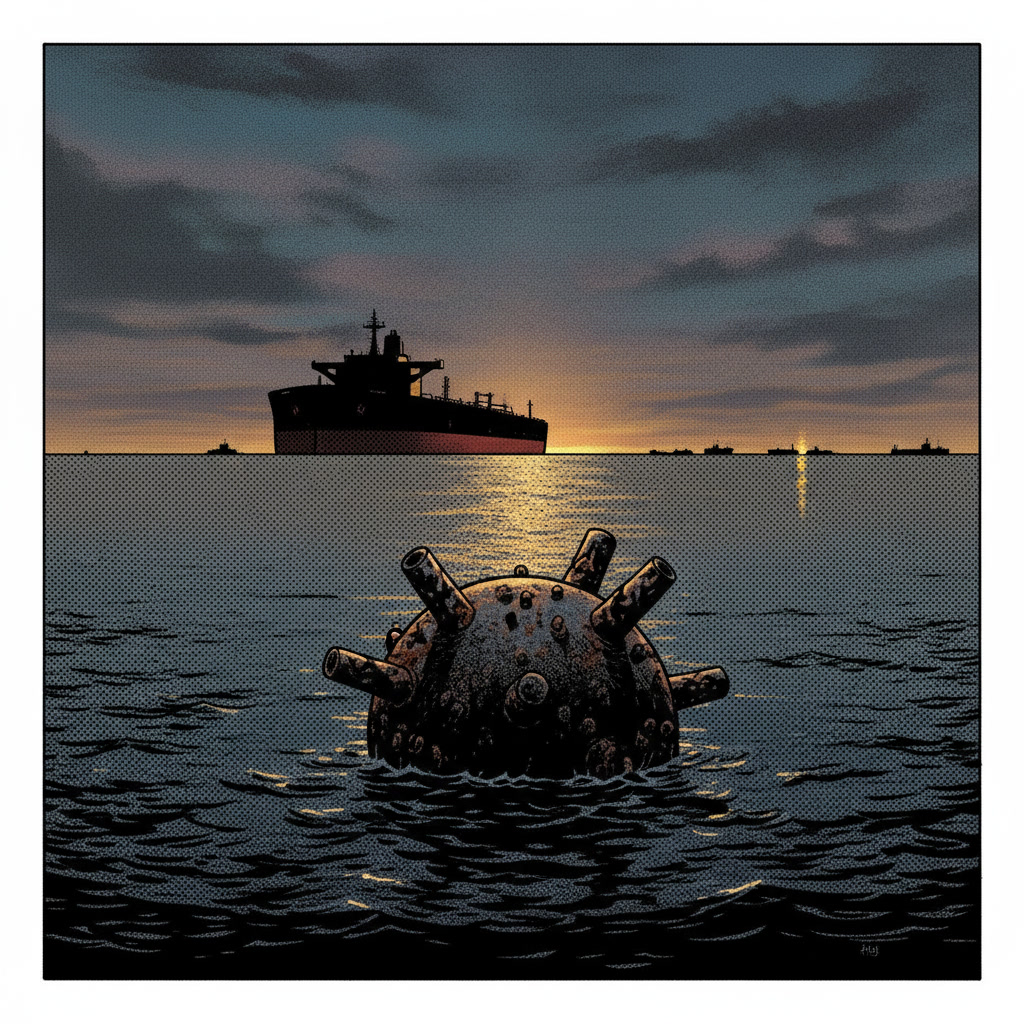
What does it take to close the world's most important oil corridor without officially declaring it closed? The answer, as of this morning, is mines. A shipping company chief executive told the Financial Times that mines now placed in the Strait of Hormuz will hold back tanker traffic not for days but for months. The New York Times is running live updates under the headline "Few Signs of De-Escalation." The Financial Times confirms fresh U.S. strikes on Iranian positions. The ceasefire is still a word both governments are using. It is not a word that describes what is happening.
Yesterday's brief set two falsifiers — one for de-escalation, one for continued escalation. The escalation falsifiers have been met in sequence: Iran struck Bahrain, Iran struck Kuwait, and a tanker was attacked in the Strait, per the Financial Times, Bloomberg, and Qatar's foreign ministry condemnation. Bahrain has called on the UN Security Council to intervene. Two of the three specific triggers the brief named as escalation markers — a second attack on Bahrain and interference with tanker transit — have now occurred. Yesterday's separate Venezuela falsifier also activated: the New York Times confirmed today that the Maduro government is politicizing earthquake relief distribution, exactly as the brief forecast it would.
What has changed overnight is not the tit-for-tat pattern — that was already visible by yesterday evening. What has changed is the mines. The read here: that is a categorically different kind of act, and it is the story worth sitting with this morning.
Who Ordered the Mines?
The Strait of Hormuz is approximately 33 kilometers wide at its narrowest navigable point. Roughly one-fifth of global seaborne oil passes through it daily. Mining it — even partially — converts a bilateral dispute into a standing threat against every maritime nation, regardless of politics. The read here is that this is a choice, and not an accidental one.
Here is the read. Mining an international waterway is categorically different from striking a vessel or a military installation. It is persistent rather than responsive. It does not de-escalate automatically when both sides lower their weapons. It requires active clearance — a technical operation that takes weeks under ideal conditions, cannot begin until both parties allow safe access, and is not currently on any announced diplomatic agenda. The closest legal precedent is the Corfu Channel case of 1949, in which the International Court of Justice found Albania responsible for mines that damaged British warships in an international strait. The court's core holding was that states cannot weaponize international shipping lanes regardless of who controls the adjacent shore. The read here: Iran's legal exposure under that precedent is severe — and Bahrain's Security Council appeal appears calibrated to lock that exposure into the international record before any diplomatic settlement obscures it. Qatar has separately condemned the attacks on Bahrain and Kuwait. These are Gulf Cooperation Council (GCC) members issuing formal condemnations of a neighbor. That is not a routine posture.
What I'd watch for next: the falsifier for genuine de-escalation is now specific — an Iranian commitment to mine clearance, or at minimum a verifiable statement marking existing mines so ships can avoid them. Neither has appeared. The falsifier for further escalation is blunter: a second tanker struck, a U.S. carrier group repositioning toward Iranian coastal waters, or Saudi Arabia issuing a condemnation that matches Qatar's. If Riyadh moves — even cautiously — the GCC posture toward Iran has shifted in a way that creates new pressure on Tehran from within its own region and narrows the available diplomatic off-ramps.
Three other things worth knowing
The president's sons and the billion-dollar mine. The New York Times reported this morning that President Trump has signed a mining agreement with Kazakhstan valued at roughly a billion dollars — and that both his sons and Commerce Secretary Howard Lutnick's sons stand to profit from it. Kazakhstan's president, for his part, described Trump to the press as "sent by Heaven." This story arrived in the same news cycle as the Hormuz crisis and will receive a fraction of the attention it merits. The read here is structural: when the U.S. president's family holds a material financial stake in a foreign resource extraction deal with a country that shares borders with both Russia and China — and whose strategic cooperation matters across a range of issues — the question of whether policy and profit are cleanly separated cannot be dismissed as rhetorical.
Ukraine escalates economic attrition. Bloomberg confirmed overnight that Ukraine launched fresh drone strikes targeting Russian oil refineries — a distinct operation from Saturday's Volgograd military plant strike using Flamingo long-range missiles. Yesterday's brief asked whether Russia would respond to the Volgograd threshold by striking Ukrainian infrastructure farther west within the week. That answer hasn't come yet, but Kyiv isn't waiting: dual targeting of Russian military production and Russian energy revenue within the same 48-hour window represents a more sophisticated attritional logic than anything Ukraine was running six months ago. What I'd watch for next: whether this dual-track pattern holds through the coming week — and whether Russia's response, when it comes, tries to match the depth or the breadth.
Uganda's military just ended independent media. Bloomberg reported that Uganda's military chief ordered the shutdown of the country's main independent media group. This is not a licensing dispute or a regulatory action; it is a uniformed officer directing the closure of an editorial institution. Uganda holds elections within the year. The historical parallel is clear: military-ordered press closure ahead of a contested vote is the standard playbook for incumbents who have decided that winning through information control is safer than winning at the ballot box. No international condemnation has appeared on the wire.
Echoes
The Corfu Channel case of 1949 is the specific legal precedent in play. After Albanian mines struck two British destroyers in an international strait in 1946, the International Court of Justice ruled that Albania bore responsibility for hazards it had introduced into a waterway used by all maritime nations. The court established that even territorial waters adjacent to a sovereign coastline cannot be weaponized against international navigation. What 1949 teaches is not that law stops wars — it did not slow the Cold War by a single day. It teaches that the legal record accumulates even when the guns don't stop, and that the party who forces a UN proceeding early tends to have more leverage when it comes time to negotiate. Bahrain understands this. Its Security Council appeal is as much a legal filing as a cry for help — and Iran's diplomatic team knows it.
The quiet things
The Bank for International Settlements — the institution that serves as the central banks' central bank — warned this week that enthusiasm around artificial intelligence investment risks ending in a prolonged bust. The Financial Times covered it. The Hormuz crisis has largely buried it. The BIS is not a headline-seeking institution. Its pre-2008 warnings about credit markets were structurally correct and chronologically early. The read here: when it uses the word "exuberance" about a technology investment cycle, that phrase carries weight.
Spain's main liquefied natural gas (LNG) import hub has asked the European Union to delay its planned ban on Russian gas imports, per the Financial Times. The read here is that this is a supply-chain signal, not a political one: Spain handles a significant share of European LNG re-export capacity, and its operators are telling Brussels that the physical infrastructure needed to replace Russian volumes is not ready on the political timeline. That gap between political ambition and pipeline reality is where energy emergencies incubate — and it now sits alongside an active Hormuz crisis generating its own supply-side pressure simultaneously.
Flash flood warnings and flood watches remain active across Kentucky, Indiana, and Tennessee this morning, with new alerts added overnight covering Campbell, Claiborne, and Scott counties in Tennessee and eight counties across southern and western Kentucky. The Agriculture Department crop condition report releases tomorrow — the first official read on whether this week's accumulated water has damaged summer corn and soybean prospects. Agricultural markets have not priced this event.
How I'd act on this
If you hold energy positions or trade commodities — the mines story is the variable yesterday's close didn't capture. A CEO telling the Financial Times that disruption will last months is a structural supply signal, not a spike-and-recover event. Brent futures and tanker insurance rates are the two instruments to watch before Asian markets open tonight.
If you follow U.S. domestic governance or cover Congress — the Kazakhstan deal deserves sustained attention that the Hormuz news is crowding out. A presidential family financial stake in a foreign resource extraction deal, combined with that government's public praise of the president, and a billion-dollar transaction that apparently bypassed the usual scrutiny — who reviewed this deal, whether an ethics waiver was sought, and what strategic consideration the U.S. received in return remain unanswered on the wire.
If you cover Gulf or Middle East diplomacy — Qatar's condemnation and Bahrain's Security Council appeal are the diplomatic story inside the military story. Watch whether Saudi Arabia follows Qatar's lead. If Riyadh moves — even softly — the GCC posture toward Iran has shifted in a way that changes the available off-ramps for Tehran and opens new ones for Washington.
If you follow the Russia-Ukraine war — Kyiv's dual-track targeting this week, military production in Volgograd on Saturday and energy infrastructure in Russian refineries today, is a campaign design, not opportunism. Watch whether Washington or any NATO member comments on the refinery strikes, and whether that comment is approving, cautionary, or silent. The distinction matters for how far this targeting doctrine is authorized to go.
The Strait of Hormuz is mined, the Security Council has been called, and the ceasefire has a name that no longer describes what is happening.
When a shipping CEO can't tell his board whether a tanker will clear the Strait in days or months, the argument about who fired first has stopped mattering.
— *The Plumb Line*. Daily world brief.
Sources
US-Iran / Hormuz / Mines
- newswire — FT: "US and Iran exchange strikes as ceasefire falters," June 28
- newswire — FT: "Mines will hold back Strait of Hormuz shipping for months, CEO warns," June 28
- newswire — NYT live updates: "US and Iran Trade Attacks With Few Signs of De-Escalation," June 28
- newswire — Bloomberg: "US, Iran Trade Fresh Attacks That Put Ceasefire Under Strain," June 28
- gdelt — qatar-tribune.com: "Qatar strongly condemns Iran's repeated attacks on Bahrain and Kuwait," June 28
- gdelt — gdnonline.com (Bahrain News): "Security Council urged to stop Iranian attacks," June 28
- gdelt — tradearabia.com: "US-Iran tensions flare over Hormuz as tanker attacked," June 28
- *The Plumb Line*, June 27 — escalation falsifiers set (second Bahrain attack, tanker interference); both triggered
Kazakhstan / Trump-Lutnick family deal
- newswire — NYT: "Trump Cut a Billion-Dollar Mining Deal. His Sons Stand to Profit.," June 28
- newswire — NYT: "Kazakhstan's Leader Deepens U.S. Ties, Saying Trump Was 'Sent by Heaven'," June 28
Ukraine / Russia
- newswire — Bloomberg: "Ukraine Targets Russian Refineries in Fresh Drone Strikes," June 28
- *The Plumb Line*, June 27 — Volgograd/Flamingo strike covered; Russian response falsifier set for within one week
Venezuela (continuity)
- newswire — NYT: "Venezuela Government Accused of Politicizing Quake Relief," June 28
- *The Plumb Line*, June 27 — politicization falsifier set and confirmed
Uganda
- newswire — Bloomberg: "Ugandan Military Chief Shuts Down Main Independent Media Group," June 28
AI / BIS warning
- newswire — FT: "AI 'exuberance' risks ending in lengthy investment bust, BIS warns," June 28
European energy
- newswire — FT: "Spanish import hub urges EU to delay ban on Russian gas," June 28
U.S. flooding
- noaa_alerts — Flash Flood Warning: Campbell, Claiborne, Scott counties, TN (NWS Morristown), June 28
- noaa_alerts — Flash Flood Warning: Adair, Barren, Clinton, Cumberland, Green, Hart, Metcalfe, Russell counties, KY (NWS Louisville), June 28
- noaa_alerts — Flood Warning: Hardin, Nelson, KY (NWS Louisville), through July 1
Historical references
- Corfu Channel Case (1949): ICJ ruling establishing state responsibility for mines introduced into international shipping lanes; British destroyers HMS Saumarez and HMS Volage struck Albanian mines in 1946