The Ceasefire Is the War
The Plumb Line
Saturday, June 27
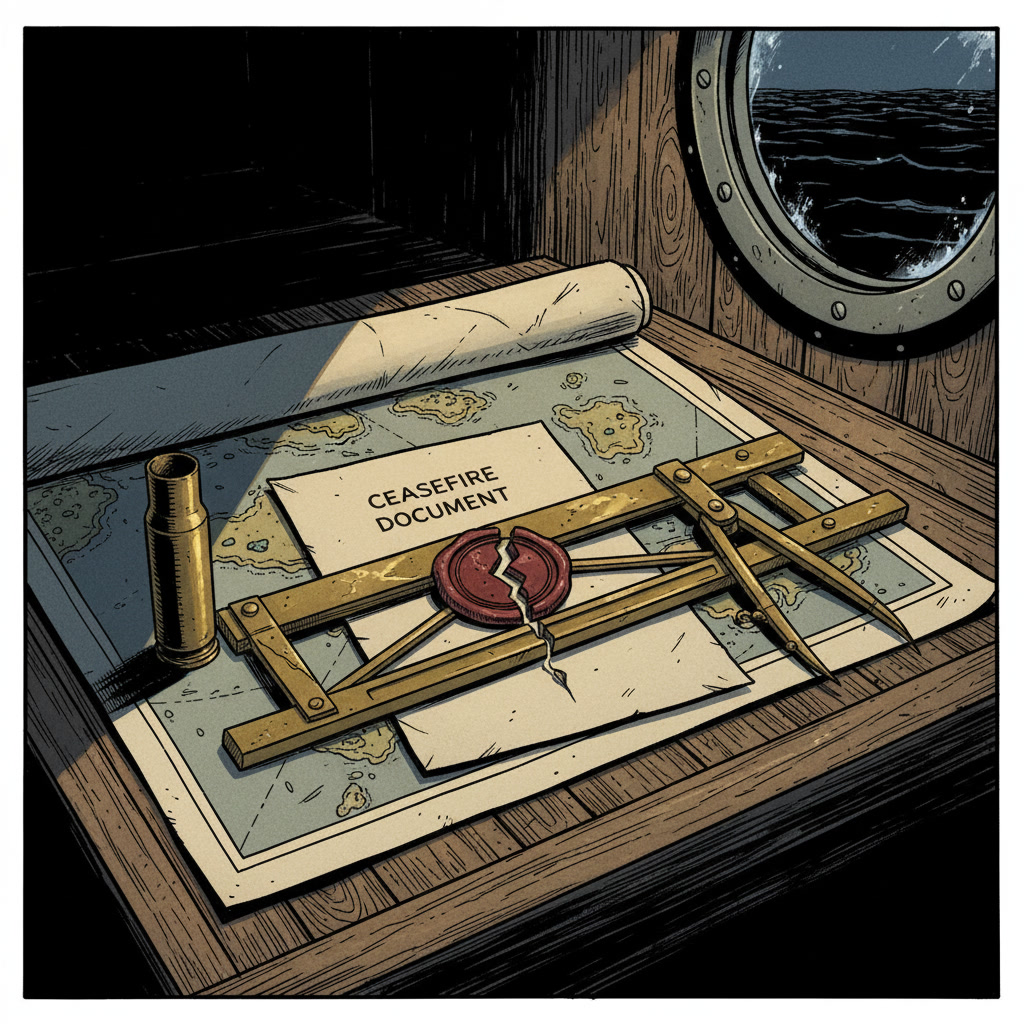
What does a ceasefire mean when both sides are simultaneously trading strikes and accusing the other of firing first? Not a rhetorical question this morning — it describes the literal state of affairs in the Strait of Hormuz and the waters off Bahrain, where the U.S.-Iran truce that President Trump called historic in late May has become a live-fire dispute with competing origin stories attached.
Iran attacked a container ship in the Strait overnight. The United States struck Iranian military sites in response. Bahrain — which hosts the U.S. Navy's Fifth Fleet and has not been a direct party to the conflict — was separately targeted in the same exchange. Bloomberg confirmed the raised naval threat level and the Bahrain targeting. The Financial Times reported the American strikes. The New York Times has live updates running as of this morning. Both governments are formally accusing each other of violating the May ceasefire, which is itself a structural feature of how these escalations sustain themselves: whoever establishes the aggressor narrative first acquires diplomatic cover for whatever comes next.
Yesterday's brief said the ceasefire was "holding by convention, not by treaty, and the verification architecture that would make it durable remains absent from the wire." That assessment lasted twenty-four hours.
The Ceasefire Is the War
Iran's attack on the container ship preceded the U.S. strikes — that is the sequence Bloomberg and the FT report — though what triggered Tehran's decision to act against commercial shipping is not established by any wire source today. Naval authorities raised the threat level in the Strait following the vessel strike. The Bahrain targeting adds a second dimension: it implicates a U.S. treaty ally, expands the geographic footprint of the confrontation, and raises the question of whether Manama will invoke mutual defense obligations or absorb the incident silently. No Bahraini official statement has appeared on the wire.
The read here is this. The closest historical parallel is not the spring ceasefire negotiations — it is the 1987-88 tanker war in the same Gulf. Iranian mines and speedboat attacks on neutral shipping drew in U.S. naval escorts under Operation Earnest Will, then retaliatory U.S. strikes under Operation Praying Mantis in April 1988. The mutual-accusation cycle ran for over a year before it terminated — and it did not terminate through diplomacy. It terminated when the USS Vincennes shot down Iran Air Flight 655 in July 1988, killing all 290 people aboard, and Iran concluded that continued confrontation now risked a level of catastrophic cost that changed the calculus entirely. The structural lesson is specific: in a contested narrow waterway, tit-for-tat does not self-limit. It escalates until one side absorbs a forcing event, or one side unilaterally chooses to stop responding. Neither side has chosen the latter today.
The falsifier for de-escalation is narrow. If Khamenei's office or Iran's foreign ministry issues a statement framing today's exchange as concluded — not as justification for further action — and if shipping volume through the Strait returns to normal by Monday, this stays below the threshold of a full ceasefire collapse. The falsifier for escalation is blunt: a second attack on Bahrain, a U.S. carrier group repositioning toward Iranian coastal waters, or any interference with tanker transit. What I'd watch for next is Bahrain's official response. If Manama issues only a muted statement or goes quiet, they've already calculated that alliance loyalty costs less than public visibility. That silence, if it comes, tells you more than any communiqué.
Three other things worth knowing
Ukraine reached the Volga. Zelenskyy confirmed overnight that Ukrainian forces struck a military production facility in Volgograd — roughly 700 kilometers from Ukraine's eastern border — using what he called "Flamingo" missiles, a long-range system not previously identified in the documented record of Ukrainian strikes. Bloomberg had not tracked it before yesterday. Volgograd is the deepest confirmed Ukrainian strike into Russian territory on record. Bloomberg simultaneously reports that Russian glide bombs are reducing a Ukrainian fortified city to rubble. The read here: the tactical exchange is now running at a depth that transforms both sides' strategic calculations. Russia must now defend its Volga industrial corridor, not just its western oblasts. That is a new and expensive constraint on Moscow's air-defense posture.
Venezuela: yesterday's falsifier activated. Yesterday's brief warned that the Maduro government would treat the earthquake disaster as a political variable rather than a purely humanitarian emergency, and named as its test whether Washington's stated posture toward Venezuela could survive contact with a crisis it cannot manage at distance. The New York Times answers both questions today: "Trump's Vow to 'Run' Venezuela Is Tested After Quakes." What's new: the Trump administration's assertive Venezuela rhetoric — the framing of imminent U.S. influence over Caracas — is now being measured against the visible limits of what Washington can actually do when a country it neither occupies nor directly assists faces a mass-casualty emergency. The gap between the claim and the capacity is legible in the headline itself.
Twenty-plus flood alerts across the central U.S. have no national headline. A continuous arc of Severe Flood Warnings, Flash Flood Warnings, and Flood Watches stretches from Louisiana and Oklahoma through Missouri, Kansas, Kentucky, Indiana, Tennessee, and into West Virginia and Ohio. Nashville's National Weather Service issued watches covering 24 counties overnight; Charleston's office covers 48 counties and zones across West Virginia and neighboring states. The footprint spans multiple FEMA (Federal Emergency Management Agency) regions simultaneously. It is receiving effectively no national wire coverage today, crowded out by the Hormuz exchange.
Echoes
The Persian Gulf tanker war of 1987-88 is the specific parallel. Iranian attacks on neutral shipping, U.S. retaliatory strikes, both sides claiming justification, the cycle running for over a year until a catastrophic miscalculation — the Vincennes-Iran Air incident — forced Iran to reassess. What 1988 teaches is not that escalation always ends badly; it teaches that in a narrow, commercially vital waterway, neither side has an easy off-ramp once the tit-for-tat cycle begins. The presence of a nominal ceasefire today is a new variable that didn't exist in 1987. But the read here is that a ceasefire neither side documented thoroughly enough to adjudicate is not a constraint — it is a grievance database. Both sides now have one, and each will mine it to justify the next move.
The quiet things
Apple has filed for a U.S. government license to purchase memory chips from ChangXin Memory Technologies — CXMT — a Chinese chipmaker on the Commerce Department's export-control list, per Bloomberg and the Financial Times. The read here: the request is a tell. It means Apple's supply chain calculus has reached a point where a blacklisted Chinese supplier is preferable to available alternatives at acceptable cost. Commerce's response — fast approval, slow review, or denial — will signal whether the semiconductor restrictions are a hard ceiling or a negotiating floor. Neither the wire nor the administration has commented.
Significant wildfires are burning in central Utah — the Millard County area — with NASA satellite readings registering fire radiative power above 435 megawatts at multiple detection points, the signature of large, established blazes rather than new ignitions. NOAA (the National Oceanic and Atmospheric Administration) has simultaneously issued Red Flag Warnings for the Lower Colorado River Valley and parts of Arizona's Tonto National Forest. A split-screen emergency — flooding across the mid-continent, fire weather across the West — is covering a large portion of the continental United States this morning. Neither story is on the national wire.
How I'd act on this
If you hold energy positions: The Strait of Hormuz carries roughly a fifth of global seaborne oil. Traffic was still moving as of Bloomberg's earlier report, but a raised naval threat level is the futures market's leading indicator. Watch Tuesday's Brent settlement. If the premium over $85 per barrel expands past $5, the market is pricing meaningful closure probability into the next 30 days.
If you follow U.S.-Iran policy: The mutual-accusation framing is how these escalations acquire legal cover for the next strike. The read here: the first side to offer a public de-escalatory off-ramp gains the international narrative and the diplomatic initiative. Neither side has done that yet. Watch for the first senior official — Iranian or American — to use the word "proportionate" without a threat attached to it.
If you track the Ukraine war: Volgograd is a new targeting threshold. What I'd watch for next is whether Russia responds against Ukrainian infrastructure farther west — Odessa's port facilities, Lviv — within the week, and whether any NATO government uses the "Flamingo" disclosure as a basis for authorizing additional long-range systems to Kyiv.
If you cover Central U.S. weather or agricultural markets: the flood arc sits directly over parts of the summer corn and soybean belt in Missouri, Indiana, and Kentucky. The USDA (U.S. Department of Agriculture) weekly crop condition report releases Monday. That is the first official read on whether this week's water is damage or irrigation.
If you hold Venezuelan sovereign debt or PDVSA (Petróleos de Venezuela, S.A.) bonds: the NYT's "tested" framing signals that Washington's assertive posture has shifted to reactive. The read here: Maduro will read it the same way. A debt-service standstill framed around earthquake emergency costs remains the most likely next financial maneuver from Caracas — the political cover just deepened.
The United States and Iran are trading strikes while accusing each other of breaking a ceasefire neither fully documented; Ukraine's Flamingo missiles just reached the Volga, a line Russia will now have to defend on top of every front it already holds.
— *The Plumb Line*. Daily world brief.
Sources
US-Iran / Hormuz / Bahrain
- newswire — FT: "US launches strikes on Iran after Tehran attacks container ship," June 27
- newswire — Bloomberg: "Ship Struck in Hormuz as Naval Authorities Raise Threat Level," June 27
- newswire — Bloomberg: "Bahrain Targeted, Ship Struck as Iran War Ceasefire Tested," June 27
- newswire — NYT: "Live Updates: Mideast Hostilities Flare, Testing Fragile U.S.-Iran Truce," June 27
- newswire — Bloomberg: "Iran, US Trade Accusations of Violating Ceasefire After Strikes," June 27
- gdelt — moneycontrol.com: "US hits Iranian military sites after cargo ship attack in Strait of Hormuz," June 27
- gdelt — standardmedia.co.ke: "US, Iran trade strikes putting new strain on Middle East truce," June 27
- *The Plumb Line*, June 26 — Iran/Hormuz falsifier set: ceasefire "holding by convention, not by treaty"; verification architecture absent; both conditions now triggered
Ukraine / Russia
- newswire — Bloomberg: "Ukraine Hits Volgograd Military Plant With Flamingo Missiles," June 27
- newswire — Bloomberg: "Putin's Glide Bombs Are Turning Ukraine's Fortress City Into Rubble," June 27
Venezuela (continuity)
- newswire — NYT: "Trump's Vow to 'Run' Venezuela Is Tested After Quakes," June 27
- newswire — NYT: "Venezuela's Economy Was On the Rise. Then the Earthquakes Struck.," June 27
- *The Plumb Line*, June 26 — Venezuela falsifier set: political-variable framing, Mexico City 1985 precedent; both now confirmed active
Central U.S. flooding
- noaa_alerts — Severe Flood Warning: Union, LA (NWS Shreveport), June 25–30
- noaa_alerts — Flood Watch: 24 counties, Tennessee (NWS Nashville), June 27
- noaa_alerts — Flood Watch: 48 zones, West Virginia/Ohio (NWS Charleston), June 27
- noaa_alerts — Flash Flood Warnings: Crawford/Perry IN; Floyd/Harrison/Jefferson KY/IN; Spencer KY; Boyle/Mercer/Washington KY (NWS Louisville), June 27
- noaa_alerts — Flash Flood Warnings: Creek/Muskogee/Tulsa/Wagoner/Okfuskee/Okmulgee counties, OK (NWS Tulsa), June 27
- noaa_alerts — Flood Warning: Lyon, KS (NWS Topeka); Butler/Cowley, KS (NWS Wichita), June 27
Utah wildfires / fire weather
- nasa_firms — Fire radiative power >435 MW at lat ~39.12, lon ~112.09 (Millard County, Utah), June 27
- noaa_alerts — Red Flag Warning: Lower Colorado River Valley AZ/CA; Tonto National Forest Foothills, AZ (NWS Phoenix), June 27
Apple / CXMT chip waiver
- newswire — Bloomberg: "Apple Seeks US Approval to Buy Chips From Blacklisted CXMT: FT," June 27
Historical references
- Operation Earnest Will, 1987–88: U.S. naval escort of Kuwaiti tankers reflagged under U.S. colors in the Persian Gulf
- Operation Praying Mantis, April 18, 1988: U.S. retaliatory strikes on Iranian oil platforms Sassan and Sirri; frigate Sahand sunk; response to mining of USS Samuel B. Roberts
- Iran Air Flight 655, July 3, 1988: USS Vincennes shoots down Airbus A300; all 290 aboard killed; cited as the event that shifted Iran's cost-benefit calculus toward ceasefire