Two Earthquakes. Thirty-Eight Seconds.
The Plumb Line
Thursday, June 25
Thirty-eight.
That is how many seconds separated a magnitude 7.2 earthquake from a magnitude 7.5 earthquake in northwestern Venezuela last night — a doublet so compressed that the second shock arrived before anyone had finished running from the first. Both events earned USGS red alerts. La Guaira, Venezuela's main port and the coastal gateway to Caracas, was among the hardest-hit areas; the New York Times, running a live blog this morning, reports the death toll rising as rescue teams dig through the rubble.
This is Venezuela's crisis stack gaining another layer. Yesterday, The Plumb Line covered Caracas entering what the Financial Times called the world's largest sovereign debt restructuring. That process is still nominally underway — but the read here is straightforward: a government managing a mass-casualty disaster does not have bandwidth for parallel creditor negotiations. Anyone holding Venezuelan sovereign or PDVSA (Petróleos de Venezuela, the state oil company) bonds should reset their timeline assumptions now.
The rest of the wires did not wait for Venezuela to steady itself. Ukraine said it struck Rosneft oil refineries in Ufa, deep in Russia's Ural region — even further into Russian territory than yesterday's Kazakhstan-border strike. France's navy boarded a shadow fleet tanker off Sicily. Taiwan publicly simulated a Chinese maritime quarantine. Three stories that would each lead a normal morning; today, they follow Venezuela.
Two Earthquakes. Thirty-Eight Seconds.
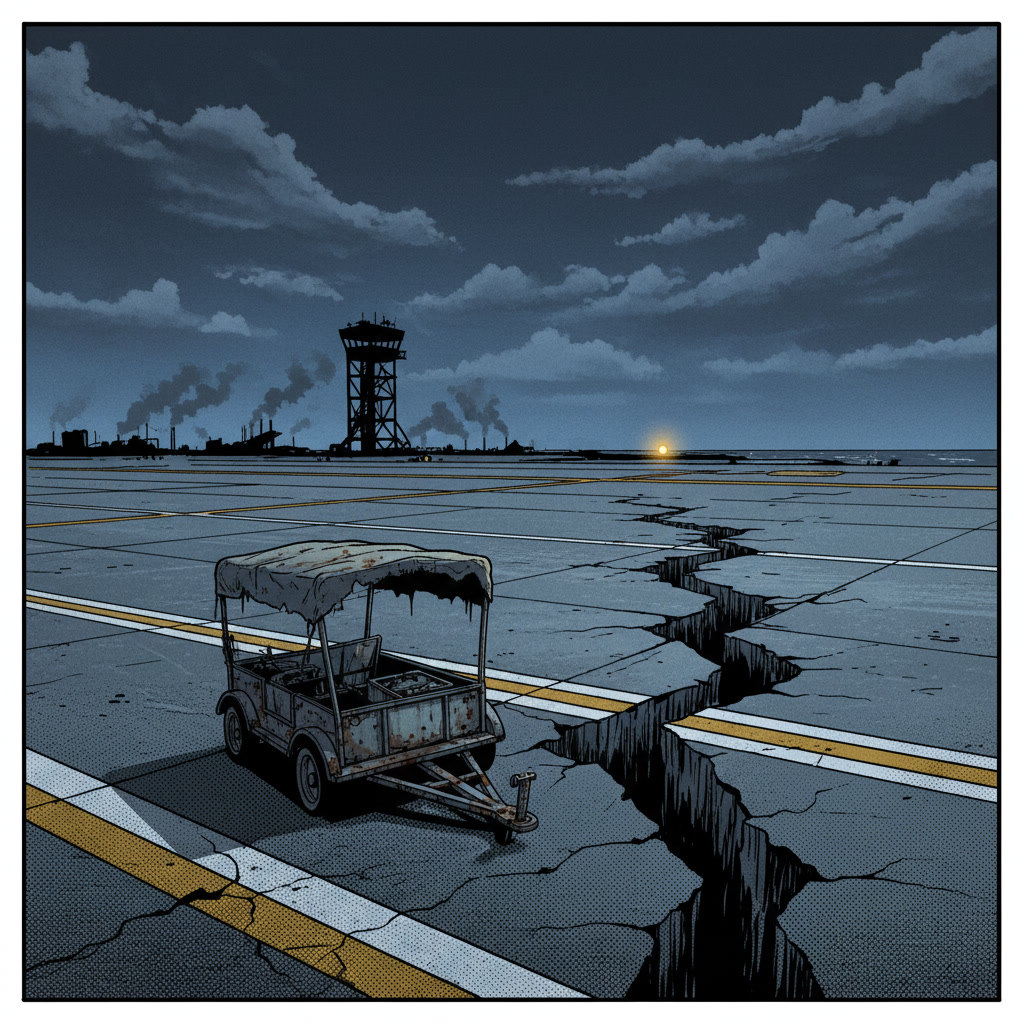
The magnitude 7.2 struck first at 22:04 UTC Wednesday, roughly 23 kilometers southeast of Yumare in Yaracuy state. Thirty-eight seconds later, the 7.5 arrived nearby at a slightly shallower depth. USGS issued red alerts for both. No tsunami warning. La Guaira — Venezuela's primary port for container and passenger traffic, and home to the only coastal highway between the Caribbean and Caracas — reported severe damage; the Times described residents fleeing through collapsed streets. The death toll was still climbing as of this morning's wire reports, with search-and-rescue operations underway.
The historical parallel here is Haiti in January 2010 — not because the seismic numbers are identical but because the pre-conditions are. Haiti's death toll from a magnitude 7.0 earthquake exceeded 100,000 not primarily because of the shaking's intensity, but because a decade of institutional deterioration had left the buildings structurally inadequate, the hospitals understaffed, and the emergency-response systems unable to scale. Venezuela has experienced its own version of that deterioration: hyperinflation, emigration of roughly seven million people since 2015, hospital decay, and infrastructure that hasn't been maintained at scale in years. The read here is that the earthquake is the diagnostic event; it reveals what was already broken.
What I'd watch for next is observable and near-term: whether Caracas accepts international search-and-rescue assets — particularly from the United States, Colombia, or Brazil — within the next 24 to 48 hours. If Caracas opens its airports to foreign heavy-lift aircraft and international rescue teams, the pragmatic reflex won the internal argument. If official statements route aid exclusively through ALBA partners (Cuba, Nicaragua, Bolivia) in a way that slows delivery for political reasons, the calculus will show up in the death-toll curve within a week.
Three other things worth knowing
Ukraine's deep-strike campaign confirmed at Ufa. Yesterday's brief flagged a Ukrainian strike on a gas-processing plant near the Kazakhstan border as the beginning of a strategic pattern — the assumption of sanctuary in Russia's eastern tier ending. Bloomberg reported overnight that Ukraine said it hit Rosneft oil refineries in Ufa, the capital of Bashkortostan in Russia's Ural mountain region. The read here is that this is not the edge of Russia's operational geography; it is the interior. The historical parallel established yesterday — the 1999 air campaign targeting Serbian energy infrastructure in places previously treated as immune — now fits more tightly. What I'd watch for next is whether the Kremlin's silence holds or whether a counterstrike materializes against western Ukrainian infrastructure in the next 72 hours.
France's navy boarded a shadow fleet tanker off Sicily. President Macron confirmed the interdiction this morning, per Bloomberg. Russia's shadow fleet — the network of older tankers operating under obscure registries to move Russian oil around Western sanctions — has run largely uncontested for two years; a French naval boarding changes the enforcement posture substantially. The historical parallel is the British seizure of the Iranian tanker Grace 1 off Gibraltar in July 2019, which Iran answered within two weeks by seizing the British-flagged Stena Impero in the Persian Gulf. Russia's retaliatory capacity differs from Iran's, but the read here is that the dynamic — a sanctioned power testing whether its oil logistics have become effectively immune — is structurally similar. What I'd watch for next is European commercial shipping in the Baltic and Black Sea for any informal counter-pressure.
Taiwan publicly gamed out a Chinese maritime quarantine. Bloomberg reported Taipei ran a tabletop exercise simulating a Chinese naval cordon cutting the island off from imports and resupply — the scenario Chinese military planners have described as their preferred opening move in any Taiwan contingency, rather than a direct beach assault. The read here is that the exercise matters less than the public disclosure. Taipei is signaling to Washington that it has modeled this scenario specifically, which is a pointed question to the parts of the U.S. government still debating whether the Taiwan Relations Act's mutual-defense clause triggers on a quarantine versus a kinetic strike. Beijing knows that question is unresolved. So does Taipei.
Echoes
Haiti on January 12, 2010 is Venezuela's most instructive precedent — not seismically but institutionally. Port-au-Prince's death toll reached catastrophic levels in part because a decade of underinvestment and political dysfunction had produced exactly the building stock and response capacity that a major earthquake destroys fastest. Venezuela's decay arrived differently — economic collapse, emigration, capital flight — but the material result is comparable: degraded hospitals, underpaid first responders, unmaintained infrastructure. The read here is that the earthquake is the trigger; the institution is the variable that determines the toll.
The French naval boarding echoes Gibraltar in July 2019 — the moment Britain tested whether maritime sanctions enforcement was real, discovered it was, and discovered also that testing it had a price. The lesson from that episode: the political logic of boarding shadow fleet vessels is sound; the question is whether Moscow has the appetite and capability to make enforcement costly enough to deter the next boarding. Iran in 2019 used conventional naval assets and still triggered a diplomatic escalation. What I'd watch for next is how Russia responds here before concluding that shadow fleet interdiction has become cost-free.
The quiet things
Oil prices have returned to their pre-Iran-war level, the Financial Times reported this morning — a significant market signal that investors are treating the ceasefire as durable and pricing in eventual resumed Iranian supply. That backdrop makes John Kerry's statement in a Bloomberg interview this morning all the more notable:
Kerry was characterizing the Iran war itself. The read here is that a former Secretary of State delivering a post-mortem verdict before the final peace terms are signed suggests the foreign policy establishment's judgment has already calcified — which is itself worth flagging as negotiations continue without meeting the falsifiers set in this brief over the past three days. No named International Atomic Energy Agency (IAEA) inspection date. No sanctions sequencing calendar. No dispute-resolution mechanism on the public record. No Hormuz operational framework. All still absent from the wire.
The U.S. Senate voted down an Iran War Powers Resolution today, declining to constrain the executive's authority over military action. The practical effect: the administration retains unilateral flexibility if talks stall — a background condition that changes the negotiating dynamic even if nothing formally triggers.
Europe's heat wave has moved from record temperatures into operational failure. Spain's government warned of a high death toll. The Financial Times reports hospitals across the continent are canceling scheduled operations because facilities lack adequate air conditioning — a quiet indicator of infrastructure built for a different climate running out of margin. The American Southwest is running a parallel emergency: Phoenix and Tucson are both under Extreme Heat Warnings through this evening. Flash flood warnings ran overnight across Oklahoma, Kansas, and Arkansas. Heat and flood simultaneously across the same continent is not unprecedented in late June; the read here is that this density of simultaneous emergencies is what's unusual.
How I'd act on this
If you hold Venezuelan sovereign or PDVSA bonds: the earthquake doesn't cancel the restructuring, but it resets the timeline and changes the political optics entirely. Model a three-to-six-month delay in formal creditor engagement as your working assumption. What I'd watch for next is whether Caracas requests a debt-service standstill on humanitarian grounds — that language, if it appears, will be the tell for how Maduro intends to use the disaster politically.
If you cover or trade energy: France's shadow fleet interdiction, if other European navies follow, begins to tighten the implicit discount on Urals crude. Against that, oil is back to pre-war prices as Iranian supply potentially returns. The read here is a market that looks calm on the headline and has more variance underneath than the price suggests. The Ufa strikes add uncertainty on Russian domestic throughput. Size to fit an environment where stability is priced in and the underlying picture is not.
If you work on Taiwan policy or Asia-Pacific security: the read here is that today's quarantine drill disclosure is a deliberate diplomatic signal, not a routine exercise announcement. Taipei is asking Washington, in a way that appears in wire services, where the mutual-defense commitment stands if China acts short of an outright military attack. That question deserves an explicit answer before Beijing decides to test whether the ambiguity runs in their favor.
If you follow Japan's fiscal and monetary situation: Prime Minister Takaichi unveiled what the Financial Times called Japan's largest-ever investment roadmap today, alongside a multi-year budget reform framework reported by Bloomberg. Neither broke into the main international wire leads, but the read here is that together they represent the most significant shift in Japanese fiscal signaling in years. If you hold yen-denominated assets or track Japanese Government Bond (JGB) yields, the framework is worth reading before markets open in Tokyo next week.
Venezuela is simultaneously managing a mass-casualty earthquake, a creditor restructuring announced yesterday, and a level of international isolation that constrains who shows up fast enough to matter. The test of whether governance still functions in Caracas will arrive at the airport in La Guaira — in the next 48 hours, in the form of foreign heavy-lift aircraft either landing or being turned away.
— *The Plumb Line*. Daily world brief.
Sources
Venezuela earthquakes
- usgs_earthquakes/us6000t7zp — M7.5 @ 28 km SE of Yumare, Venezuela; USGS red alert; depth 10.0 km; June 24
- usgs_earthquakes/us6000t7zc — M7.2 @ 23 km SE of Yumare, Venezuela; USGS red alert; depth 20.3 km; June 24
- usgs_earthquakes/us6000t80d — M4.5 aftershock @ 13 km N of Caucagüito, Venezuela; June 24
- newswire/nyt — "Venezuela Live Updates: Death Toll Rises as Rescuers Mount Frantic Search for Survivors of Twin Earthquakes," June 25
- newswire/nyt — "La Guaira, Venezuelan Port Town, Is Hit Hard by Earthquakes," June 25
- newswire/nyt — "Two Earthquakes Hit Venezuela: What to Know About Death Toll, Damage and Rescue Response," June 25
- newswire/nyt — "Venezuela Residents Describe Terror as Deadly Earthquake Struck," June 25
Ukraine / Ufa strikes
- newswire/bloomberg — "Ukraine Says It Hit Rosneft Oil Refineries in Russia's Ufa," June 25
France / shadow fleet interdiction
- newswire/bloomberg — "Macron Says French Navy Boards Shadow Fleet Tanker Off Sicily," June 25
Taiwan quarantine drill
- newswire/bloomberg — "Taiwan Drill Simulates Maritime 'Quarantine' by Chinese Forces," June 25
Iran / oil / Kerry
- newswire/ft — "FirstFT: Oil price returns to prewar level," June 25
- newswire/bloomberg — "Kerry Says Iran War 'Never Should Have Happened'" (video), June 25
- newswire/bloomberg — "US Senate Votes Down Iran War Powers Resolution," June 25
Europe heat wave
- newswire/nyt — "Live Updates: Spain Warns of High Death Toll in Heat Wave," June 25
- newswire/ft — "Hospitals cancel operations because of lack of air conditioning," June 25
U.S. severe weather
- noaa_alerts — Extreme Heat Warning, Phoenix metro area (Northwest Valley, Buckeye/Avondale, Deer Valley, Central Phoenix, North Phoenix/Glendale, Scottsdale/Paradise Valley, East Valley, South Mountain/Ahwatukee, Southeast Valley/Queen Creek); NWS Phoenix AZ; through June 25 8 PM MST
- noaa_alerts — Extreme Heat Warning, Tucson Metro Area (Tucson/Green Valley/Marana/Vail, Sierra Vista/Benson, Clifton/Safford); NWS Tucson AZ; through June 25 8 PM MST
- noaa_alerts — Flash Flood Warnings, Mayes/Rogers/Washington/Osage/Pawnee/Tulsa counties OK; NWS Tulsa OK; June 25
- noaa_alerts — Flash Flood Warnings, Clark/Dallas/Hot Spring counties AR; NWS Little Rock AR; June 25
- noaa_alerts — Flood Watch, 27 central and south Kansas counties; NWS Wichita KS; through June 26
Japan investment framework
- newswire/ft — "Takaichi sets out Japan's largest-ever investment roadmap," June 25
- newswire/bloomberg — "Japan Unveils Multi-Year Framework as Part of Budget Reform," June 25
Historical references
- Haiti earthquake, January 12, 2010: M7.0; estimated 100,000+ deaths; institutional failure as casualty multiplier
- British seizure of Iranian tanker Grace 1, Gibraltar, July 4, 2019; Iranian seizure of Stena Impero, Strait of Hormuz, July 19, 2019
- NATO Operation Allied Force, 1999: deliberate targeting of Serbian energy infrastructure (see *The Plumb Line*, June 24)
- *The Plumb Line*, June 24 — Venezuela debt restructuring announced (FT); Ukraine Kazakhstan-border gas plant strike flagged as emerging pattern; Iran falsifiers set