Two Thresholds, One Morning
The Plumb Line
Wednesday, June 24
At what distance from the front does a country's energy infrastructure stop being safe? For Russia, that answer moved sharply eastward this morning.
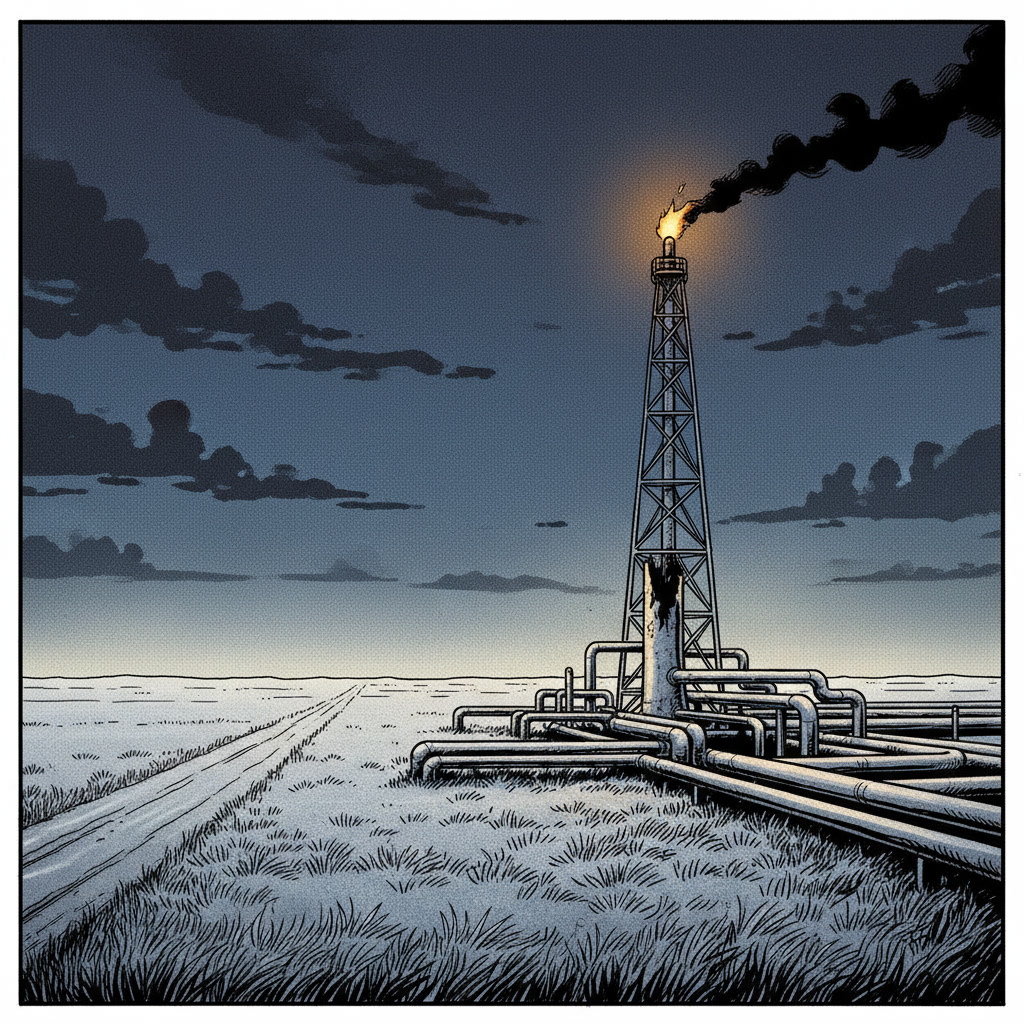
Ukraine said it struck a Russian gas-processing plant near the Kazakhstan border, Bloomberg reported — a target far beyond what most observers have treated as Russia's operational rear area. The plant sits in Russia's eastern reaches, where pipelines run toward Central Asia and the assumption of sanctuary had, until now, held. This isn't a border village. It isn't a refinery in the western oblasts. It is infrastructure in a part of Russia that, until recently, no one was defending against Ukrainian strikes because no one thought they needed to.
That assumption expired this morning. So did another one, in a different hemisphere. The Financial Times reports that Venezuela is moving to initiate what it characterizes as the world's largest sovereign debt restructuring — nine years after the Maduro government first stopped servicing its bonds in 2017. A gas plant in Russia's eastern tier and a creditor negotiation in Caracas share no operational connection. What they share is the quality of threshold: both represent lines crossed this morning, not threats pending.
Two Thresholds, One Morning
Ukraine said it struck a Russian gas-processing plant near the Kazakhstan border, Bloomberg reported. The facility is part of the infrastructure through which Russia processes and routes gas through its eastern grid — supply chains serving domestic consumption and potentially export routes running toward Central Asia. No Ukrainian statement specified the weapon system. The Kremlin had not issued a formal response in wire reporting as of this morning.
The read here: the closest strategic parallel is NATO's 1999 air campaign in the former Yugoslavia — specifically the deliberate targeting of Serbian energy infrastructure (fuel depots, transformer stations, power distribution nodes) designed not to win the front-line battle but to impose cost at depth and force Serbian planners to defend targets they had assumed were immune. The analytical claim here is that Ukraine's strike near Kazakhstan performs the same function. The mechanism: if no point in Russian territory can be treated as a defensible rear area, the cost of maintaining eastern energy infrastructure without air-defense coverage increases substantially. A single gas-processing plant near Kazakhstan matters less for what it removes from supply than for what it communicates to Moscow's defensive planners.
What I'd watch for next: if Moscow announces defensive upgrades to its eastern energy infrastructure — air-defense repositioning, restricted perimeters, civilian access changes around facilities in the region — that signals the strike registered strategically. If the Kremlin says nothing publicly and the wires stay quiet, this may have been calibrated to avoid a formal response that would require proportionate retaliation. The falsifier for a stable read: a Russian counterstrike on western Ukrainian infrastructure — Lviv, Uzhhorod, the western rail corridors that carry military aid — within 72 hours. If that happens, this was escalation. If not, it was calibration.
Three other things worth knowing
Venezuela is initiating what the Financial Times characterizes as the world's largest sovereign debt restructuring. Nine years after the Maduro government first defaulted on its bonds in 2017, Caracas is moving to open formal creditor negotiations — a process that encompasses both sovereign debt and obligations through PDVSA (Petróleos de Venezuela, the state oil company). Bloomberg reports that Delcy Rodríguez, increasingly Venezuela's effective political operator, is already campaigning for the presidency before a vote has been called. The analytical read: the trigger for the restructuring appears tied to the Trump administration's shifting posture toward Caracas — the same political realignment that has made Venezuela a case study in what access to American diplomatic normalization costs, and what it buys.
Rubio's Gulf tour is showing the distance between optics and substance on Iran. Bloomberg ran two pieces this morning that, read together, describe a negotiation performing better than it is functioning: one headlined "Good Vibes at US-Iran Talks Hide Big Problems," another confirming the talks had a "rocky start" before Rubio met Gulf leaders. Yesterday's brief set three specific falsifiers for a real deal — a named International Atomic Energy Agency (IAEA) inspection date, a sanctions sequencing calendar, and a named dispute-resolution mechanism — and added a fourth: any public language addressing Iranian naval conduct in the Strait of Hormuz. None of those four markers has appeared in wire reporting from Rubio's Gulf stops. The regional partners are being reassured; the substance of the arrangement remains opaque.
SK Hynix, South Korea's largest memory chip maker, filed for a $29 billion listing on a U.S. exchange. The FT confirmed the filing this morning, and an F-1 registration appeared simultaneously with the SEC (Securities and Exchange Commission). The read here: the transaction is not primarily a financial story. SK Hynix is one of only three manufacturers globally capable of producing the high-bandwidth memory chips essential for AI computing; the other two are Micron (American) and Samsung (also Korean). Anchoring to U.S. capital markets at this scale makes SK Hynix's financial fate increasingly tied to American investors — and implicitly makes it harder for any future U.S. administration to treat the company as an adversary in a semiconductor supply-chain confrontation. Watch whether Samsung follows.
Echoes
Venezuela's restructuring echoes Argentina's 2001–2014 debt cycle most precisely: Buenos Aires defaulted in December 2001, restructured at roughly 30 cents on the dollar in 2005, and was back in technical default by 2014 — driven by holdout creditors who refused the first haircut. The analytical lesson: it isn't that restructurings fail; it's that a first deal that excludes holdouts tends to extend the timeline rather than close it. Watch whether Caracas's opening offer addresses the holdout creditor class; if it doesn't, expect a second round. For the Ukraine strike, the relevant echo is that same 1999 NATO campaign: not designed to win on the ground, but to force an adversary to defend targets previously thought immune. In both 1999 and 2026, the logic is identical — imposing cost at depth changes an adversary's calculation faster than contesting the front line directly.
The quiet things
Andy Burnham gave Bloomberg a policy position today — "flexibility" in Britain's fiscal rules — but still nothing on foreign policy. The falsifier set Monday (Burnham's first public foreign policy statement) remains unmet as his City of London speech arrives tomorrow. The EU-UK summit remains delayed. The interregnum is doing what interregnums do.
The Utah wildfire tracked in this brief since Tuesday has intensified. NASA satellite data this morning shows 867 megawatts of fire radiative power from the Millard County cluster — up from 710 megawatts yesterday, and the highest single-source reading in North American fire data today. The Siberian fire complex northwest of Krasnoyarsk is now in its eleventh consecutive day of satellite detection, with readings above 390 megawatts overnight. Neither complex is a standalone wire story.
The American interior is running three distinct severe weather emergencies simultaneously. Arizona's Tucson metro area is under an Extreme Heat Warning through tomorrow evening. Flash flood warnings ran overnight from southwest Arkansas and northwest Louisiana through Kansas and Oklahoma — with multi-day flood warnings in Reno and Rice counties in Kansas extending through next weekend. Red flag fire warnings cover the Mojave Desert and the Victor Valley corridor in Southern California. None individually unusual for late June; the combination notable.
A shallow seismic cluster near Mindanao in the southern Philippines produced six earthquakes ranging from magnitude 4.4 to 5.0 within roughly four hours overnight, all within about 30 kilometers of each other near Catuday. No tsunami warning was issued; no damage reported in wire sources. Unresolved shallow seismic clusters in historically active zones warrant one flag before they're forgotten.
How I'd act on this
If you hold Venezuelan sovereign or PDVSA bonds: the restructuring announcement opens the process, it doesn't resolve it. Recovery rates will hinge on two things not yet public — how much oil-export revenue Caracas projects over the restructuring term, and what the Trump administration has committed to in exchange for the Rodríguez political opening. Neither is in wire reporting. Get both before modeling recovery value.
If you cover or trade the Iran file: Bloomberg's "good vibes / big problems" framing this morning is a yellow flag. Rubio's Gulf stops produced reassurance language but no confirmed Hormuz operational framework. The four falsifiers from yesterday's brief remain unmet. Watch for any public communiqué addressing Iranian naval conduct in the strait — not just sanctions timing. That distinction tells you whether this is a financial arrangement or a strategic one.
If you track energy markets: two vectors converged this morning. Ukraine struck Russian gas infrastructure far in the country's eastern reaches. Venezuela's restructuring, if it proceeds toward resolution, eventually unlocks PDVSA production capacity — a long-term supply story, not a short-term one. Together they add uncertainty on both the Russian supply side and the timeline for Venezuelan barrel recovery.
If you work in technology policy or semiconductor supply chains: SK Hynix's $29 billion U.S. listing is a strategic alignment signal dressed as a capital markets transaction. At this scale, a Korean chipmaker anchoring to American equity markets is making a choice about which column it wants to be in when Washington eventually forces the sorting.
A gas plant near Kazakhstan, a creditor table in Caracas, and an F-1 filing in Washington — three places no one was looking at sunrise, three places the map changed before lunch.
— *The Plumb Line*. Daily world brief.
Sources
Ukraine strike near Kazakhstan
- newswire/bloomberg — "Ukraine Says It Hit Russian Gas-Processing Plant Near Kazakhstan," June 24
Venezuela restructuring
- newswire/ft — "FirstFT: Venezuela to initiate world's largest sovereign restructuring," June 24
- newswire/bloomberg — "Delcy Rodríguez Is Campaigning Even Before Venezuela Calls for Vote," June 24
- newswire/nyt — "Delcy Rodríguez, Venezuela's President, Struggles to Uphold Trump's Narrative of Success," June 23
Iran / Rubio Gulf tour
- newswire/bloomberg — "Rubio Meets Gulf Leaders After Rocky Start to US-Iran Talks," June 24
- newswire/bloomberg — "Good Vibes at US-Iran Talks Hide Big Problems," June 24
- newswire/nyt — "Rubio Seeks to Reassure Persian Gulf Allies on Iran Deal," June 24
SK Hynix listing
- newswire/ft — "SK Hynix bets on AI demand with bumper $29bn US listing," June 24
- sec_edgar/0001193125-26-280172 — SK hynix Inc., F-1 registration, June 24
UK / Burnham
- newswire/bloomberg — "Burnham to Seek 'Flexibility' in UK Fiscal Rules, Ally Says," June 24
- newswire/ft — "Burnham draws up plans for devolution blitz ahead of key City speech," June 24
Utah / Siberian wildfires
- nasa_firms/7f00f4393bbc0ccffeba97409db4f0ba — lat 38.36°N, lon -112.25°W; FRP 867.08 MW, high confidence; June 24
- nasa_firms/a7d368ca4196d2324117bfe2a4459eb3 — lat 61.81°N, lon 107.73°E; FRP 392.19 MW; June 24 (Siberia)
- nasa_firms (multiple) — Siberia cluster, 59°–62°N, 90°–108°E; FRP 193–297 MW; June 24
U.S. severe weather
- noaa_alerts — Extreme Heat Warning, Tucson Metro Area (including Green Valley/Marana/Vail); NWS Tucson AZ; through June 25
- noaa_alerts — Flash Flood Warnings, Columbia/Hempstead/Lafayette/Miller/Nevada AR, Claiborne/Lincoln/Webster LA; NWS Shreveport LA; June 24
- noaa_alerts — Flood Warnings, Reno and Rice counties KS; NWS Wichita KS; through June 26–28
- noaa_alerts — Red Flag Warning, Victor Valley–Apple Valley–Lucerne Valley–Johnson Valley; NWS San Diego CA; June 24
- noaa_alerts — Flood Watch, multiple Oklahoma counties; NWS Norman OK; June 24
Philippines seismic cluster
- usgs_earthquakes/us6000t7rf — M4.8 @ 52 km WNW of Catuday; June 23
- usgs_earthquakes/us6000t7rq — M4.9 @ 64 km WNW of Catuday; June 24
- usgs_earthquakes/us6000t7ru — M4.8 @ 61 km WNW of Catuday; June 24
- usgs_earthquakes/us6000t7rv — M4.4 @ 49 km WNW of Macabuboni; June 24
- usgs_earthquakes/us6000t7rx — M5.0 @ 71 km WNW of Catuday; June 24
- usgs_earthquakes/us6000t7s8 — M4.8 @ 78 km SSW of Lumatil; June 24
Historical references
- NATO Operation Allied Force, March–June 1999: deliberate air campaign against Serbian energy and transport infrastructure during the Kosovo intervention
- Argentina sovereign debt default, December 2001; restructuring at approximately 30 cents on the dollar, June 2005; return to technical default, July 2014 (holdout creditor dispute)
- *The Plumb Line*, June 23 — Iran falsifiers set (IAEA inspection date, sanctions sequencing calendar, dispute-resolution mechanism, Hormuz operational language); Utah wildfire tracked at 710 MW; Siberian fire complex at Day 10