Tehran Pockets the Relief and Muscles Into the Strait
The Plumb Line
Tuesday, June 23
The story most people are reading out of Tehran today is the financial one. Bloomberg reported that Iran says $12 billion in previously frozen assets will be unfrozen in the lead-up to Secretary of State Marco Rubio's Gulf tour — a number large enough to dominate the diplomatic dispatch. That read is real.
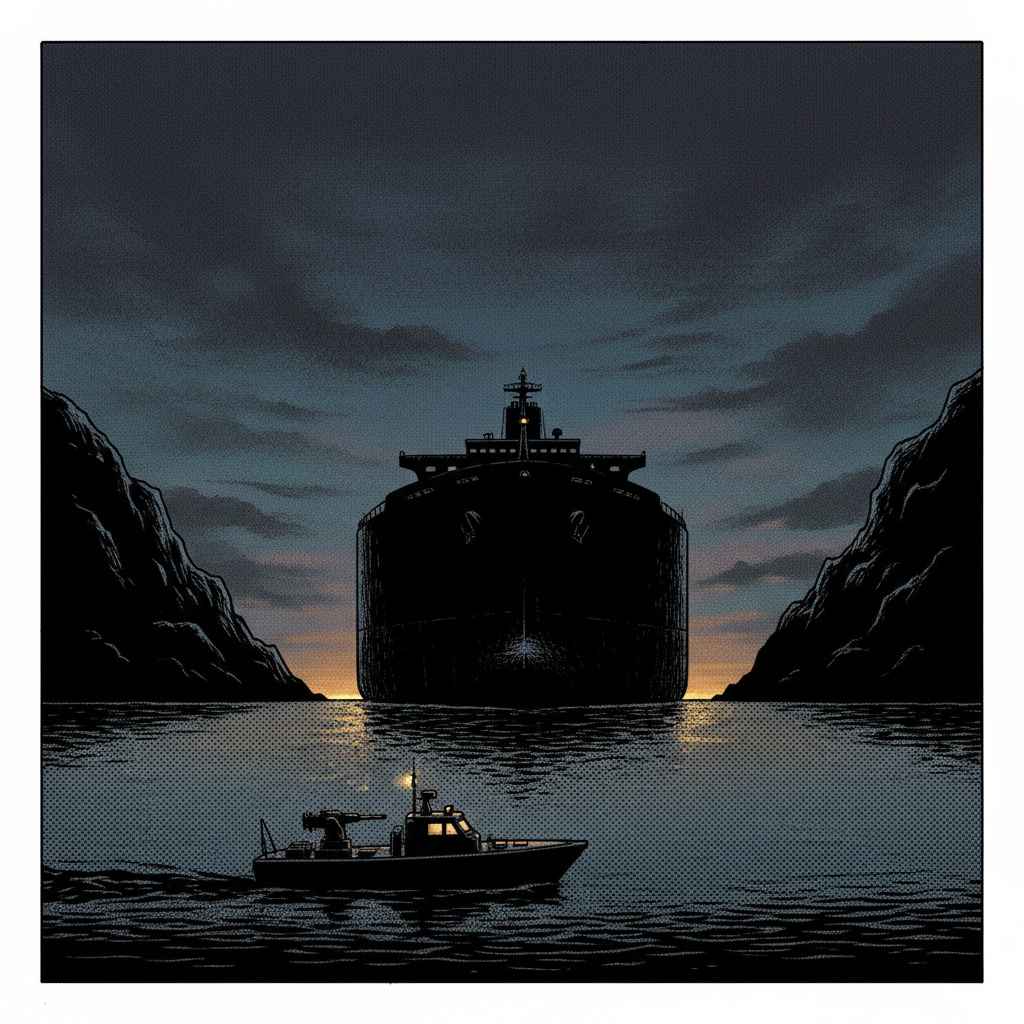
What's running alongside it, without most analysts connecting the two: the New York Times reported separately that Iran has been making moves to assert tighter physical control over the Strait of Hormuz, the waterway through which roughly 20 percent of global crude passes every day. These are not separate stories from Iran. They are the same story.
There is a word for the strategy of pocketing financial relief while simultaneously tightening your grip on the asset that gives you leverage over the people offering that relief. It is called not giving away your cards. The read here is that Iran is not choosing between diplomacy and coercion — it's running them in parallel, at the precise moment the diplomatic process enters its binding phase.
Tehran Pockets the Relief and Muscles Into the Strait
Iran's dual dispatch deserves to be read as a single document. On the financial side: Bloomberg reports $12 billion in frozen Iranian assets will be released ahead of Rubio's Gulf tour, a deliberately timed announcement calibrated to an audience Rubio is about to visit. On the physical side: the Times reports Iran is making moves to assert tighter control over the Strait of Hormuz, including positioning and activity along the strait. No dateline separates the two dispatches. The subject is the same.
Here's the read. The historical parallel is not the 2015 Iran nuclear framework — that process assumed Iranian compliance as a precondition for relief. The closer parallel is the Tanker War of 1987–1988, when Iran mined Gulf shipping lanes and attacked oil tankers while simultaneously engaging in ceasefire negotiations. The mechanism: leverage accumulation ran ahead of concession. Iran did not relinquish chokepoint control as a good-faith confidence builder; it traded that control for specific, verifiable deliverables — and recalibrated when the external cost of holding the strait exceeded the benefit. The read in 2026 follows the same logic: assert the physical chokepoint before the deal hardens, not after. The $12 billion number is what Iran is willing to name publicly. The Hormuz moves are what Iran is willing to do quietly.
Two specific signals to watch. If Rubio's Gulf tour produces any public language about the strait — not just sanctions sequencing, but physical conduct in Hormuz — that is evidence the diplomatic track is addressing Iran's leverage directly. If his stops produce only financial framework language while the Hormuz posture goes unaddressed in the communiqués, that is evidence the two tracks are running independently, which means what's being negotiated is a financial deal, not a strategic one. What I'd watch for next: an agreed operational arrangement for the strait, publicly stated, within the next two weeks. That is the falsifier for the optimistic case.
Three other things worth knowing
China has the fastest computer in the world again. The New York Times reported that China has reclaimed the top position in global supercomputer rankings for the first time since 2017. That nine-year gap — the span during which the U.S. held the crown — coincided almost exactly with the period of the most intensive American semiconductor export controls on Chinese computing hardware. The read here is pointed: export controls are a friction mechanism, not a wall. China found pathways — through domestic chip production, alternative architectures, or supply workarounds — sufficient to reclaim a benchmark the U.S. treated as a barometer of technological supremacy. What I'd watch for next: this ranking surfacing in congressional testimony before the defense appropriations debate closes.
Andy Burnham is going to be the next Prime Minister, and the foreign policy question is still unanswered. Yesterday's brief called Burnham's succession and set a specific falsifier: his first public statement on foreign policy. Today, Bloomberg reports Burnham is fleshing out his economic plan with a Chancellor pick looming, and the FT reports that Labour MPs skeptical of Burnham "don't have the numbers to stop him." That settles the domestic arithmetic. On foreign policy: nothing yet. Brussels is already signaling irritation — the FT reports the EU moved to delay a key UK-EU summit following Starmer's departure. The read here: the interregnum is already creating diplomatic friction, and Burnham hasn't taken office yet.
Global stocks fell today, led by big technology. The Financial Times this morning: "Big Tech leads sell-off in global stocks," with the FT's morning digest calling it a "tech sell-off deepening." A technology-led decline rather than a macro-driven one — rates, currencies, commodities — carries different implications. The read here, alongside the China supercomputer announcement: markets may be repricing the protective moat of U.S. technology leadership at exactly the moment that moat is showing visible cracks. Specific magnitudes are not yet confirmed in wire sources; the direction and the sector driving it are.
Echoes
Operation Earnest Will (1987–1988) is the historical rhyme worth reading precisely today. When Iranian mining and tanker attacks in the Gulf threatened oil flow to the point of international crisis, the Reagan administration reflagged Kuwaiti tankers under the American flag and deployed Navy convoy escorts — eleven convoys through the end of 1987. Iran's physical pressure on the strait did not stop under diplomatic pressure; it recalibrated when the Reagan administration imposed real operational costs. The ceasefire that ended the Iran-Iraq War in August 1988 did not require Iran to formally surrender its Hormuz leverage — it required Iran to judge that the leverage no longer paid. The read here for 2026: the mechanism is identical. What raises the cost of holding the strait enough to make the financial relief look more attractive than the physical position? That calculation, not the dollar figure, is what Rubio's team needs to answer.
The quiet things
Western fires are underreported this morning. NASA satellite data shows fire readings of 710 megawatts near Millard County, Utah — among the highest single-source readings in North American fire data this year — with additional readings at 294 and 259 megawatts in adjacent areas of Nevada and central Utah. No major wire service has this as a standalone story. For comparison: the Siberian fire cluster northwest of Krasnoyarsk that this brief has now tracked for ten consecutive days registered 344 megawatts overnight. The Utah reading is higher. June arrived fast for the American West.
The Siberian fires remain active at Day 10. Overnight satellite data shows multiple detections at 59°–60°N, 90°E — the same cluster north of Krasnoyarsk — with readings above 230 megawatts. This story has not surfaced in major English-language wire coverage despite its duration and intensity.
A Tropical Storm Warning is in effect for Tinian and Saipan in the Northern Mariana Islands. These are U.S. territories in the western Pacific; Tinian hosts a U.S. Air Force forward presence. The storm's track and intensity have not yet been confirmed in wire reporting.
Bolivia's president declared a state of emergency and announced he is moving to deploy the military, according to multiple regional sources overnight. Whether this is in response to political unrest, economic crisis, or both is not yet confirmed in English-language reporting. Bolivia's structural instability has received limited Anglophone coverage relative to its significance in South America's southern tier.
How I'd act on this
If you trade oil futures or hold energy sector positions: the Hormuz story is the one to actually price, not the $12 billion release announcement. Physical disruption of the strait — even partial, even implied — moves crude risk premiums faster than sanctions paperwork. The diplomatic calendar provides narrative cover; Iranian naval positioning in the strait provides the operational signal.
If you're tracking the Iran nuclear file: yesterday's brief set three falsifiers — a named International Atomic Energy Agency (IAEA) inspection date, a sanctions sequencing calendar, and a named dispute-resolution mechanism. The $12 billion announcement gets partway toward the second. Still no IAEA date, still no verification mechanism in wire reporting. Rubio's Gulf tour is the next data point; watch whether his public statements address Hormuz operations at all, not just financial sequencing.
If you follow UK politics or European security: Burnham is PM-in-waiting, the succession is effectively decided, and the foreign policy test I set yesterday remains unmet. The EU summit delay is a leading indicator of how much diplomatic drag Britain accumulates during its transition period. This runs through September at minimum.
If you track US-China strategic competition: the supercomputer ranking matters less as a technology benchmark than as a narrative input into U.S. defense spending arguments. It will be cited in congressional testimony. Watch whether it surfaces in the Senate defense appropriations debate currently in motion.
Today's Iran dispatches are two halves of the same hand: a $12 billion check on one side, a tightening grip on the world's most important oil corridor on the other. The question Rubio carries to the Gulf is not whether Tehran will take the money — it's what Tehran will surrender in return for not closing the tap.
— *The Plumb Line*. Daily world brief.
Sources
Iran / Hormuz / $12 billion
- newswire/bloomberg — "Iran Says $12 Billion to Be Unfrozen Ahead of Rubio's Gulf Tour," June 23
- newswire/nyt — "Iran Makes Moves to Assert Control Over the Strait of Hormuz," June 23
- newswire/nyt — live coverage: Iran-US-Trump-Lebanon updates, June 23
UK succession / Burnham
- newswire/bloomberg — "Burnham to Flesh Out Economic Plan With Chancellor Pick Looming," June 23
- newswire/bloomberg — "A Poisoned Chalice Awaits the Next Leader of the UK," June 23
- newswire/ft — "Labour's Burnham sceptics don't have the numbers to stop him," June 23
- newswire/ft — "Labour MPs consider backing challenger to Andy Burnham," June 23
- newswire/ft — "UK 'irritated' by EU move to delay key summit after Starmer's resignation," June 23
- newswire/nyt — "Who Will Replace Keir Starmer as UK Prime Minister? Here's What Happens Next," June 23
China supercomputer
- newswire/nyt — "China Takes Supercomputer Crown From U.S. For First Time Since 2017," June 23
Global markets / tech sell-off
- newswire/ft — "Big Tech leads sell-off in global stocks," June 23
- newswire/ft — "FirstFT: Global markets slump as tech sell-off deepens," June 23
Utah / Nevada fires
- nasa_firms — lat 38.28°N / lon -112.44°W; FRP 710 MW, high confidence; June 23
- nasa_firms — lat 40.05°N / lon -112.20°W; FRP 294 MW; June 23
- nasa_firms — lat 37.41–37.42°N / lon -114.32°W; FRP 259 MW, high confidence; June 23
Siberia fires — Day 10
- nasa_firms — Multiple detections, 59°–60°N, 90°E (northwest of Krasnoyarsk); FRP 230–344 MW; June 23
Tropical Storm Warning — Northern Mariana Islands
- noaa_alerts — Tropical Storm Warning, Tinian and Saipan; NWS Tiyan GU; June 23
Bolivia emergency
- gdelt/sanantoniopost.com — "Bolivia president declares emergency, moves to deploy military," June 23
Historical references
- Operation Earnest Will (1987–1988): U.S. Navy convoy escorts in the Persian Gulf during the Iran-Iraq War tanker phase; Iran-Iraq War ceasefire, August 20, 1988
- *The Plumb Line*, June 22 — Burnham succession called; Iran falsifiers set (IAEA inspection date, sanctions sequencing calendar, dispute-resolution mechanism); Siberian fires tracked at Day 9