'Undone by Caution.' Britain Heads for September.
The Plumb Line
Monday, June 22
Three things happened in the last 24 hours that change how this week will be remembered. Keir Starmer announced his resignation as Prime Minister of the United Kingdom — Andy Burnham, Greater Manchester's mayor and twice a Labour leadership candidate, immediately won key endorsements to succeed him, with a new PM in place by September as the stated plan. Across the English Channel, Germany struck a deal to acquire 40 percent of Europe's largest tank manufacturer, the most consequential act of defense industrial consolidation on the continent since the post-2022 rearmament began in earnest. And the first formal round of U.S.-Iran talks concluded: mediators pointed to "progress," both sides expressed "high hopes," and the wires simultaneously filed stories about "big challenges still ahead" — which is diplomatic shorthand for both sides moved, without agreeing on what they moved toward.
Yesterday this brief called the Starmer departure using the Theresa May pattern — once cabinet members begin openly naming successors, the exit in British politics arrives in days, not weeks. It arrived in hours. The read here: the question that threads all three stories together is how much strategic coherence Western capitals can project when their domestic politics are moving at a speed the security calendar cannot accommodate.
The through-line is the same in London, Berlin, and the Geneva hotel room where U.S. and Iranian delegations just wrapped their first round: the post-2022 order is being renegotiated in real time, and the democracies doing the negotiating are doing it while managing transitions that none of them fully control.
'Undone by Caution.' Britain Heads for September.
Keir Starmer resigned as UK Prime Minister this morning, confirmed by the Financial Times, the New York Times, and Bloomberg. The succession plan announced from Downing Street: a new Labour leader, and new Prime Minister, in place by September. Andy Burnham — Health Secretary under Gordon Brown, twice a Labour leadership candidate, and metro mayor of Greater Manchester since 2017 — won key endorsements within hours and is the acknowledged frontrunner.
The FT's morning analysis of Starmer's tenure carries the headline "How Starmer was undone by caution and no clear plan." That verdict is both accurate and instructive for what comes next. Starmer won the largest Labour majority in a generation in 2024 and governed from a defensive crouch that never found a fiscal spine or a strategic one. He inherited a country with a live question about its place in a Europe that is rapidly rearming, and he never answered it. Yesterday this brief invoked the Theresa May pattern as its structural prediction. The Starmer exit moved faster than May's — formal successor-naming to announcement in hours, not days.
The read here. Burnham is not a continuity candidate in the domains that matter most to anyone tracking Western security architecture. His political reputation was built on the National Health Service and regional devolution, not on Atlantic alliance management or defense spending. The concern isn't that Burnham will repudiate Labour's current foreign policy positions; what I'd flag is that a new leader with a domestic mandate and a September deadline may deprioritize the European security expenditures Starmer's Treasury had accepted — arriving at exactly the wrong moment, just as Germany is executing its own strategic shift in steel and just as the Iran deal's second round will require Allied coordination to hold. The falsifier for the optimistic case: Burnham's first foreign policy statement. If he signals continuity with NATO commitment and alignment with the Franco-German defense buildup, the UK's strategic direction holds. If his first major public speech is domestic, with foreign policy deferred until after the Labour conference season, that is a meaningful signal of what Britain's September government will prioritize.
What I'd watch for next, with a specific trigger: who Burnham appoints as Foreign Secretary and Defence Secretary. Those two portfolio choices will tell you more about Britain's next two years than anything Burnham says at the Labour leadership hustings.
Three other things worth knowing
Iran's first round produced hope, not a date. The New York Times reported that the first formal round of U.S.-Iran talks ended with mediators describing "progress" and both sides expressing "high hopes" — alongside frank acknowledgment of "big challenges." Yesterday this brief set three specific falsifiers: a named International Atomic Energy Agency (IAEA) inspection date, a sanctions sequencing calendar, and a named dispute-resolution mechanism. None have appeared in wire reporting so far. The read here: "high hopes and big challenges" is the diplomatic formula for parties who agree on the destination and not on the route. The second round's scheduling is the next operational signal. A second-round date announced within 48 hours means the first round did structural work. Silence by Wednesday means both sides are still negotiating the negotiation itself.
Germany moves from budgets to ownership.
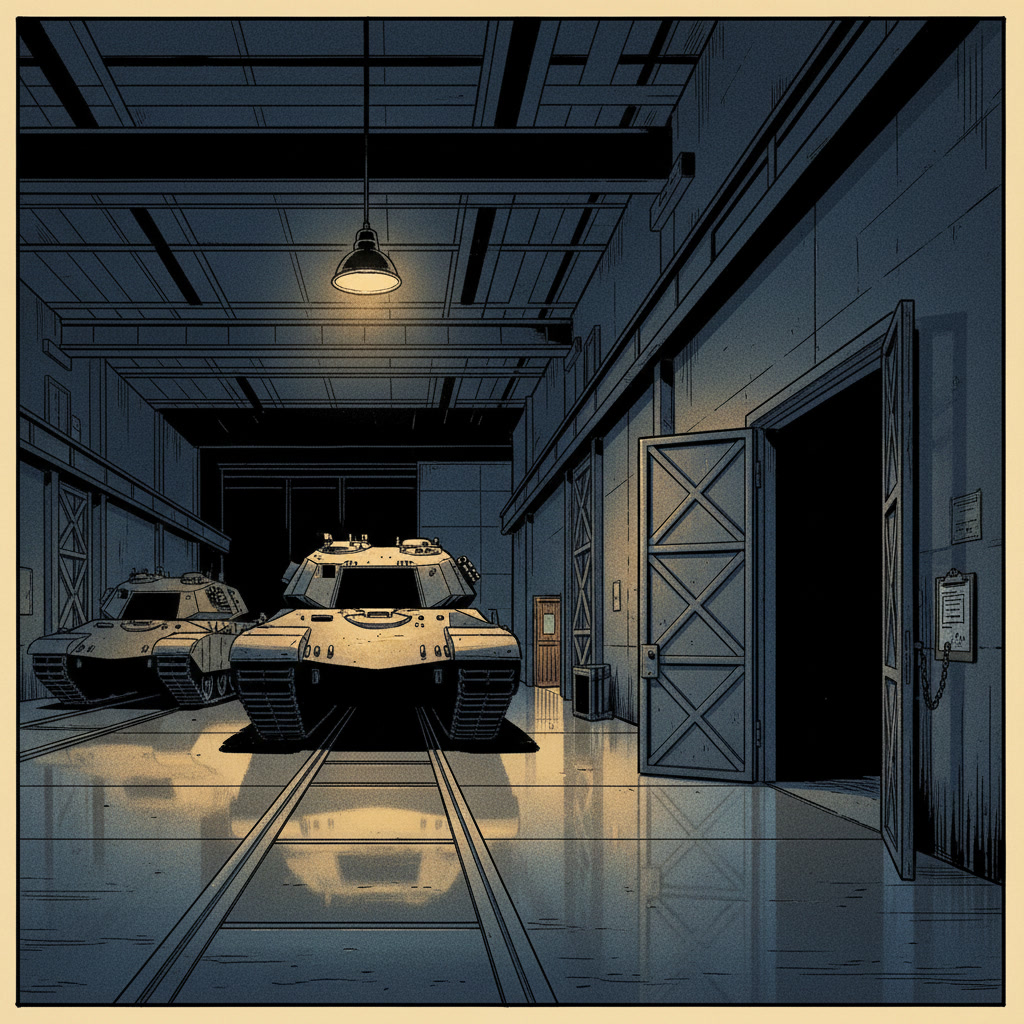
The Financial Times reported that Germany has reached a deal to acquire 40 percent of Europe's largest tank maker. The read here: the distinction matters. Procurement spending is a demand signal; equity ownership is an industrial policy commitment. Governments that buy into defense manufacturers are backstopping production capacity regardless of procurement cycle volatility — a different risk posture from simply placing large orders. France has moved this way on its own defense industrial base. Germany is now following. The UK, in interregnum until September, is not in this conversation. That absence is worth marking.
Russia closes on Sloviansk and Kramatorsk. The New York Times reported that thousands of Ukrainian civilians are fleeing Donbas strongholds as Russia pushes closer to Sloviansk and Kramatorsk — the last major Ukrainian-controlled cities in Donetsk Oblast. These are not small towns: Sloviansk and Kramatorsk together represent the administrative and logistical spine of Ukrainian-held Donetsk. The historical parallel here: their loss would be the most significant territorial shift in the eastern front since Russia's capture of Bakhmut in 2023. The civilian exodus now is a leading indicator. The wires have this story; it is not getting the prominence it warrants on a morning crowded with European politics.
Echoes
The historical parallel that fits today most cleanly is the July 2007 handover from Tony Blair to Gordon Brown. Blair resigned mid-term, with the Atlantic relationship under strain, Russia signaling revisionist ambitions in eastern Europe, and an ongoing military commitment in Iraq consuming British political bandwidth. Brown inherited a foreign policy he hadn't designed and spent his first six months assembling the team and situational awareness to run it. The mechanism that mattered then: new leaders need a full government formation cycle — roughly six months — before their foreign policy is coherent rather than improvised. Burnham's six months runs to roughly March 2027. That window overlaps precisely with the phase in which a potential Iran nuclear framework will either take root or collapse, and in which the Donbas front will be most actively contested. History argues: watch the Foreign Secretary and Defence Secretary appointments, not the victory speech. In 2007, it was David Miliband taking the Foreign Office under Brown that told you what the new government's international instincts actually were. In 2026, the equivalent appointment will be the tell.
The quiet things
The Siberian fire cluster northwest of Krasnoyarsk is today in its ninth consecutive day of confirmed high-intensity burning. NASA satellite data from overnight shows multiple sources at 59°–60°N in central Siberia with individual fire radiative power readings still above 140 megawatts. A second cluster at 61°–64°N in the same region registered above 100 megawatts on the same pass. No major English-language wire service has made this a standalone story. The read here: nine days of sustained intensity puts this among the durable fire events of the early summer globally — the kind that affects carbon sequestration numbers, not just regional air quality.
The U.S. flood system this brief has tracked since June 16 — beginning on the Gulf Coast, moving through Kansas and Missouri last week — has now expanded into Appalachia. Flood warnings and watches are active across most of West Virginia, eastern Kentucky, and parts of southern Ohio, covering dozens of counties from the West Virginia coalfields to the Kentucky mountains. Jefferson County, Kentucky, which includes Louisville, was under flash flood warning this morning. This is a seven-day, multi-regional flood event moving steadily northeast that is receiving no sustained coverage proportional to its geographic footprint.
Qatar's largest gas processing complex experienced an explosion, leaving at least 54 workers injured. The New York Times confirmed the incident. Qatar is the world's leading exporter of liquefied natural gas; production disruptions at major processing facilities, even temporary ones, carry direct implications for European energy markets still managing post-Ukraine supply diversification. Whether production was interrupted has not been confirmed in wire reporting yet — that's the number to watch if you hold European energy exposure.
How I'd act on this
If you cover UK foreign policy or NATO: the next month of Labour leadership maneuvering is the read, but the portfolio appointments are the actual tell. Track who Burnham signals for Foreign Secretary — particularly whether that person has any background in European security or Atlantic alliance management. If the pick is a domestic policy figure being rewarded for leadership support, that's a different government than the stated platform will suggest.
If you're tracking the Iran file: go back to the three falsifiers from yesterday's brief. "High hopes and big challenges" is not a named inspection date. If the second-round date is not announced by Wednesday, the first round resolved nothing structural. The IAEA's silence on Iran verification has now run for two weeks; that silence is still the operational line between a deal with enforcement capacity and a communiqué with good intentions.
If you hold European defense equities: Germany's equity acquisition of a tank manufacturer is a government backstop signal, not a market trade. The read here: that changes the risk profile of European defense industrial stocks. Procurement demand has been priced in for two years; supply-side government ownership is a different input — it means production capacity will be maintained through political cycles, not just funded through them.
If you're in West Virginia, eastern Kentucky, or southern Ohio: the flood system is in its seventh day and still expanding northeast. National Weather Service warnings in the region run through Wednesday. This is not a one-day event, and river gauges in your county matter more than total rainfall figures at this point.
Starmer leaves Downing Street having never answered the question his 2024 landslide posed — what Britain wants in a Europe that is relearning how to arm itself. Berlin answered it today with 40 percent of a tank factory, no press conference required.
— *The Plumb Line*. Daily world brief.
Sources
UK / Starmer resignation
- newswire/ft — "Keir Starmer steps down as UK prime minister," June 22
- newswire/ft — "How Starmer was undone by caution and no clear plan," June 22
- newswire/ft — "Starmer's premiership in 7 charts," June 22
- newswire/ft — "FirstFT: Starmer quits as UK prime minister," June 22
- newswire/nyt — "U.K. Live Updates: Starmer Announces Resignation; Burnham Wins Key Endorsement," June 22
- newswire/bloomberg — "Starmer Quits and Sets Out Plan for New UK PM by September," June 22
- newswire/bloomberg — "Markets Expected Starmer's Resignation as UK PM: Amundi," June 22
Iran / U.S. talks — first round
- newswire/nyt — "First Round of U.S.-Iran Talks Ends With High Hopes and Big Challenges," June 22
- newswire/nyt — "Mideast Live Updates: Mediators Point to Progress After First Round of U.S.-Iran Talks," June 22
Germany / defense industry
- newswire/ft — "Germany reaches deal to buy 40% of Europe's biggest tank maker," June 22
Ukraine / Donbas
- newswire/nyt — "Thousands Are Fleeing Ukraine's Donbas Strongholds as Russia Pushes Closer," June 22
Colombia
- newswire/bloomberg — "Colombian Voters Add to Trump's Sway in the Americas," June 22
Qatar gas explosion
- newswire/nyt — "Explosion at Qatar Gas Plant Leaves at Least 54 Injured," June 22
Flooding / U.S. multistate — Appalachia expansion
- noaa_alerts — Flood Watch: NWS Charleston WV, most of West Virginia and Ohio River counties, June 22
- noaa_alerts — Flash Flood Warning: NWS Louisville KY, Jefferson County KY, June 22
- noaa_alerts — Flood Warning: NWS Louisville KY, Bullitt/Hardin/Nelson/Spencer counties KY, June 22
- noaa_alerts — Flood Watch: NWS Jackson KY, eastern Kentucky mountain counties, June 22
- noaa_alerts — Flood Warning: NWS Jackson MS, Hinds/Warren counties MS (ongoing since June 21)
- noaa_alerts — Flood Warning: NWS New Orleans LA, St. Tammany/Hancock/Pearl River (ongoing since June 16)
Siberian fires — Day 9
- nasa_firms — Multiple high-confidence detections, 59°–60°N, 84°–85°E; fire radiative power >140 MW; June 22
- nasa_firms — Multiple detections, 61°–64°N, 108°–113°E; FRP >100 MW; June 22
Historical references
- Blair → Brown succession, 2007 — Blair resigned May 10, Brown took office June 27, 2007; first six months dominated by Northern Rock crisis and eastern European tensions
- German Zeitenwende, February 2022 — Scholz announced €100B Sondervermögen defense fund, February 27, 2022
- *The Plumb Line*, June 21 — Starmer departure called using Theresa May pattern; Iran falsifier criteria set (named IAEA inspection date, sanctions sequencing calendar, dispute mechanism); Siberian fire cluster Day 8; U.S. flooding moving north through Plains