Two Wars Share One Strait
The Plumb Line
Monday, June 1
Three things happened in the last 24 hours that belong in the same sentence, even though the wires are treating them as separate stories. The United States struck military targets in southern Iran — Goruk and Qeshm Island — while peace negotiations continue in parallel. Colombia's presidential election sent the established political order into something close to free fall, with Bloomberg describing voters as having "cast the old order into the abyss." And Warren Buffett's designated successor, Greg Abel, closed his first major deal at the helm of Berkshire Hathaway: an $8.5 billion acquisition of homebuilder Taylor Morrison. War, political rupture, and a succession signal — all before Monday morning in New York.
The through-line, if you squint at it: every one of these events is about who holds authority and for how long. The U.S.-Iran exchange tests whether American military credibility can coexist with a negotiating track. Colombia's result tests whether a left-wing governing coalition can survive an electorate that is angry but not unified. And the Berkshire deal is, among other things, the market's first real read on whether Abel can move like Buffett — boldly, at scale, in a single stroke. Different domains. Same underlying question.
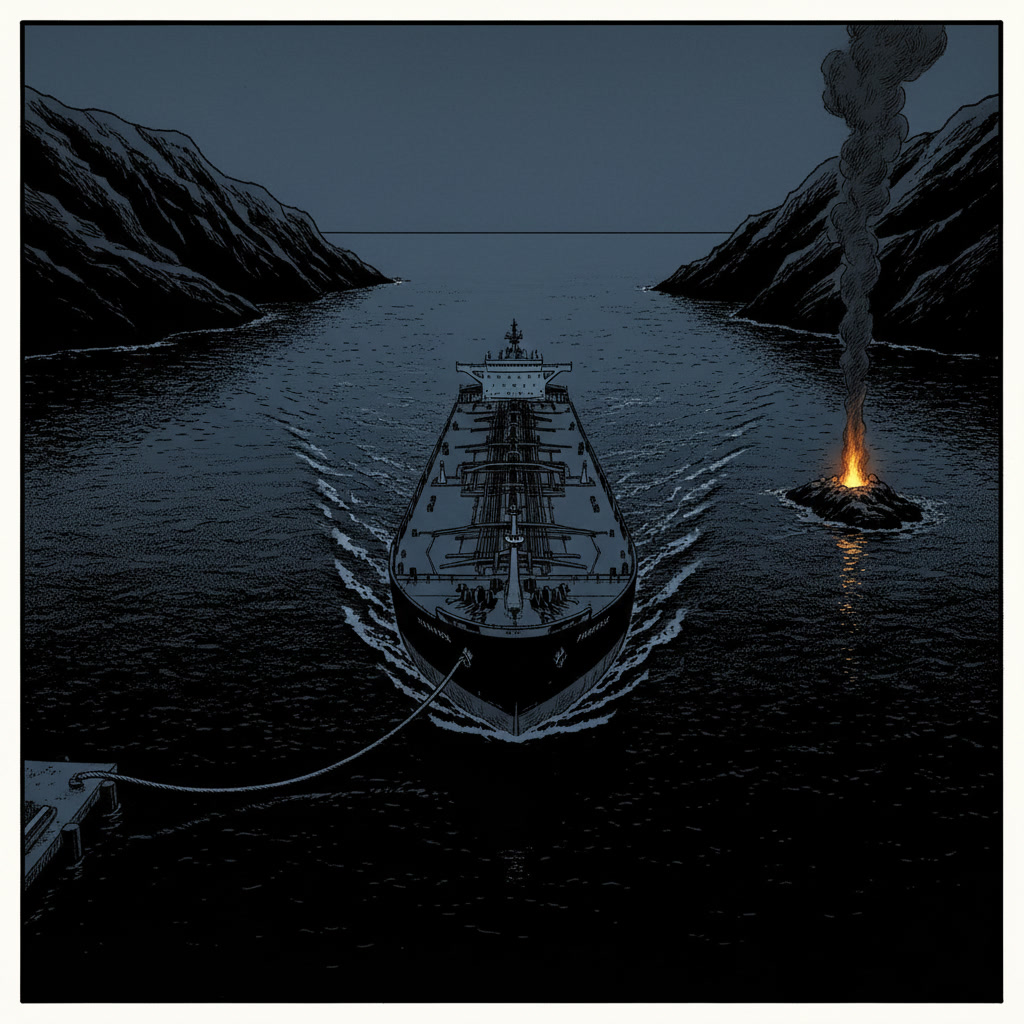
Two Wars Share One Strait
The U.S. and Iran Trade Fresh Strikes as Talks Continue
The New York Times and Financial Times both confirmed Sunday night that the United States hit additional military targets in southern Iran — specifically facilities at Goruk and on Qeshm Island in the Persian Gulf. Iran responded with its own strikes. The exchange is unfolding against an active diplomatic backdrop: peace efforts, as the FT noted, are continuing in parallel. Bloomberg separately reported that the closure of the Strait of Hormuz — or the threat of it — is already squeezing petrochemical markets globally, with supply chains for plastics, fertilizers, and industrial chemicals beginning to feel the pressure.
Here's the read. Yesterday's brief asked whether the Trump administration would respond visibly to the Kuwait casualties — American personnel hospitalized by an Iranian attack — or absorb the contact to preserve the nuclear deal track. The answer, it turns out, was neither a clean retaliation nor a quiet stand-down. Washington struck new targets in Iran's south while keeping diplomats at the table. The historical parallel is the Reagan administration's Operation Praying Mantis in April 1988 — a sharp, bounded military action against Iranian naval assets in the Gulf, calibrated to punish without foreclosing a political exit. The mechanism then and now is the same: demonstrate that military costs are real while leaving the off-ramp visible. The risk in 1988 was miscalculation at sea. The risk now is that Iran, facing domestic pressure to respond, escalates in a domain — say, a proxy strike on a Gulf state facility, or a Hormuz interdiction — that forces Washington off the calibrated track entirely.
What I'd watch for next: if Iran moves to physically interdict commercial shipping in Hormuz in the next 72 hours, the calibrated-exchange model breaks and you are in a different conflict. If instead the strikes produce a pause and the diplomatic channel holds through midweek, the Praying Mantis read holds — bounded violence as negotiating pressure. The falsifier is simple: watch the Lloyd's of London war-risk premium on Gulf transits. If it spikes above the levels seen in early May, the market has decided the off-ramp is closing.
Three other things worth knowing
Colombia's election reshapes Latin American politics overnight. Bloomberg's coverage framed the result in blunt terms: Colombian voters have effectively repudiated the existing political establishment. This follows a first-round result that sent the race to a runoff, with the anti-Petro vote fragmented across multiple candidates — exactly the dynamic yesterday's brief flagged as the risk. The read here is that Colombia, historically one of Washington's most reliable partners in the Western Hemisphere on counternarcotics and regional security, is entering a period of political realignment whose foreign-policy implications won't be clear for months. Watch which candidates consolidate in the runoff and whether either makes Petro's Venezuela relationship a campaign issue.
Greg Abel's first Berkshire deal is a housing bet, not a technology bet. Berkshire Hathaway agreed to acquire Taylor Morrison Home Corp — a U.S. homebuilder — for $8.5 billion, the FT reported. This is Abel's first major transaction since taking over operational leadership from Warren Buffett. The read here is that the choice of a homebuilder is analytically significant: it says Abel reads the U.S. housing supply shortage as a multi-decade structural story, and it positions Berkshire as a beneficiary of whatever the Federal Reserve does with rates. It is not a flashy, futurist move. It is exactly the kind of patient, capital-intensive wager that looks like Buffett — which is probably the point.
Hungary is about to rewrite its own power structure. The FT reported that Hungary's new opposition government intends to remove President Tamás Sulyok and other figures installed by Viktor Orbán — described in the FT's framing as "Orbán puppets" — from office. This is a significant institutional move in a country that has spent the last decade being lectured by Brussels about rule-of-law backsliding. The read here is that the new government is moving fast, before Orbán's network can entrench further, and that Budapest's posture on EU policy and Ukraine support is about to shift measurably. Worth watching for how quickly the European Commission updates its rule-of-law assessments for Hungary — that paperwork will signal whether Brussels treats this as real or performative.
Echoes
The U.S.-Iran exchange — strikes paired with open diplomatic channels — maps cleanly onto Praying Mantis, but there is a second historical register worth naming. In the summer of 1982, Israel invaded Lebanon while simultaneously signaling it wanted a political settlement on its northern border. The dual-track approach held for about six weeks before the Sabra and Shatila massacre made the political track untenable. The lesson is not that dual tracks always fail — Praying Mantis worked. The lesson is that dual tracks fail when a third actor (in 1982, the Phalangist militia; today, a potential Iranian proxy in Iraq, Yemen, or the Gulf states) takes an action that forces one side off the diplomatic path before either party is ready. The disciplined question right now is not "will the U.S. and Iran negotiate?" — they clearly are. It is "who has the power to blow up the table, and are they currently restrained?"
The quiet things
The Strait of Hormuz closure has dominated energy coverage, but the downstream chemical story — Bloomberg's point about petrochemicals — is receiving almost no attention in policy circles. The Hormuz chokepoint is typically framed as an oil-and-gas story, but roughly 20 percent of global trade in petrochemical feedstocks transits the Gulf. Fertilizer supply chains, plastics manufacturing, and pharmaceutical precursor chemicals all run through that corridor. The read here: a sustained closure — even a partial one — would show up in food prices and industrial output on a lag of roughly six to twelve weeks. The wires are covering the crude price. Nobody is yet writing the fertilizer-supply story. That gap will close, probably at an inconvenient moment.
How I'd act on this
If you cover energy markets or trade finance — the petrochemical angle Bloomberg raised this morning is the underpriced risk. Crude gets the headlines; naphtha, ethylene feedstocks, and ammonia precursors are where the supply-chain pain will actually land on manufacturers and food producers. That story has roughly a six-week fuse.
If you follow the Iran negotiation or U.S. Middle East policy — the Praying Mantis read holds for now, but the test is this week's shipping data and the Lloyd's war-risk premium. A continued exchange of limited strikes without Hormuz interdiction means the calibrated model is working. Watch for a statement from the U.S. special envoy's office, not the Pentagon, for the authoritative signal on whether the diplomatic track is still live.
If you invest in housing or follow the homebuilder sector — the Berkshire-Taylor Morrison deal at $8.5 billion sets a valuation benchmark for the sector. The read here is that Abel is making a bet on structural U.S. housing undersupply that implies rates are manageable for long-horizon capital even at current levels. Other institutional buyers will update their models accordingly.
If you follow European politics — Budapest is the story to watch this week. Hungary's new government moving to remove Orbán-installed officials is the first real institutional test of whether the post-Orbán transition is durable. The European Commission's response, when it comes, will tell you whether Brussels is willing to reward democratic backsliding-in-reverse as quickly as it punished the original slide.
Yesterday's brief asked whether the administration's Sunday talk-show posture on the Kuwait casualties would signal deal-track preservation or breakdown. The answer arrived in the form of strikes on Qeshm Island paired with diplomats still at the table — calibrated pressure, not rupture. The model is holding. For now.
Strikes on Qeshm by breakfast, diplomats at the table by lunch, and an $8.5 billion homebuilder deal closed before the New York open — that is what a Monday looks like when three different authority structures are being tested at once.
— *The Plumb Line*. Daily world brief.
Sources
U.S.-Iran / Hormuz
- newswire/nyt — "U.S. Says It Hit More Military Targets in Southern Iran," June 1
- newswire/nyt — "Iran War Live Updates: U.S. and Iran Exchange New Attacks," June 1
- newswire/ft — "US and Iran Launch Fresh Strikes as Peace Efforts Continue," June 1
- newswire/bloomberg — "Hormuz Closure Squeezes Petrochemical Markets," June 1
Colombia Election
- newswire/bloomberg — "Colombian Voters Cast Old Order Into the Abyss in Presidential Runoff," June 1
- newswire/nyt — "Colombia Presidential Election Heads to a Runoff," May 31
Berkshire / Taylor Morrison
- newswire/ft — "Berkshire Buys Homebuilder Taylor Morrison for $8.5bn in Abel's First Big Deal," June 1
- sec_edgar/0001193125-26-249694 — Taylor Morrison Home Corp, 8-K item 1.01, June 1
Hungary / Orbán
- newswire/ft — "Hungarian PM to Remove President and Other 'Orbán Puppets' from Office," June 1
UK Housing / Iran Turmoil
- newswire/ft — "UK House Prices Fall in May Amid Iran Turmoil," June 1
France / Investment
- newswire/bloomberg — "Macron Says France Got €93 Billion of Foreign Investment Pledges," June 1
- newswire/bloomberg — "SoftBank Announces €75 Bln AI Data Center Plan in France," June 1
Historical references
- Operation Praying Mantis, April 18, 1988 — U.S. Navy action against Iranian naval assets, Gulf of Oman
- Israeli invasion of Lebanon, 1982; Sabra and Shatila, September 1982 — third-party spoiler dynamic