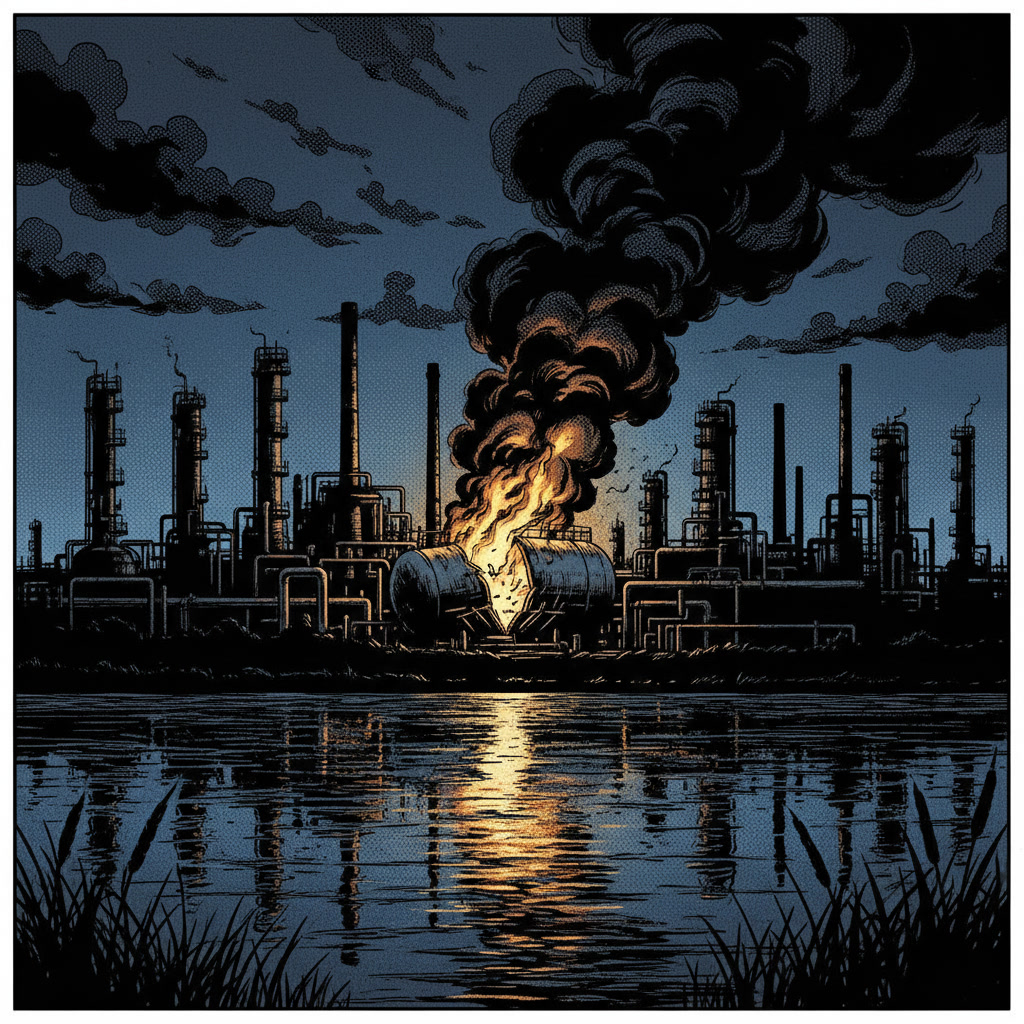
Ukraine Reaches Saratov. Watch the Map.
The Plumb Line
Saturday, May 31
Three things happened yesterday and overnight that together reframe what the Ukraine war is actually about in its fourth year of full-scale fighting. Ukraine struck the Saratov oil refinery in southwestern Russia — a facility roughly 850 kilometers from the front line, well inside what Moscow considers its productive heartland. China quietly launched four SatNet test satellites on a Long March 2D rocket from Xichang, adding to the twelve Qianfan broadband satellites simultaneously cataloged in low Earth orbit overnight. And Germany's top defense official told Bloomberg that Europe "needs clarity from the U.S." on security commitments — a public formulation that, two years ago, no German defense establishment figure would have made on the record.
The read here: none of these events is isolated. Taken together, they describe a world in which Ukraine is prosecuting a campaign of infrastructure attrition against Russian energy production, China is methodically building the satellite architecture it needs to be independent of Western communications in a conflict scenario, and America's European partners are doing something diplomatically significant: saying out loud that the ambiguity is the problem, not the solution.
Ukraine Reaches Saratov. Watch the Map.
Ukraine Strikes a Saratov Refinery in Deep Russia
Ukraine struck the Saratov oil refinery yesterday, Bloomberg confirmed. Saratov sits on the Volga River in southwestern Russia, a city of roughly 800,000 people and a significant node in Russia's domestic fuel processing and distribution network. The strike places Ukrainian offensive reach at a distance from the front lines that, a year ago, would have been operationally implausible with the weapons Kyiv had in hand.
The read here. The closest historical parallel is the British strategic bombing campaign's shift in 1944 from tactical battlefield support to attacking German oil infrastructure — the Transportation and Oil Plans debate. The mechanism that mattered then, and that Ukraine appears to be executing now, is not destroying a single facility but forcing an adversary to disperse air defense assets, repair crews, and logistical attention across an enormous geographic area. Russia cannot protect every refinery. Ukraine knows it. Every successful deep strike raises the cost of Russian industrial production and puts a ceiling on how long Moscow can sustain armored operations without drawing down its own domestic fuel supply. Separately, Bloomberg reports the EU is weighing a temporary freeze on the Russia oil price cap framework — tied explicitly to the ongoing Iran war situation — which would loosen the financial architecture constraining Russian export revenue at exactly the moment Ukraine is trying to constrain Russian production capacity. Those two policies are working at cross purposes, and someone in Brussels needs to notice.
What I'd watch for next: if Ukraine follows this Saratov strike with additional hits on Volga-basin refineries or storage infrastructure in the next two weeks, the deep-strike campaign is systematic, not episodic. That's escalation in degree, not just in distance, and it will force a European diplomatic response about what weapons authorizations are actually permitting. If the strike goes unanswered on the infrastructure side and Russia responds only with more front-line pressure in Sumy or Kharkiv, this was a one-off demonstration of range, not a new doctrine.
Three other things worth knowing
The EU's oil price cap wobble is a significant policy signal. Bloomberg reported this morning that European officials are debating a temporary freeze on the Russia oil price cap — the $60-per-barrel ceiling that has constrained Moscow's export revenue since late 2022 — citing the disruption caused by the ongoing Iran conflict on global energy markets. The mechanism here is straightforward: high oil prices globally make enforcing the cap economically painful for buyers who need alternatives. But the timing is poor. Freezing the cap while Ukraine is striking Russian refineries sends a contradictory signal — EU policy would simultaneously be tightening Russia's production capacity and loosening its revenue ceiling. The read here is that energy price anxiety in European capitals is, for the moment, winning the argument over strategic coherence.
Japan's Koizumi rejected Chinese accusations of "new militarism" directly. The Financial Times reported this morning that Prime Minister Sanae Koizumi, responding to Beijing's characterization of Japan's defense buildup, publicly pushed back by name — an unusually direct rebuttal by the standards of Japanese diplomatic communication. This comes one day after Pete Hegseth told the Shangri-La Dialogue in Singapore that U.S.-China ties are "better than in years." The juxtaposition matters: Washington is managing the top line of the relationship, while Tokyo — which is actually spending the money and building the forces — is absorbing the friction. The read here: the Koizumi government has concluded that public deference to Chinese framing is now more costly domestically than speaking plainly.
Colombia holds its presidential election today. The Financial Times and the New York Times both carried pre-election coverage overnight. President Gustavo Petro's left-wing coalition faces a fragmented opposition — the FT's read is that the anti-Petro vote is split in ways that could produce a messy result or a runoff. Colombia's election matters beyond its borders: the country's posture on Venezuela, coca eradication, and U.S. counternarcotics cooperation all hinge on who takes office. Worth a separate watch if you cover Latin American policy.
Echoes
Yesterday's brief raised the 1987 tanker war as the parallel for the Kuwait missile strike. Today's Saratov refinery attack calls up a different historical register — not the Gulf, but the European air war. In June 1944, the Allied shift to attacking German synthetic oil plants at Leuna and Politz created the first real petroleum crisis for the Wehrmacht's armored units. The Luftwaffe was forced to cut pilot training hours because of avgas shortages within six months. Ukraine is not the U.S. Eighth Air Force, and Russia's refinery network is geographically vast, but the principle is identical: an adversary that cannot protect everything will eventually run short somewhere that matters. The question — then and now — is whether the striking power is sustained and systematic enough, or whether political constraints truncate the campaign before the cumulative effect is felt.
The quiet things
The Iran situation, which dominated every brief this week, is conspicuously quieter this morning. Yesterday's brief noted that the Kuwait missile strike — American personnel hospitalized by an Iranian attack — would force the Trump administration to choose between visible retaliation and absorbing the contact to preserve the nuclear deal track. That choice has not yet been publicly announced. The morning wires carry no named U.S. military response to the Kuwait casualties, and no statement from the administration naming Iran explicitly and demanding accountability. That silence, 24 hours in, leans toward the "deal track preserved" read from yesterday — but it is not yet a confirmation. Watch the Sunday morning U.S. political shows for the first public framing.
How I'd act on this
If you follow the Ukraine war or European energy policy — the EU oil price cap story is the policy contradiction to flag to your editors or clients. Ukraine striking Russian refineries while the EU considers loosening revenue constraints on Russian oil exports is not a tenable strategic posture. Someone will have to reconcile these tracks, and the reconciliation will happen in Brussels before it happens in public.
If you cover Latin American politics or U.S. foreign policy in the Western Hemisphere — Colombia votes today. A Petro successor from the opposition looks different from a Petro re-alignment, but the fragmented opposition could also produce a result that satisfies no one and paralyzes policy for months. The result will likely be known by Sunday.
If you watch the Iran nuclear negotiation — the administration's Sunday talk-show posture on Kuwait casualties is the read. Silence sustained through the weekend means the deal track is holding. A named accusation of Iran means the timeline has cracked.
If you follow the satellite and space domain — eleven new Qianfan and SatNet objects were cataloged overnight alongside a successful Falcon 9 Starlink launch yesterday afternoon from Vandenberg. The low Earth orbit buildout is now moving faster than any governance framework can track. The read here: this is not a technology story; it's an allocation and sovereignty story that will land on the UN Committee on the Peaceful Uses of Outer Space's desk within two years.
Ukraine reached 850 kilometers into Russia to hit a Volga refinery while Germany's defense minister told Bloomberg, on the record, that Europe no longer knows what American security guarantees mean. Saratov and Berlin, on the same news day, are the same story: the old assumptions about who covers what are being tested in public.
— *The Plumb Line*. Daily world brief.
Sources
Ukraine / Russia / Saratov
- newswire/bloomberg — "Ukraine Says It Struck Saratov Refinery in Southwestern Russia," May 31
- newswire/bloomberg — "EU Weighs Temporary Freeze on Russia Oil Price Cap Over Iran," May 31
Germany / European Security / U.S. Clarity
- newswire/bloomberg — "Europe Needs Clarity from US, Top German Defense Official Says," May 31
- newswire/bloomberg — "'Quiet' Hegseth Plays Off Europe Against Asia: Balance of Power Special," May 31
Japan / China / Koizumi
- newswire/ft — "Japan's Koizumi Rejects China Accusations of 'New Militarism'," May 31
Colombia Election
- newswire/ft — "Petro's Leftwing Project Faces Split Opposition in Colombia Presidential Vote," May 31
- newswire/nyt — "Colombia Presidential Election: What to Know About the Candidates and Main Issues," May 31
Space / Satellite
- launch_library/0ab3587d — Long March 2D | 4 x SatNet test satellites, Launch Successful, May 30
- launch_library/a7341350 — Falcon 9 Block 5 | Starlink Group 17-41, Launch Successful, May 30
- celestrak/69074–69117 (multiple) — Qianfan-128 through 158, cataloged May 31
Iran / Kuwait (continuity from May 30 brief)
- Yesterday's brief — Kuwait missile strike, American casualties, Hegseth "patient pursuit" framing
- Morning wire silence on U.S. named response — absence noted as significant
Historical reference
- Allied Oil Plan / Transportation Plan debate, 1944; Leuna and Politz synthetic oil raids — standard historical record