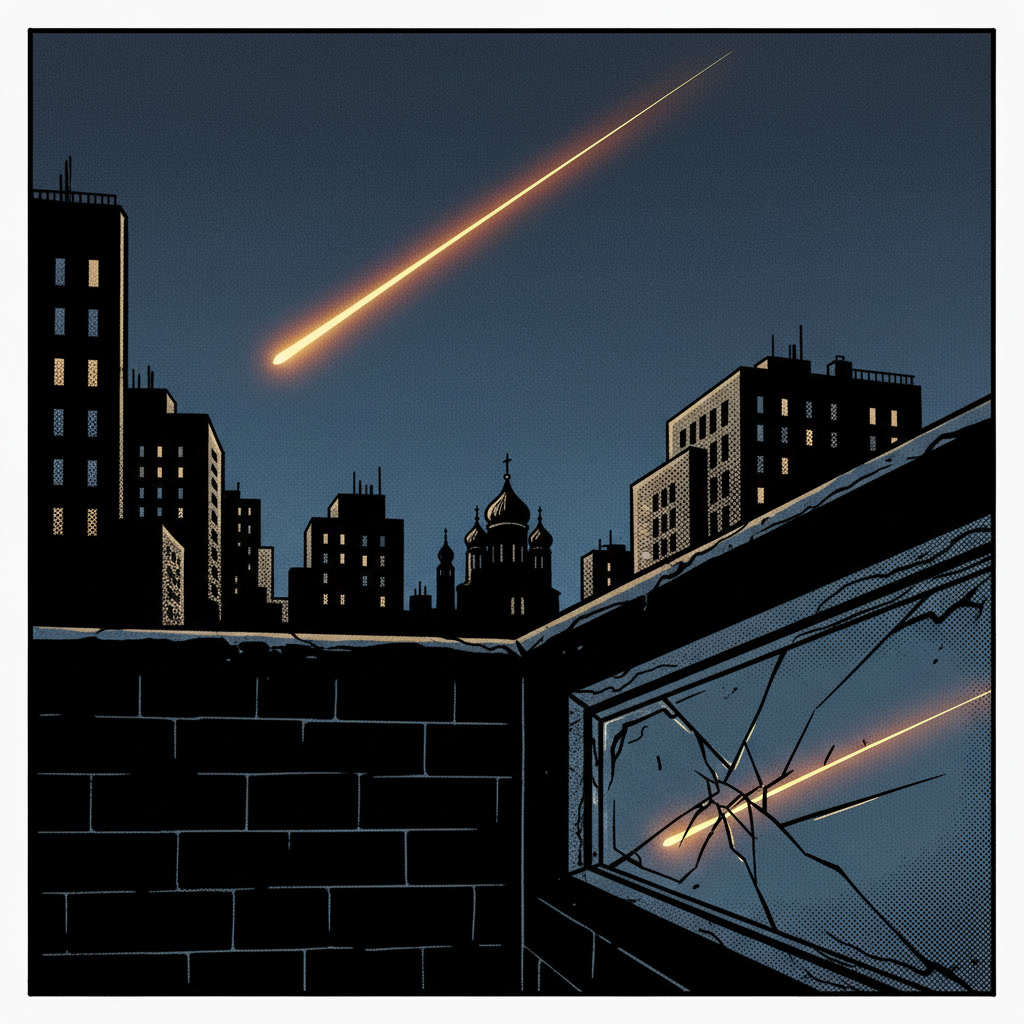
Oreshnik Over Kyiv. The Deal Clock and the Missile Clock Are Running Together.
The Plumb Line
Saturday, May 24
"Largely negotiated." Those are Donald Trump's words for a proposed deal with Iran to reopen the Strait of Hormuz — published this morning by the Financial Times. Iranian officials followed within hours, confirming to the New York Times that a proposed peace framework would include opening the strait. That is the first time Tehran has publicly described the terms rather than simply denying negotiation exists.
The past day has also brought a Russian hypersonic Oreshnik ballistic missile strike on Kyiv, a standoff at Turkey's main opposition offices, a suspect shot dead by Secret Service outside the White House, and Egypt deploying jets to the United Arab Emirates as what the FT calls "Iran war strains Arab alliances." These stories are related. The read here is that the Iran diplomacy track is racing a military track on at least two fronts simultaneously — and the outcome depends on which one moves faster.
One thread from yesterday's brief to close out: we tracked Pakistani Army Chief Munir's trip to Tehran as the most operationally significant diplomatic signal of the week, and called for a U.S. or Omani counterpart follow within 72 hours. What arrived instead was Trump himself — publicly declaring the deal "largely negotiated." That is a faster and more senior escalation than the back-channel path suggested. The back-channel has, for the moment, been superseded by the front door.
Oreshnik Over Kyiv. The Deal Clock and the Missile Clock Are Running Together.
Russia struck Kyiv overnight with an Oreshnik hypersonic ballistic missile, the Financial Times and New York Times both reported. The Oreshnik — a medium-range ballistic missile Russia first used against Ukraine in November 2024 — is not a cruise missile that air defenses reliably intercept. It is a fast, maneuvering system designed to defeat layered point defense. Its use against Kyiv specifically, rather than frontline infrastructure, is a deliberate signal about reach and regime pressure.
The read here is that the timing is the message. Trump declared an Iran deal "largely negotiated" on Saturday morning; Russia struck Ukraine's capital that same night. The historical parallel that fits is October 1973: Egypt and Syria launched the Yom Kippur War the day after Henry Kissinger told the Soviets that a ceasefire framework was coming together. The mechanism was identical — a party that benefits from continued conflict accelerating its military operations precisely when diplomatic resolution looks plausible, because a deal that ends the broader confrontation may foreclose their window of advantage. Putin's calculus, as best it can be read from the outside, is that a U.S.-Iran deal reduces the regional pressure on Russia's war effort — Iran has been a supplier of drones — and that a demonstration of Oreshnik capability over Kyiv simultaneously signals continued resolve and tests whether Washington will prioritize the Iran deal over Ukraine solidarity.
What I'd watch for next: if Ukraine receives a direct U.S. diplomatic statement tying the Iran framework to Ukrainian security guarantees within 72 hours, the two tracks are being managed together. If instead Washington stays quiet on Ukraine while touting the Iran deal, that silence is the signal Moscow was buying with last night's strike. The falsifier for "Russia is trying to decouple the Iran deal from Ukraine" is a joint U.S.-Ukrainian statement before Tuesday that explicitly links both.
Three other things worth knowing
Iran's Revolutionary Guards used a UAE front company to acquire military satellite equipment, according to the Financial Times this morning. The report names the mechanism — a legal entity registered in the Emirates, used to route procurement around sanctions — at the same moment Trump is announcing a deal with Tehran. The read here is that sanctions evasion infrastructure does not dismantle itself when diplomacy opens; it remains operational and can be reactivated. Any deal that includes sanctions relief will need a verification architecture capable of tracking this exact pattern, and this morning's FT story is effectively a public audit of what that architecture would need to catch.
Turkey's main opposition is under active pressure. Bloomberg reported this morning that tensions are rising at the headquarters of the Republican People's Party (CHP) following a standoff that began overnight. Turkey's domestic political situation — President Erdoğan's government leaning on the organized opposition ahead of what may be an early election cycle — has been underreported in Western outlets focused on Turkey's NATO role and its Gaza mediation. The read here: a governing party squeezing opposition offices is not a coup, but it is a leading indicator of institutional erosion that tends to precede one.
Egypt has deployed jets to the UAE as Iran war pressures strain Arab alliances, the FT reported. This is the ground truth beneath the diplomatic surface: the Arab states nominally neutral in the U.S.-Iran confrontation are making military hedging moves that suggest they do not fully trust the diplomatic track to hold. Egypt flying combat aircraft to the Emirates — which sits directly across the strait from Iran — is a concrete commitment that goes beyond public statements of concern. For anyone modeling what a deal collapse looks like, this is the regional military posture it would inherit.
Echoes
The Oreshnik strike on Kyiv during active deal-making rhymes with a pattern that recurs in twentieth-century diplomacy: the Tet Offensive of January 1968, launched while U.S.-North Vietnamese back-channel communications were live, was designed not primarily as a military victory (it wasn't one) but as a negotiating signal — proof that the insurgent side retained the capacity and will to escalate regardless of diplomatic progress. The specific lesson that applies is that military escalation during active diplomacy is rarely irrational. It is usually a bid to improve the terms of any deal that does emerge, by demonstrating that the alternative to a deal is costly. The question today is whether Washington reads the Oreshnik strike as a veto on the Iran track, or as Russia pricing its acquiescence.
The quiet things
The Strait of Hormuz deal, as described publicly, has one conspicuous gap: Israel. The New York Times notes that Netanyahu has been sidelined from the Iran negotiating lane. Britain is preparing for a mission that could clear the strait, per another Times report. But there is no public statement from Jerusalem welcoming, opposing, or even acknowledging the framework — and the read here is that Israeli silence on an Iran deal is not neutrality. It is either a diplomatic courtesy extended to Washington while the terms are being finalized, or a prelude to a harder objection once they are.
The Midwest flooding also deserves a sentence it isn't getting nationally. Flood warnings are active across Gibson and Knox counties in Indiana through June 2 — nearly ten days out — and across much of southern Illinois, Ohio, and coastal Louisiana simultaneously. This is not a single weather event; it is a persistent hydrological stress across the central U.S. that will show up in agricultural output data before it shows up on the front page.
How I'd act on this
If you follow Middle East diplomacy or energy markets, the next 72 hours are the read. Trump's "largely negotiated" claim either gets a formal framework announcement or it doesn't — and the market for Hormuz-transiting crude, LNG, and shipping insurance will price the difference before any official statement does. Watch the strait traffic data and tanker insurance rates, not the press conferences.
If you cover Ukraine or European security, the Oreshnik strike on Kyiv is the data point to hold. The question it raises — whether Washington will trade Ukrainian security for an Iran deal — is the most consequential open variable in U.S. foreign policy right now. The next NATO foreign ministers' statement will tell you whether the alliance is treating this as linked or separate.
If you invest in defense or follow Gulf state sovereign funds, Egypt's jet deployment to the UAE is the kind of concrete military commitment that precedes either a conflict or a very expensive deterrence posture. The read here is that Gulf defense procurement is heading higher either way. The stocks to watch are not American primes — they're the UAE and Egyptian domestic defense build-outs.
If you work in sanctions compliance or financial due diligence, the FT's Iran-UAE satellite equipment story is the template for what the next wave of enforcement actions will look like. Front companies registered in neutral jurisdictions routing military procurement — this pattern is now publicly documented. Review your UAE-linked counterparties accordingly.
The day's through-line is simultaneity: a deal being announced in Washington and a missile being fired at Kyiv in the same news cycle, by parties with opposite interests in whether diplomacy succeeds.
Trump said "largely negotiated" at breakfast. Putin answered with an Oreshnik over Kyiv by nightfall. Whichever clock you're watching, both are running.
— *The Plumb Line*. Daily world brief.
Sources
Iran / Hormuz / Diplomacy
- newswire/ft — "Trump says deal with Iran to reopen Hormuz 'largely negotiated'," May 24
- newswire/nyt — "Iranian Officials Say Proposed Peace Deal Would Open Strait of Hormuz," May 24
- newswire/nyt — "What to Know About the Potential U.S.-Iran Peace Deal," May 24
- newswire/nyt — "Britain Preparing for Mission That Could Clear Strait of Hormuz," May 24
- newswire/ft — "Iran's Guards used UAE company to buy military satellite equipment," May 24
Ukraine / Russia
- newswire/ft — "Russia pounds Ukraine with hypersonic 'Oreshnik' missile," May 24
- newswire/nyt — "Kyiv, Ukraine, Hit in Russian Missile Attack," May 24
- gdelt/kyivpost.com — "Defense Forces Cripple Key Russian Oil Terminal and Strike Black Sea Warships," May 24
Turkey
- newswire/bloomberg — "Tensions Rise at Turkey's Main Opposition Offices After Standoff," May 24
Egypt / Gulf / Arab Alliances
- newswire/ft — "Egypt deploys jets to UAE as Iran war strains Arab alliances," May 24
White House Security
- newswire/ft — "Suspect killed after gunfire exchange with Secret Service outside White House," May 24
U.S. Domestic Flooding
- noaa_alerts — Flood Warnings: Gibson/Knox counties IN through June 2; Daviess/Pike IN through May 30; Clay/Richland IL; multiple Ohio counties; Louisiana flood watch, May 23–24
UK Politics
- newswire/bloomberg — "Starmer's Lame Duck Status Risks Policymaking Paralysis in UK," May 24
- newswire/ft — "Starmer's EU drive put in doubt by 'rejoin' calls from leadership hopefuls," May 24
Space / Orbital
- celestrak/68912, 69082, et al. — Starlink, Qianfan, and rideshare objects catalogued May 24