Novorossiysk Is Burning. Watch the Oil Price, Not the Fire.
The Plumb Line
Friday, May 23
Three things happened in the last 24 hours that belong in the same sentence even though most coverage treats them as separate stories. Ukraine struck Russia's key Black Sea oil export terminal at Novorossiysk, setting it on fire. Pakistani Army Chief General Asim Munir flew to Tehran to push a U.S.-Iran nuclear framework. And SpaceX's Starship Flight 12 — the one yesterday's brief left as an open thread — launched successfully from Starbase, Texas at 10:30 p.m. Eastern, completing a suborbital profile that advances both NASA's Artemis timeline and the Air Force's heavy-lift competition calculus. One war expanding its reach into Russian energy infrastructure. One fragile ceasefire diplomacy entering a new phase. One rocket that changes the price of getting to orbit. The read here: not three stories — one world.
The Iran thread is moving faster than the news cycle has absorbed. Bloomberg reported this morning that the ceasefire between Israel and Iranian-backed forces is holding but fragile, and that a broader peace framework push is intensifying. Pakistan's army chief in Tehran — confirmed by the Financial Times — is the operational complement to what the U.S. and Oman have been working through back-channels for weeks. The New York Times noted that Netanyahu, once Trump's co-pilot on Iran policy, has been reduced to a passenger: the read there is that Washington and Tehran are now negotiating in a lane Israel cannot control and can barely observe. Yesterday's brief flagged the Hormuz toll proposal and uranium enrichment as the two blocking issues. Those haven't moved publicly — but Munir's presence in Tehran suggests someone thinks the blocking issues are, at least, discussable.
Meanwhile, an Ebola outbreak in the Democratic Republic of Congo (DRC) is generating more American bureaucratic friction than public health response. The White House has told Congo's national soccer team — in New York for World Cup qualifiers — to isolate. Congo's health officials are criticizing a U.S. travel ban as counterproductive. And the underlying outbreak, which the New York Times reports is still rising in cases and deaths, is receiving the kind of intermittent coverage that tends to precede the moment everyone suddenly acts surprised it got worse.
Novorossiysk Is Burning. Watch the Oil Price, Not the Fire.
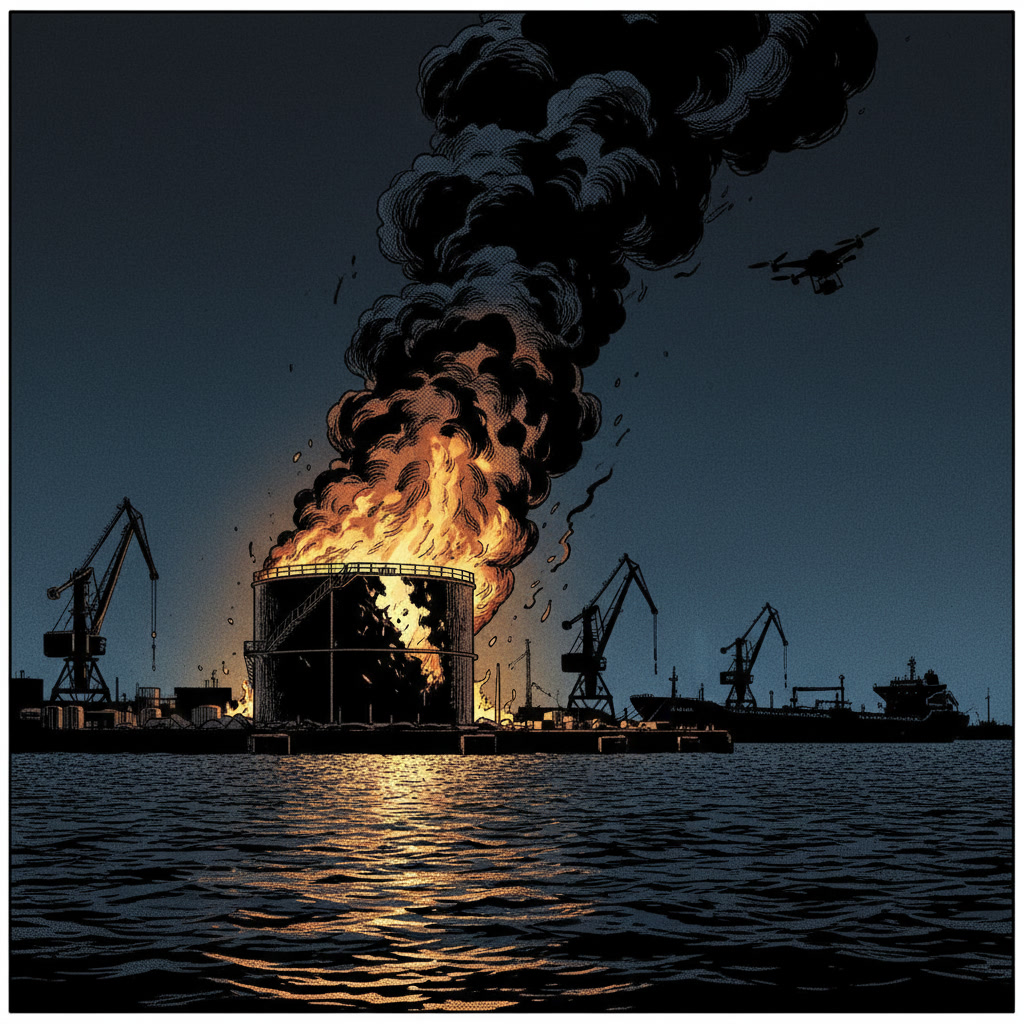
Ukraine struck Russia's Black Sea oil export terminal at Novorossiysk with drones overnight, setting facilities at the port on fire, Bloomberg reported this morning. Novorossiysk is not a marginal target — it is Russia's primary outlet for Caspian and southern Russian crude, handling a substantial share of Moscow's seaborne oil exports that fund the war effort. This follows the pattern of Ukrainian drone strikes on Moscow itself overnight, with the New York Times running first-person accounts from residents describing "a total nightmare" of repeated impacts across the capital.
Here's the read. Ukraine has made a strategic decision to attack Russian economic infrastructure — refineries, pipelines, export terminals, and now a major port — at a tempo that is qualitatively different from the first two years of the war. The historical parallel that fits is the Allied oil campaign against Nazi Germany in 1944-45: the targeting logic held that destroying fuel supply chains would degrade military capability faster than attriting frontline units. That campaign worked, but it took 18 months of sustained pressure before the degradation became operationally decisive. Ukraine does not have 18 months of uncontested access to Russian infrastructure, and Russia's ability to reroute exports — through Arctic ports, through pipeline to China — means the economic squeeze is real but not immediate. The mechanism to watch is not the fire at Novorossiysk; it's the shipping insurance market's response to sustained Black Sea terminal risk, and whether Russian crude exports actually decline in the weekly tanker tracking data over the next month.
What I'd watch for next: if Russian crude export volumes drop more than 15 percent from their 90-day average within the next four weeks, the Ukraine targeting campaign has moved from symbolic to economically material. If volumes hold steady through rerouting, today was painful for Moscow but not strategically decisive. The falsifier for "this campaign degrades Russian war financing" is an unchanged or increasing Russian export volume by late June.
Three other things worth knowing
China's coal mine explosion is Xi's immediate domestic crisis. At least 90 people were killed in a coal mine explosion in China, the New York Times reported, with Xi Jinping personally calling for "all-out rescue" efforts. China's coal sector kills hundreds of workers annually in accidents that tend to receive brief official acknowledgment and then disappear from state media. The scale of this one — 90 confirmed dead, rescue ongoing — puts it in a different category. The read here is that Xi's direct public involvement signals the political exposure is high enough to require visible leadership, which in turn suggests the death toll may not have peaked.
The Iran-India-U.S. triangle is getting complicated in real time. Secretary of State Marco Rubio landed in New Delhi today as the New York Times reported that Trump's overtures toward China have raised serious anxiety in India — the country that U.S. strategy has spent three years cultivating as the Indo-Pacific counterweight to Beijing. Iran's foreign ministry, apparently choosing its moment, told Rubio to "learn civility from Indians" before he deplaned, per the Hindustan Times. The read here is that India is watching Washington's China rapprochement with the same unease it watched the Obama-era "reset" with Russia: a major power realignment being managed without consulting the parties most affected by the downstream consequences.
Starship Flight 12 landed clean — and that changes the launch economics math. Yesterday's brief left the Starship outcome as an open thread. It closed: the launch was successful, suborbital profile, from Starbase at 10:30 p.m. Eastern Wednesday. The read here is that the significance is not the single flight but the accumulation — Flight 12 represents SpaceX iterating through vehicle variants at a pace that makes the gap between Starship's payload capacity and every other heavy-lift competitor wider with each success. The FT reported this morning that SpaceX, OpenAI, and Anthropic IPOs are set to test the limits of the AI boom; the Starship data point is the physical-world anchor to that financial story.
Echoes
The Novorossiysk strike rhymes with a 1944 operation few people remember: the RAF and USAAF's sustained attack on the Ploiești oil refineries in Romania, which supplied roughly a third of Germany's processed fuel. The first raid, in August 1943, was catastrophic for the Allies and changed almost nothing for Germany operationally. The sustained campaign beginning in April 1944 eventually worked — but required air superiority, persistent targeting, and a theater-level commitment that Ukraine is currently approximating with drones and missiles rather than bombers. The specific lesson that applies: the first headline strike is not the signal. The third and fourth are. What I'd watch for is whether Ukraine keeps coming back to Novorossiysk specifically, or disperses its targeting to other Russian infrastructure nodes. Concentrated repetition is what broke Ploiești. Dispersion is what didn't.
The quiet things
The bond market vigilante story is murmuring in the FT this morning — "Bond slump stirs vigilante fears" — without a named trigger event. The last time this phrase entered regular circulation was 2022-23, when gilt markets punished Liz Truss's fiscal package within days of announcement. The current context is different: U.S. Treasuries, not gilts, and a debt-ceiling resolution (the "big beautiful bill") moving through Congress rather than a surprise fiscal event. But the read here is that the underlying mechanism — bond markets forcing fiscal discipline that politics cannot — is the same. With Kevin Warsh now installed as Fed Chair (sworn in yesterday, as this brief covered), the question of whether Treasury markets will test his independence before a Trump demand does is worth holding. No crisis today. Worth watching.
Armenia is also conspicuously absent from the wire this week, and Bloomberg filled that gap this morning with a piece on Russia "turning the screws" on Yerevan over its tilt toward Europe. The quiet on this story in major U.S. outlets is notable: Armenia is attempting a genuine democratic pivot toward the EU, Russia is retaliating economically and politically, and the story is receiving approximately one Bloomberg feature per week rather than the sustained coverage its geopolitical significance warrants.
How I'd act on this
If you follow energy markets or trade commodities, the Novorossiysk strike is the event to price — not today's headline, but the weekly tanker tracking data over the next four weeks. Lloyd's and the Baltic Exchange will tell you whether Russian exports are actually rerouting successfully before any official statement does.
If you cover Iran or Middle East security, Pakistani Army Chief Munir's presence in Tehran is the most operationally significant diplomatic signal of the week. Pakistan has been the back-channel since the Oman talks stalled on enrichment and the toll proposal; his trip means someone has something new to say. The next scheduled contact point to watch is whether a U.S. or Omani counterpart follows within 72 hours.
If you invest in tech or follow IPO markets, the FT's framing of the SpaceX/OpenAI/Anthropic IPO queue as a stress test for the AI boom is worth reading in full. Starship Flight 12's success yesterday changes SpaceX's valuation argument — the physical infrastructure thesis just got another data point. Size your AI exposure accordingly before the S-1s arrive.
If you work in public health, global health security, or international development, the DRC Ebola outbreak has now generated a U.S. travel restriction and a White House order to a visiting soccer team. That is the level of official response that precedes either containment or a WHO emergency declaration. The next 10 days are the read.
The day's through-line is reach: Ukraine reaching deep into Russian economic infrastructure, Tehran reaching for a deal through Islamabad, SpaceX reaching a suborbital milestone that makes every competitor's roadmap look slower.
A port burning at Novorossiysk, a Pakistani general in Tehran, a Starship clearing the stratosphere — by next Friday we'll know which fire is still lit.
— *The Plumb Line*. Daily world brief.
Sources
Ukraine / Russia
- newswire/bloomberg — "Russia's Key Black Sea Oil Port on Fire After Drone Attack," May 23
- newswire/nyt — "'A Total Nightmare': Voices From a Moscow Hit by Ukrainian Drones," May 23
Iran / Diplomacy
- newswire/bloomberg — "Iran Peace Deal Push Intensifies as Fragile Ceasefire Holds," May 23
- newswire/ft — "Pakistan army chief travels to Tehran in push for US-Iran deal," May 23
- newswire/nyt — "Once Trump's Co-Pilot Against Iran, Netanyahu Is Now a Mere Passenger," May 23
- gdelt/hindustantimes.com — "Iran tells Rubio to learn civility from Indians as he lands in Delhi," May 23
India / US-China
- newswire/nyt — "Trump's Pursuit of a Partnership With China Raises Concerns in India," May 23
China / Domestic
- newswire/nyt — "Xi Calls for All-Out Rescue After Coal Mine Explosion Kills at Least 90 in China," May 23
Ebola / Public Health
- newswire/nyt — "White House Tells Congo's Soccer Team to Isolate, Citing Ebola Outbreak," May 23
- newswire/nyt — "U.S. Ebola Travel Ban Faces Criticism From Congo Health Officials," May 23
- newswire/nyt — "What to Know About the Ebola Outbreak as Cases and Deaths Rise," May 17/23
Space
- launch_library/ed83366c-872c-4484-97c1-bc74832304fc — Starship Flight 12, Launch Successful, Suborbital, SpaceX Starbase TX, May 22
- newswire/ft — "SpaceX, OpenAI and Anthropic IPOs set to test limits of AI boom," May 23
- celestrak/68843–68846 et al. — Starlink batch catalogued May 22
Bond Markets / Economics
- newswire/ft — "Bond slump stirs vigilante fears," May 23
Armenia / Russia
- newswire/bloomberg — "Russia Is Turning the Screws on Armenia Over Its Tilt to Europe," May 23
Seismology
- usgs_earthquakes/hv74966427 — M5.96, 13 km S of Honaunau-Napoopoo, Hawaii, depth 22.6 km, yellow alert, May 23
Lebanon / Sanctions
- gdelt/naharnet.com — "Israel strikes Bekaa and Tyre as other raids kill 10," May 23
- gdelt/naharnet.com — "What US sanctions on two officers mean for Lebanon," May 23