"Do Your Own Thing" — and What Warsh Does Next
The Plumb Line
Friday, May 22
"Do your own thing." That's what Donald Trump told Kevin Warsh moments before Warsh was sworn in as Federal Reserve Chair this morning in a White House ceremony. The sentence is either the most reassuring thing a new central banker could hear from his appointing president, or a masterclass in plausible deniability — and the two readings are not mutually exclusive.
The Warsh swearing-in lands on a day when the yield curve has steepened to 43 basis points (the gap between the 10-year and 2-year Treasury, a measure of how much investors expect rates to differ over time), the 10-year breakeven inflation rate sits at 2.4 percent, and the S&P 500 closed yesterday at 7,473. None of those numbers scream crisis. But the read here is that the Fed transition itself is the signal worth tracking — not because markets will move today, but because the question of whether Warsh governs like a Powell successor or a Trump ally will define the macro environment for the next four years.
Two other threads worth noting before we go deeper: the Iran-U.S. nuclear talks remain frozen on the two hardest questions (uranium enrichment levels and a new Strait of Hormuz toll system Tehran is floating with Oman), and Amazon's Project Kuiper constellation added a fresh batch of satellites to low-Earth orbit overnight, with twelve new craft catalogued. The orbital economy doesn't pause for geopolitics.
"Do Your Own Thing" — and What Warsh Does Next
The story to actually watch
Kevin Warsh was sworn in as Federal Reserve Chair at a White House ceremony this morning, with Trump telling him to "do his own thing" in brief public remarks. Warsh is a former Fed governor who served from 2006 to 2011, spent the crisis years at the Fed's table during the 2008 collapse, and has since built a reputation as a hawk-leaning institutionalist. He is not Jerome Powell — on communication style, on the pace of rate signaling, or on his view of the Fed's mandate boundaries. The yield curve reading of 43 basis points and a 2.4 percent inflation breakeven give him a market that is, for now, neither panicked nor complacent.
Here's the read. The mechanism to watch is not the first rate decision — it's the first moment of public divergence between what Trump says he wants (lower rates) and what Warsh's inflation read dictates. The historical parallel that fits is Paul Volcker's appointment by Carter in 1979: a president under political pressure chose a credibility-first central banker, then spent the next two years publicly complaining about the consequences. Volcker held. The 43-basis-point spread today suggests markets are pricing in a relatively orthodox Warsh — not a chair who immediately cuts to please the White House. That pricing is the bet. If Warsh cuts faster than the inflation data justifies in the next two quarters, the breakeven rate will tell you before the headlines do.
What I'd watch for next: Warsh's first public statement as Chair — the framing of his inflation mandate will be the signal. If he emphasizes the 2 percent target without qualification, that's the Volcker signal. If he hedges toward "range" or "trajectory," the market's current pricing is wrong and Treasuries will reprice accordingly. The falsifier for the "Warsh governs independently" call is a rate cut within 90 days of a Trump public demand for one, with no corresponding deterioration in the labor market or inflation data to justify it.
Three other things worth knowing
Iran talks are stalled on uranium and a new toll system. Bloomberg reported overnight that U.S.-Iran nuclear negotiations have hit two simultaneous walls: disagreement over Iran's enrichment levels and a separate Tehran proposal to charge commercial ships transiting the Strait of Hormuz — a channel through which roughly 20 percent of global oil passes. Secretary of State Marco Rubio said flatly that no country should accept the toll system. Pakistan's foreign ministry, which has been playing mediator, confirmed its top diplomat is in Tehran. The talks are not collapsed, but the distance between the parties on enrichment — the core issue — has not narrowed publicly in weeks. The read here is that a deal that resolves uranium but leaves the toll question open is not a stable deal.
Germany charged two men with plotting to kill Jewish leaders on Iran's behalf. German federal prosecutors announced charges against two individuals accused of planning to assassinate Jewish community figures in Germany at the direction of Iranian intelligence. This follows a pattern of Iranian-directed plots on European soil that has accelerated since 2022 — Germany, France, and Austria have all seen cases. The read here is structural: Iran's external operations arm appears to be treating European Jewish institutions as legitimate targets in a way that is qualitatively different from the pre-2022 baseline. Berlin's decision to prosecute rather than quietly expel is itself a signal about German tolerance for this activity.
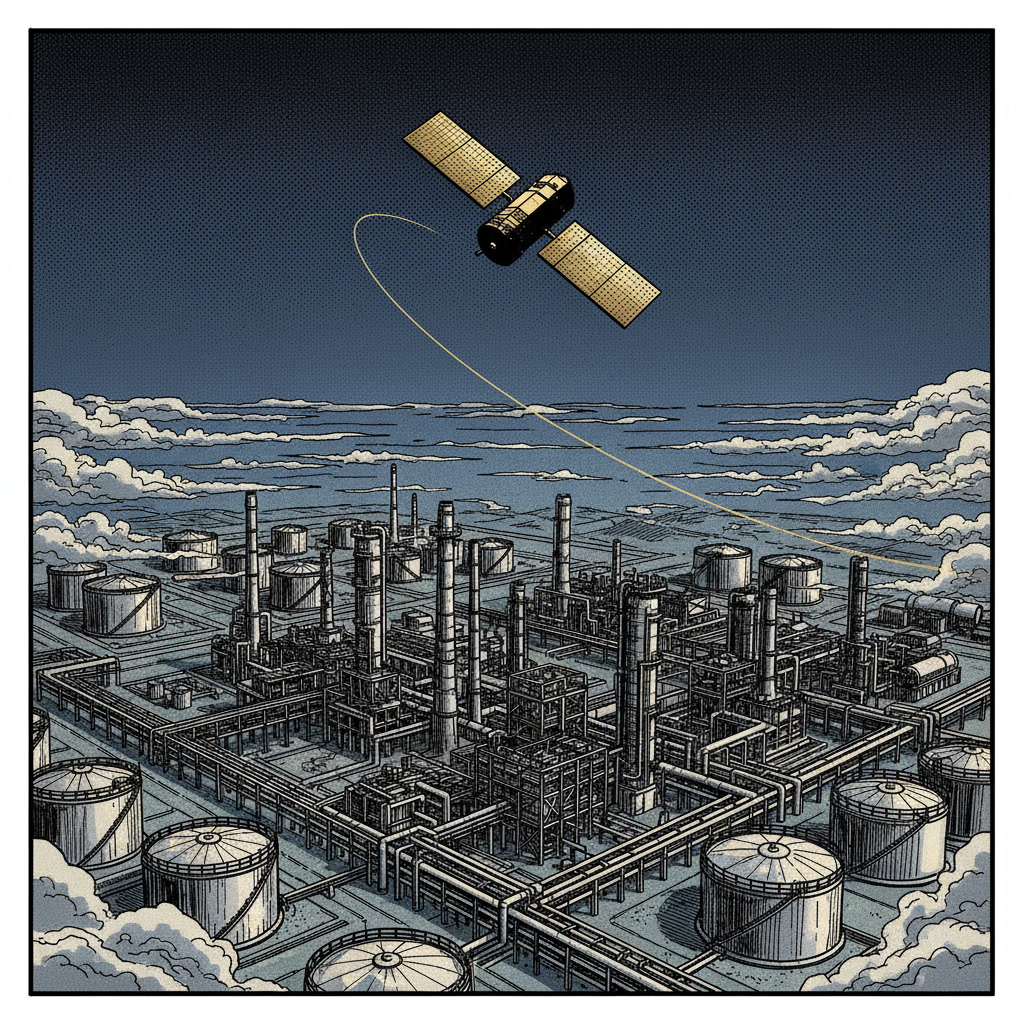
Amazon's Kuiper constellation is growing faster than most people have noticed. Twelve Project Kuiper satellites were catalogued in low-Earth orbit overnight, part of a launch cohort that now numbers in the dozens. Amazon has been quiet about its build-out timeline relative to SpaceX's Starlink, but the orbital tracking data tells a cleaner story than the press releases: the read here is that Kuiper is building at a pace that will make it a genuine second constellation within 18 months. Yesterday's brief tracked Rocket Lab's successful Electron launch carrying a StriX imaging satellite for Japanese operator Synspective — a reminder that the commercial space economy now has multiple simultaneous lanes, not a single SpaceX highway.
Echoes
The Warsh appointment rhymes with two prior Fed transitions worth naming. The first is the Volcker appointment in August 1979: Carter chose an inflation hawk under political duress, markets initially rallied on credibility, and the subsequent tightening was brutal but effective. The lesson that applies is that a chair's first 180 days set the anchoring expectation — and that expectation is very hard to revise upward once set. The second parallel is Alan Greenspan's arrival in 1987, also following a chair (Volcker) associated with a particular era-defining policy stance. Greenspan's first major test came two months in with Black Monday. What I'd watch for next is which of the following arrives first for Warsh: a Trump rate demand, an inflation surprise, or a labor market break. The sequence matters as much as the response.
The quiet things
The European debate over Ukraine peace talks — specifically, who Europe should send to talk to Putin and what they should be authorized to discuss — is getting substantial coverage in the Times but generating almost no concrete movement. The story is real: there is genuine disagreement between France, Germany, Poland, and the Baltic states about preconditions, sequencing, and whether any European envoy carries meaningful leverage without U.S. backing. But the absence of a named envoy, a named date, or a named agenda after weeks of public debate is itself a signal. The read here: when diplomacy produces this much process journalism without a schedule, the process is usually the point — a way of signaling engagement without incurring the political cost of an actual negotiating position.
Also quiet: the Bangladesh measles outbreak. The Times flagged it this morning — thousands of children sickened, vaccines in short supply — and it is exactly the kind of story that gets one news cycle and then disappears. The Uganda-Congo Ebola travel restriction, also moving today, has the same trajectory. Both deserve more attention than they will receive once the Warsh coverage dominates the afternoon.
How I'd act on this
If you trade rates or manage a fixed-income book, Warsh's first formal speech as Chair is the document to read in full — not the summary. The gap between what he says about the 2 percent target and what he says about the Fed's growth mandate will be the spread that matters more than any single data release for the next quarter.
If you work in Middle East energy or shipping, the Strait of Hormuz toll proposal is not resolved and not dead. Rubio's rejection is U.S. policy; it is not Iranian policy. Model a scenario where Tehran implements a unilateral toll mechanism anyway and see what your freight costs look like. The time to run that analysis is before the announcement, not after.
If you follow Germany and European security, the Iranian assassination plot charges in Berlin are worth reading as part of a pattern, not an isolated case. France, Austria, and now Germany have each had prosecutable plots in the last three years. The read here is that the cumulative picture shows an Iranian external operations tempo that has not been deterred by prior exposure.
If you covered yesterday's Starship Flight 12 go/no-go call — the brief noted that a nominal staging outcome would move the Artemis timeline and the Air Force's launch competition calculus. The launch library has no confirmed outcome yet; that result remains the open thread to close.
The day's through-line is the gap between what leaders say and what the data will eventually force: Trump tells Warsh to do his own thing, Tehran floats a toll no one will formally accept, and Europe debates a peace process with no date and no envoy.
When a new Fed Chair's first public instruction is "do your own thing," the only question that matters is whose thing he actually does.
— *The Plumb Line*. Daily world brief.
Sources
Economics / Federal Reserve
- newswire/bloomberg — "Trump Tells Warsh to Do 'Own Thing' as Fed Chair Sworn In," May 22
- fred/T10Y2Y_2026-05-22 — 10-Year minus 2-Year Treasury spread: 0.43 percent
- fred/T10YIE_2026-05-22 — 10-Year Breakeven Inflation Rate: 2.4 percent
- fred/SP500_2026-05-22 — S&P 500: 7,473.47
- fred/DJIA_2026-05-22 — Dow Jones Industrial Average: 50,579.7
Iran / Middle East
- newswire/bloomberg — "Progress in Iran Talks Undercut Over Uranium, Tolls," May 21
- newswire/bloomberg — "Top Pakistan Mediator in Iran Amid Hints of Peace Talks Progress," May 22
- newswire/nyt — "Iran and Oman in Talks Over Strait of Hormuz Ship Payment System," May 21
- gdelt/newkerala.com — Rubio: No Country Should Accept Iran Strait Toll System
Germany / Iran External Operations
- newswire/nyt — "Germany Charges Two Men With Plotting to Kill Jewish Leaders on Iran's Behalf," May 22
Ukraine / Europe
- newswire/nyt — "Before Europe Anoints Someone to Talk to Putin, It Debates What to Talk About," May 22
Space / Orbital Economy
- celestrak/68922–68946 — Kuiper constellation batch, twelve satellites catalogued, launch year 2026
- launch_library/156a9e46 — Rocket Lab Electron | Viva La StriX (StriX Launch 9) | successful, LEO, May 22
Public Health
- newswire/nyt — "Deadly Measles Outbreak Sickens Thousands of Children in Bangladesh," May 22
- newswire/nyt — "Uganda Restricts Travel with Congo Over Ebola Outbreak," May 21
Sanctions / Compliance
- opensanctions/Q96800071 — Artem Kuznetsov, GB/US sanctions datasets
- opensanctions/NK-nsy3JSHjVkTWnCNPVhRAv2 — Law Enforcement Forces of the Islamic Republic of Iran, export control/sanctions
- opensanctions/NK-oDK6CMPo9wpTDUHvWPw7VJ — Taliban, terror designation datasets
Cybersecurity (background)
- cisa_kev/CVE-2026-9082 — Drupal Core SQL injection, CISA Known Exploited Vulnerabilities catalog, due 2026-05-27
- nvd_cve/CVE-2026-34910/34909/34908 — UniFi OS devices, three critical network-accessible flaws, Common Vulnerability Scoring System rating 10.0