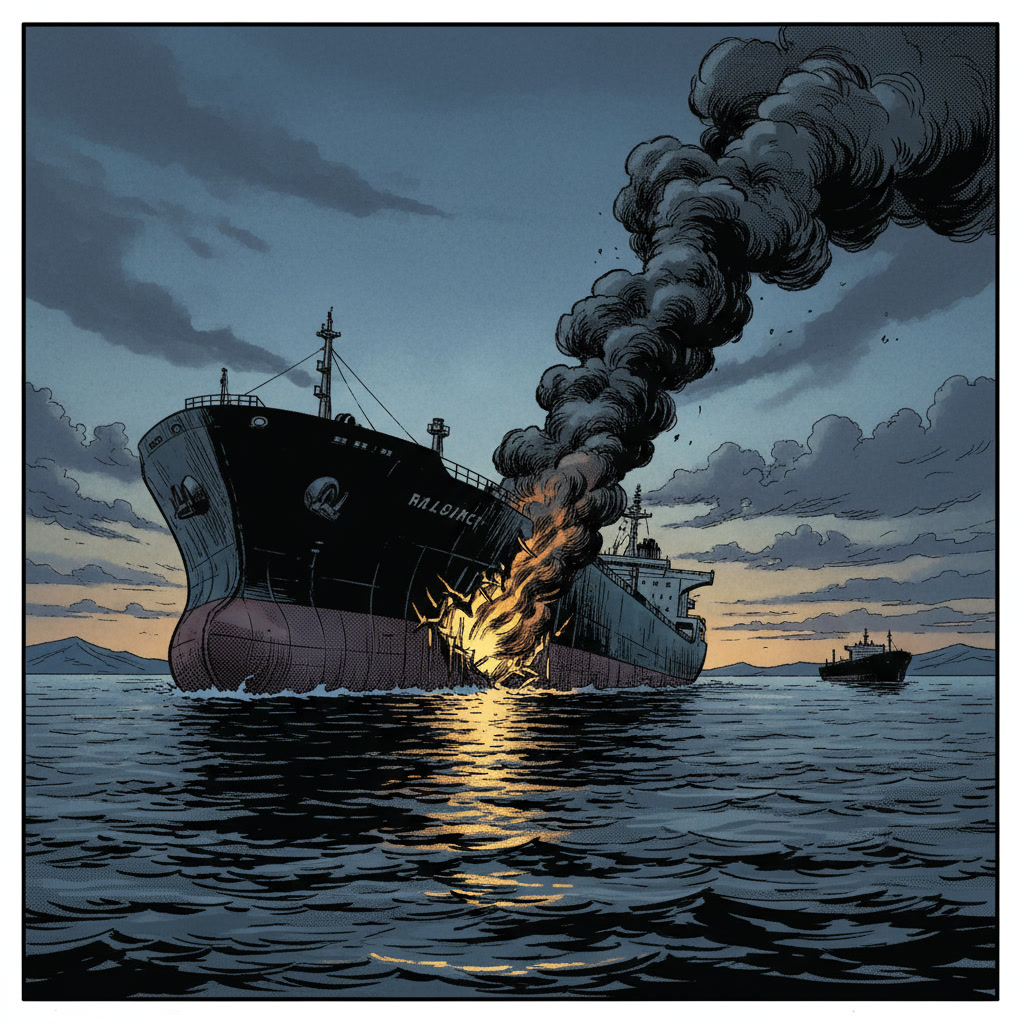
$90 Oil. Iran Is Hitting Tankers.
The Plumb Line
Monday, July 20
$90.
That's where Brent crude touched this morning after the Financial Times confirmed that Iran has struck tankers in or near the Strait of Hormuz — the first time Tehran has deployed the oil-shipping weapon since this war began. A seventeenth American service member died overnight in the Iran conflict, the New York Times confirmed, updating the toll of sixteen we tracked in yesterday's issue. And separately, the Times reported that Iran shipped billions of dollars' worth of oil during the war's recent cease-fire — not a diplomatic interlude, it turns out, but a revenue-building interval.
Three facts that look contradictory are not. They describe the same conflict from three different angles: a war that has now reached the energy infrastructure layer, with both sides escalating and signaling at the same time. Seventeen dead is a grief count. Ninety-dollar oil is a coercion count. And Secretary of State Marco Rubio's statement Monday that Washington remains "open to diplomacy with Iran" is not reassurance — the read here is that it's a bid price.
$90 Oil. Iran Is Hitting Tankers.
Oil touched $90 a barrel Monday after the Financial Times confirmed Iran has struck tankers in or near the Hormuz passage — the first confirmed use of the shipping-attack instrument since the war began. The New York Times reported a seventeenth US service member killed overnight, the latest casualty since the Jordan attack documented in yesterday's brief. Rubio told reporters Washington remains open to diplomatic engagement. He named no specific terms; Tehran offered none in response. The Times also reported that during the war's cease-fire period, Iran shipped billions of dollars' worth of oil — a revelation that reframes what the pause actually was.
Here's the read. The tanker-strike playbook is not improvised — Iran pulled it from the shelf most extensively during the 1980-1988 Gulf Tanker War, when Tehran struck roughly 400 vessels to impose costs on Gulf states financing Iraq and pressure Washington toward either direct confrontation or negotiated exit. The mechanism is identical now: hit the shipping lanes broadly enough that third parties — European insurers, Asian oil importers, Gulf producers — generate pressure on Washington independent of any Iranian lobbying effort. The 2026 modification is that Iranian drones and missiles are substantially more precise than the small-boat-and-mine warfare of 1987, oil markets are more globally integrated, and $90 crude inflicts real import-cost pain in India, Japan, and South Korea simultaneously. The read on Rubio's simultaneous diplomacy signal is that it is not inconsistent with the tanker strikes. It is the other half of Tehran's negotiating structure. Iran escalates to set a price; Washington signals openness to talks to slow the clock; the settlement gets reached somewhere between the two positions — which is precisely how the 1988 ceasefire under UN Resolution 598 eventually landed.
What I'd watch for next is the maritime response. In 1987, President Reagan re-flagged Kuwaiti tankers under the US flag — Operation Earnest Will — which forced direct naval engagements between US and Iranian forces and expanded the war's scope considerably. If within the next 48 to 72 hours the administration announces convoy escort operations, re-flagging, or active interdiction of Iranian attack assets, the 1987 analog clicks into place with its full escalation architecture. If instead Rubio's diplomatic language intensifies and the naval posture stays defensive, the read is that Washington is testing whether Iran will trade tanker strikes for some form of political acknowledgment. Oil holding at or above $90 is the market's read that no one can yet tell which path Washington will take.
Three other things worth knowing
Andy Burnham is about to become Britain's first openly Roman Catholic Prime Minister. The New York Times and Financial Times confirmed Sunday that Burnham — currently Mayor of Greater Manchester — will take Downing Street in a significant Labour realignment. His first foreign policy test arrives before he unpacks: North Sea drilling, where Trump administration pressure for increased UK oil output runs directly against Burnham's party base's offshore decarbonization commitments. The read here is that how he handles the first bilateral exchange with Washington will tell you more about his governing instincts than anything he says about it beforehand.
Zelensky is facing real pressure to remove his wartime commander. Yesterday's brief flagged that Kyiv's protests had shifted from Digital Minister Fedorov to General Valery Syrskyi, Ukraine's commander-in-chief. The New York Times reports today the pressure is hardening. Removing a wartime commander under street pressure while fighting is active is a decision almost impossible to walk back — and has almost never delivered the political relief it promises. The read is that Zelensky knows this, which means if Syrskyi goes, it will be because the president concluded the frontline situation is already deteriorating enough that a command change costs less than the alternative.
The Sinaloa cartel's founder faces a $15 billion forfeiture order and a life sentence. The Financial Times confirmed the terms of the expected US sentencing — the largest forfeiture demand in the history of US organized crime proceedings against a single individual. The meaningful question is recoverability: orders of this scale routinely exceed what prosecutors can locate and seize in practice. But the deterrent architecture of the number carries weight independently of what gets collected.
Echoes
The historical parallel here is the 1984-1988 Gulf Tanker War, the closest structural analog to what began in the Hormuz passage this morning, and it's worth naming the specific lesson it carries. The war didn't end with an Iranian defeat — it ended with UN Security Council Resolution 598 in 1987, a ceasefire framework that both sides nominally accepted. Iran's compliance was imperfect through 1988. The Ayatollah Khomeini stopped not because the United States broke his capacity to fight, but because he decided the war's cost had exceeded its strategic value. US re-flagging operations and naval presence changed Iran's cost calculation; they did not break it. The read here is that this is the ceiling on what maritime escalation can achieve in 2026, too. The tool works — but only up to the point where Tehran decides it has extracted enough, or paid enough, to stop.
Andy Burnham's elevation carries a specific historical footnote: British law formally barred Catholics from the prime ministership for centuries, and Parliament didn't lift the prohibition until 2013. Tony Blair converted to Catholicism only after leaving Downing Street — explicitly to avoid the political complication while in office. That constraint is gone. The more relevant precedent for Burnham's actual governance may be Harold Wilson in 1964: a Northern, working-class-rooted Labour leader who arrived at Number 10 managing a transatlantic relationship complicated by American foreign policy he didn't design and couldn't ignore.
The quiet things
A tropical storm watch was posted early Monday for the northern Gulf Coast — covering Mobile Bay, Pensacola, Santa Rosa County, the Florida Panhandle coast as far east as Apalachicola — while Texas remains under active flood warnings from the National Weather Service office in Corpus Christi, with alerts running through July 22. Two simultaneous weather emergencies on the same arc of coast have received almost no wire coverage. The read here is that oil at $90 and a new British prime minister are consuming all available column inches.
Also quiet: the FDIC (Federal Deposit Insurance Corporation) published its first formal reporting requirements for FDIC-supervised stablecoin issuers in the Federal Register Monday — a significant step in the long-running debate over how to integrate digital-dollar products into the US banking framework. It arrived on a morning the wires spent entirely on the Strait of Hormuz.
How I'd act on this
If you trade energy or carry oil exposure, the pivot point in the next 48 to 72 hours is Washington's maritime posture — not Rubio's diplomatic language. Convoy protection or re-flagging announcements push oil higher and extend the Iran risk premium. Diplomatic intensification without a naval response suggests the premium is running ahead of the policy. Size accordingly; those two outcomes are not gradations of the same signal.
If you cover British politics or UK-US trade, the North Sea drilling file is Burnham's first real test with Washington — not Iran. He has limited room to delay: Trump's energy preferences are publicly stated and the relationship starts cold. Watch the framing of his first bilateral exchange. Whether he leads with energy or with Iran diplomacy will tell you which relationship he thinks he needs to manage more urgently.
If you follow Ukraine, General Syrskyi's status is the subplot that will shape the next phase of the war's political management. Yesterday's brief flagged the protest pivot toward the general; today it has hardened into a formal political pressure campaign. A wartime commander removed under street pressure sets a precedent that is very hard to contain — for the next commander, for military advice, for the relationship between Kyiv's politics and its frontline decisions.
If you work in federal financial regulation or digital assets, the FDIC stablecoin reporting form is the tell that the regulatory framework is hardening around bank-supervised issuers specifically — not crypto-native platforms. The form is administrative; the policy direction embedded in it is not.
Seventeen Americans dead, oil touching $90, tankers burning in the strait, and a new British prime minister calculating his first call to Washington about North Sea oil — Monday opened on four simultaneous pressure fronts that would each define a quieter week on their own.
— *The Plumb Line*. Daily world brief.
Sources
Newswire — US-Iran War / Tanker Strikes / Diplomacy
- newswire/ft (52e98fc4) — "Oil touches $90 as Iran hits tankers," FT, July 20
- newswire/nyt (https://www.nytimes.com/live/2026/07/20/world/iran-war-strikes-trump-hormuz/heres-the-latest) — Live blog: seventeenth US casualty confirmed, NYT, July 20
- newswire/nyt (https://www.nytimes.com/live/2026/07/20/world/iran-war-strikes-trump-hormuz/iran-shipped-billions-in-oil-during-its-cease-fire-with-the-us) — "Iran shipped billions in oil during the cease-fire," NYT, July 20
- newswire/nyt (https://www.nytimes.com/2026/07/20/world/middleeast/rubio-us-iran-war-diplomacy.html) — "Rubio Says That U.S. Is Still Open to Diplomacy With Iran," NYT, July 20
- newswire/nyt (https://www.nytimes.com/2026/07/20/world/middleeast/iran-united-states-escalation.html) — "Tehran and Washington Face a 'Wake Up Moment' Over the War," NYT, July 20
- newswire/nyt (https://www.nytimes.com/2026/07/18/world/middleeast/us-troops-killed-iran-war-jordan.html) — "Deaths of 2 U.S. Troops in Jordan Brings American Toll to 16," NYT (background toll tracker)
Newswire — UK Politics / Burnham
- newswire/nyt (https://www.nytimes.com/2026/07/20/world/europe/burnham-openly-roman-catholic-prime-minister.html) — "Burnham Set to Become Britain's First Openly Roman Catholic Prime Minister," NYT, July 20
- newswire/nyt (https://www.nytimes.com/2026/07/20/world/europe/burnham-trump-uk-us-relationship-north-sea-oil.html) — "North Sea Drilling Offers First Test for Burnham's Relationship With Trump," NYT, July 20
- newswire/ft (b8fd6341) — "FirstFT: Andy Burnham weighs Number 10 overhaul," FT, July 20
Newswire — Ukraine
- newswire/nyt (https://www.nytimes.com/2026/07/20/world/europe/ukraine-zelensky-general-defense-minister.html) — "Zelensky Faces Pressure to Remove Ukraine's Top General," NYT, July 20
Newswire — Sinaloa / China
- newswire/ft (a803297d) — "Sinaloa cartel founder set for $15bn forfeiture order and life sentence," FT, July 20
- newswire/ft (e6e3acd7) — "China's 'national team' buys shares worth $9bn to prop up market," FT, July 20
NOAA Alerts — Gulf Coast / Texas
- noaa_alerts — Tropical Storm Watch: Mobile Bay, Pensacola, Santa Rosa, Escambia, Okaloosa, Baldwin, Franklin, Gulf, Bay coastal areas; NWS Mobile AL and Tallahassee FL, issued July 20
- noaa_alerts — Flood Warning: Live Oak, McMullen, Calhoun, Goliad, Refugio, Victoria, Webb, TX; NWS Corpus Christi; active through July 22
Federal Register — FDIC Stablecoin
- federal_register/2026-14589 — "Reporting Forms and Instructions Associated With Requirements and Standards for FDIC-Supervised Permitted Payment Stablecoin Issuers," FDIC, July 20