The War Just Hit Infrastructure. Graham Is Gone.
The Plumb Line
Thursday, July 17
Three things happened in the last 24 hours that the wires are treating as separate stories but shouldn't.
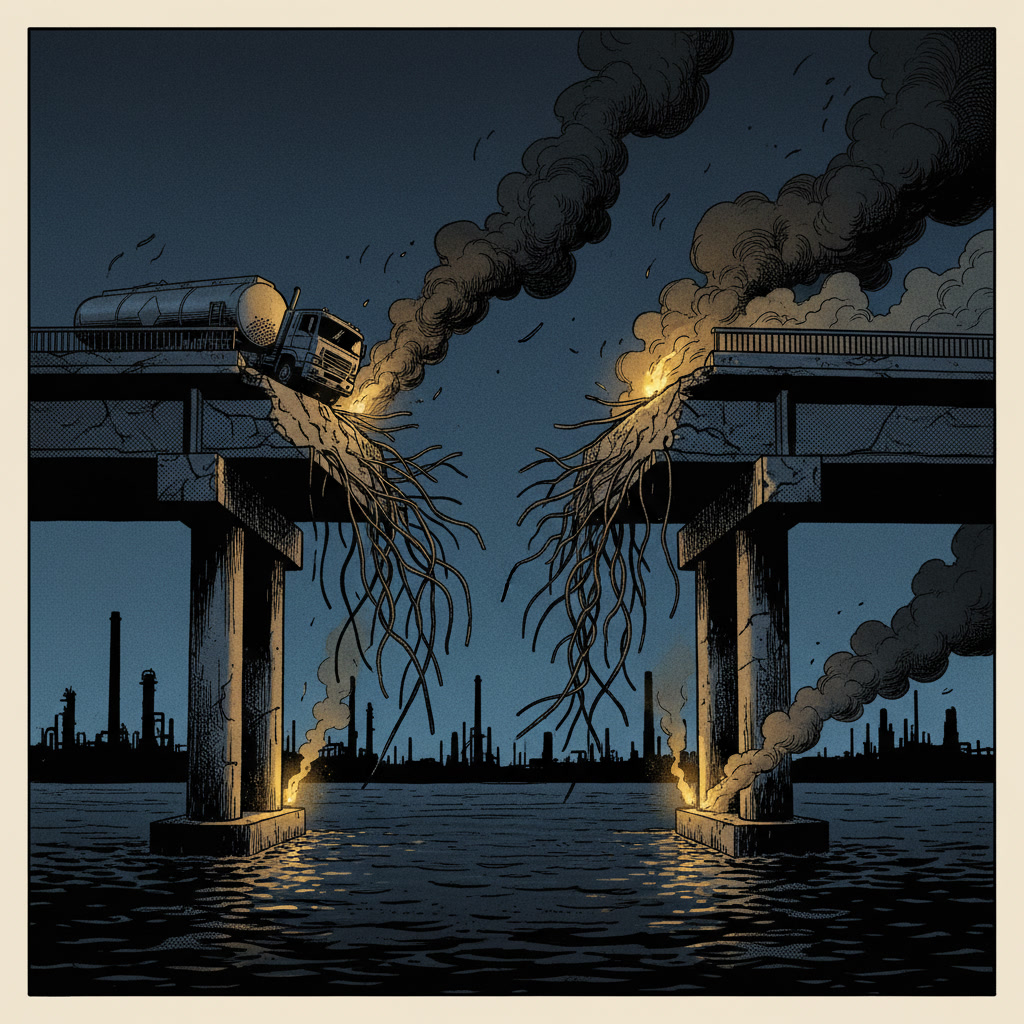
The United States expanded its bombing campaign in Iran to include bridges and a port in the country's south, moving from military installations into logistics infrastructure. Senator Lindsey Graham, the senior Republican from South Carolina and the Senate's most practiced institutional voice for military pressure on Iran, died — confirmed today by presidential proclamation. And Andy Burnham was crowned Labour Party leader in London, succeeding Keir Starmer and positioning himself to become the United Kingdom's next Prime Minister.
Read separately, each is a large story. The read here: taken together, they describe a war escalating in its target doctrine, losing its most reliable congressional architect, and about to face a reconfigured government in its most important European partner — all before a single round of peace talks has been scheduled.
The War Just Hit Infrastructure. Graham Is Gone.
American forces struck bridges and a port in southern Iran overnight, Iranian state media reported and the Financial Times confirmed. The New York Times's live coverage described the operation as part of what the United States is calling an expansion of its target set — moving past military and nuclear installations into the logistics infrastructure of the country's south.
The read here. Bridges and ports are not weapons; they are the skeleton through which a country moves fuel, materiel, and people. Targeting them signals a shift in campaign logic — from coercion, which says "stop what you're doing," to degradation, which says "we will reduce your capacity to continue regardless of your decisions." The historical parallel is the 1991 Gulf War's Phase II, when coalition air forces pivoted from Iraqi command targets to bridges, power plants, and supply routes in the campaign's third week. That pivot was decisive — but it worked because there was a defined terminal condition (Iraqi withdrawal from Kuwait), a ground force positioned to exploit the degradation, and a coalition that agreed on what winning looked like. None of those three conditions is clearly present in the Iran campaign today. The analytical read: degradation campaigns without an exit condition have a ratchet quality. Infrastructure strikes are visible to the Iranian public in a way that radar installations are not, which makes backing down after them more politically costly for Tehran, not less. The ladder goes up more easily than down.
What I'd watch for next is how Washington characterizes these strikes in the next 48 hours. If officials describe them as a response to a specific Iranian provocation, the coercive frame is still intact and a negotiated pause remains structurally possible. If the language shifts to doctrine — "expanded target set" as standing policy — this is Phase II. The falsifier for continued escalation: Iran signals willingness to open a direct channel with the United States within 96 hours. The falsifier for a negotiated pause: the US returns to exclusively military targets before the week is out.
Three other things worth knowing
Senator Lindsey Graham is dead. A presidential proclamation from the Executive Office of the President confirmed his passing today. Graham was not the Senate's only hawk on Iran, but he was its most practiced operator — reliably present with floor time, authorizing language, and the political scaffolding that allows administrations to sustain unpopular military commitments through budget cycles and oversight hearings. The read here: his death does not change the White House's freedom of action in the immediate term, but it hollows out the Senate's internal advocacy architecture for this war at exactly the moment that architecture will be tested by an expanding campaign. South Carolina's governor will appoint a replacement. What I'd watch for next: the appointee's first public statement on the Iran conflict and first votes on defense supplementals.
Zelenskyy's government remains in crisis. Yesterday this brief covered the firing of Mykhailo Fedorov — Ukraine's defense minister and architect of its drone warfare program — and the mass protests that followed within hours. Today the Financial Times characterized the situation as a government in ongoing turmoil, not a resolved personnel decision. The read here: the framing matters. A "firing" is an event; "turmoil" is a state. The replacement appointment we flagged yesterday as the analytical tell — military background signals strategic pivot, civilian or tech background signals factional settlement — has not been named as of this morning. The protests are political signal, but the strategic direction will only be readable when the new minister's name and background are public.
Andy Burnham is Britain's next Prime Minister. Burnham, the Mayor of Greater Manchester, was confirmed today as Labour leader, succeeding Keir Starmer and positioning himself to assume the Prime Ministership without a general election — standard British parliamentary procedure when the governing party changes its leader. The Financial Times and New York Times covered his ascension as a genuine generational shift, built on northern England's post-industrial credibility and a record of public investment in Manchester. The foreign policy read is direct: Burnham comes from a wing of Labour that has been skeptical of the pace of British defense-spending increases and cautious about US-led military campaigns. He will inherit a UK formally aligned with Washington on Iran. His domestic coalition will pull him toward a more independent posture. What I'd watch for next: his first foreign policy speech as leader.
Echoes
The 1991 Gulf War Phase II is the template Washington is working from, consciously or not. Coalition forces systematically degraded Iraqi bridges, power infrastructure, and supply lines beginning in late January; Iraq's ability to sustain positions in Kuwait collapsed within weeks. The lesson most planners absorbed: infrastructure targeting works. The lesson cited less often: it worked in 1991 because the campaign had a defined terminus, a coalition with unified war aims, and a ground force ready to advance the moment degradation reached threshold. The Iran campaign currently lacks all three. The read here is not that the approach is wrong — it is that the historical analog only applies where the conditions match.
The quiet things
Iraq's new leader is actively courting Washington, the Financial Times reported this morning — the headline described him in the words of his American interlocutors as "handsome" and "a great fighter," warmth unusual in diplomatic coverage. This story is being swamped by the Iranian infrastructure strikes and the Graham news, but it deserves a separate read. Iraq is the corridor through which a significant portion of Iranian regional influence moves — politically, economically, through proxy networks. The analytical read: an Iraqi government recalibrating toward Washington during an active US-Iran war is structurally meaningful. Baghdad is watching what happens to Iranian bridges and drawing its own conclusions about which side of this conflict to stand closer to.
China's state-media apparatus published an AI-generated video depicting the Philippines as a monkey, the New York Times reported. The Philippines condemned it formally. The coverage treats this as a diplomatic insult, which it is. The read here: it is also a probe of Chinese information-warfare tactics in Southeast Asia, timed to a moment when American attention is saturated by Iran. What I'd watch for next: whether ASEAN (Association of Southeast Asian Nations) governments respond collectively or handle it separately in bilateral channels. Collective response means the tactic failed. Quiet bilateral negotiations mean it may have worked.
How I'd act on this
If you are trying to understand what the Iran campaign now is — the type of target is more important than the strike count. Bridges and ports are civilian infrastructure. The shift from military to logistics targets is the variable that changes the strategic character of the conflict. Watch whether the next White House briefing calls this a specific response or a standing doctrine.
If you cover Congress or federal contracting tied to national security — the Graham vacancy is the practical near-term consequence. Senate floor management for anything touching Iran authorization, defense supplementals, or sanctions packages just lost its most experienced practitioner. Watch the South Carolina appointment and the new senator's first floor statement on the war.
If you follow UK foreign policy or transatlantic relations — the read here is that Burnham's relationship with Washington will not be the same as Starmer's. He will be more likely to express distance on targeting decisions and less likely to provide automatic institutional cover for US military operations. His first foreign policy speech as Labour leader and PM is what to watch.
If you hold tech equity — the Financial Times reported global tech stocks fell today as what it described as the "AI trade" went into reverse, with chip and memory stocks leading the decline. On the same morning, Xi Jinping outlined China's ambitions to challenge US AI dominance in remarks given prominent placement in Chinese state media. The read here: these two signals — US AI-sector correction and a formal Chinese strategic declaration — are worth reading together, not in isolation.
If you are in southern Texas — flash flood warnings across Uvalde, Maverick, Dimmit, Kimble, Edwards, Crockett, and Sutton counties remain active through tomorrow night. These are the same counties this brief flagged yesterday; the National Weather Service has extended several watches, and the situation has not improved.
Today the United States expanded its Iran campaign from military sites to bridges and a southern port, lost the Senate's most practiced war-manager to a presidential proclamation, and watched Labour swap Starmer for Burnham without a call from the White House. No off-ramp opened.
— *The Plumb Line*. Daily world brief.
Sources
Iran War / US escalation
- newswire/ft — "US escalates attacks on Iran as it expands range of targets" (July 17)
- newswire/nyt (live blog) — "Iran War Live Updates: U.S. Hits Bridges and a Port in Country's South, Iranian Media says" (July 17)
Senator Lindsey Graham
- federal_register/2026-14547 — "Death of Senator Lindsey Graham" (Executive Office of the President, July 17)
UK Labour / Andy Burnham
- newswire/ft — "Burnham to promise to 'give back control' as he is crowned Labour leader" (July 17)
- newswire/ft — "Burnham's industrial revival will join up local needs and strengths" (July 17)
- newswire/nyt — "How Andy Burnham, 'King of the North,' Conquered U.K. Politics" (July 17)
- newswire/nyt — "How Andy Burnham Becomes Britain's New Prime Minister" (July 17)
- newswire/nyt (live) — UK-Burnham-Starmer-Labour latest (July 17)
Ukraine / Zelenskyy
- newswire/ft — "Zelenskyy government in turmoil after defence minister fired" (July 17)
- [continuity: Fedorov firing and mass protests, July 16]
Iraq
- newswire/ft — "'Handsome' and 'a great fighter': Iraq's new leader woos Washington" (July 17)
China / Philippines / AI
- newswire/nyt — "Philippines Condemns AI Video Posted by Chinese State Media Depicting It as a Monkey" (July 17)
- newswire/ft — "FirstFT: Xi outlines China's ambitions to challenge US dominance in AI" (July 17)
- newswire/ft — "Global tech stocks fall as AI trade goes into reverse" (July 17)
- newswire/ft — "Chip and memory stocks slide in fresh bout of Wall Street tumult" (July 17)
Weather / Texas
- noaa_alerts — Flash Flood Warnings and Flood Watches: Uvalde, Maverick, Dimmit, Kimble, Edwards, Crockett, Sutton, Schleicher, Mason, Kerr, Real counties, TX (active through July 19)
- noaa_alerts — Extreme Heat Warning: Hennepin, Anoka, Ramsey, Washington, Carver, Scott, Dakota counties, MN (July 17)